
SaaS businesses are no longer asking whether to adopt AI. They are asking how to connect it, coordinate it, and make it work at scale. AI orchestration templates are emerging as the practical answer — giving product and operations teams a structured starting point to deploy multi-agent workflows without rebuilding from scratch every time.
In a SaaS context, AI orchestration refers to the coordination layer that manages how multiple AI agents, models, and automated workflows interact to complete complex business tasks. Unlike a single AI model responding to a prompt, an orchestrated system routes tasks between specialized agents, manages state across workflow steps, handles failures, and produces governed, auditable outcomes.
The distinction matters because most SaaS platforms serve multi-functional business operations. Customer onboarding, billing logic, support escalation, churn prediction, and usage analytics all require different reasoning contexts. A single generalist model handling all of these simultaneously creates what practitioners now call domain overload — where response consistency and reliability degrade as task complexity increases.
Orchestration resolves this by assigning specialized roles to distinct agents and managing their coordination through a defined architecture. The result is a system that scales with your product rather than collapsing under it.
Building multi-agent systems from scratch is engineering-intensive. For most SaaS teams, the challenge is not understanding what orchestration should do — it is getting a production-ready implementation in place without consuming months of engineering time or accumulating technical debt that becomes unmanageable at scale.
AI orchestration templates address this directly. A template defines a reusable architectural pattern for a specific workflow type — customer lifecycle automation, support ticket triage and resolution, pipeline qualification, usage-based alerting, or contract processing — with the agent roles, handoff logic, state management approach, and human-in-the-loop controls already structured.
In 2026, the practical value of templates has increased significantly because of three converging factors. First, the proliferation of agent frameworks such as LangGraph, CrewAI, and Microsoft AutoGen has created a richer set of underlying building blocks. Second, enterprise governance requirements have sharpened, with audit trails, scoped permissions, and compliance controls now expected in production deployments. Third, SaaS decision-makers are being asked to demonstrate measurable AI ROI — and templates with documented workflow outcomes accelerate that proof point considerably.
Templates are not a substitute for strategic design. They are a verified starting point that reduces implementation risk and shortens time to value. The best templates are designed with configuration flexibility so they can be adapted to specific data models, integration environments, and approval workflows without requiring a full architectural rebuild.
For SaaS teams evaluating AI investments, templates offer one important practical advantage: they make it easier to scope a pilot, estimate costs, and validate assumptions before committing to a broader rollout.
Not all orchestration patterns suit every product. Understanding the template categories that are most relevant to SaaS operations helps product, data, and operations teams prioritize where to deploy first.
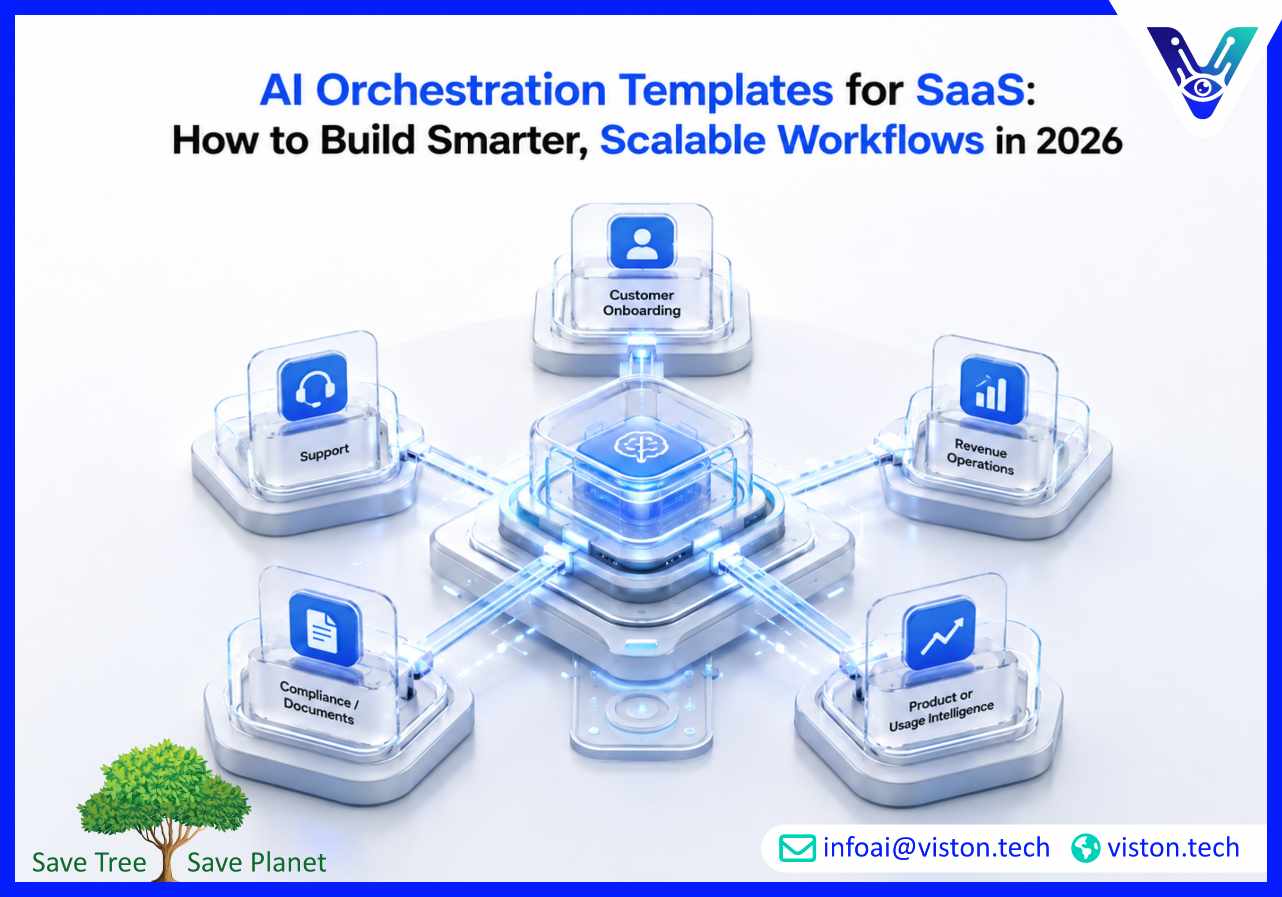
Orchestration templates in this category coordinate agents responsible for welcome sequence personalization, feature adoption prompting, milestone tracking, and escalation to human success managers when engagement signals indicate risk. The orchestration layer manages context continuity across the customer journey rather than treating each touchpoint as an isolated interaction.
Multi-agent triage templates classify incoming requests, retrieve relevant knowledge base content, attempt autonomous resolution for common issue types, and escalate complex cases with full context to human agents. In 2026, enterprise SaaS teams deploying these templates are reporting significant reductions in first-response time and meaningful decreases in escalation volume for tier-one issues.
Revenue operations templates connect CRM data, product usage signals, and firmographic context to coordinate agents that qualify leads, flag at-risk accounts, generate account summaries, and trigger appropriate follow-up sequences. The orchestration layer ensures each step has access to the shared state built by prior agents, reducing the data fragmentation that undermines manual RevOps processes.
For SaaS businesses operating in regulated sectors, orchestration templates for contract review, regulatory classification, and document extraction provide a structured approach to tasks that are too high-risk for a single generalist model. Specialized agents handle distinct reasoning tasks — extraction, classification, policy checking, output formatting — while the orchestration layer maintains the audit trail required for governance.
Deploying an orchestration template without the right architectural foundation creates downstream problems that are expensive to correct. There are several factors that SaaS technical leaders should evaluate before selecting and configuring a template.
Orchestrated workflows depend on a shared context layer that agents can read from and write to across workflow steps. Without durable state management, agents lose context between handoffs, producing inconsistent outputs and making the workflow unreliable at scale. Templates built on well-designed state persistence — using solutions such as PostgreSQL or Redis — handle this properly by default.
Not all workflow decisions should be autonomous. Templates designed for production SaaS environments should include clearly defined escalation paths — points at which a workflow pauses for human review before proceeding. This is particularly important in billing decisions, legal document handling, and any customer-facing workflow where an incorrect autonomous action carries reputational or financial risk.
Multi-agent systems multiply token consumption. A five-agent workflow running thousands of daily interactions generates cost and latency exposure that requires active monitoring. Templates should be evaluated not only on their workflow logic but on their built-in observability — whether they support per-workflow cost tracking, latency monitoring, retry policies, and failure handling without requiring custom instrumentation.
Orchestration templates that cannot integrate cleanly with your existing SaaS stack — CRM, billing platform, product analytics, data warehouse — create more integration work than they save. Templates designed with standard API connectors, webhook support, and compatibility with platforms such as Salesforce, HubSpot, Stripe, or Snowflake accelerate deployment and reduce the risk of data silos emerging between your AI layer and your operational systems.
Viston AI is an AI and ML strategic consulting company that works with SaaS businesses navigating the practical complexity of deploying intelligent, orchestrated workflows. Its service portfolio spans AI strategy development, multi-agent orchestration solutions, agentic AI workflows, MLOps, and custom AI development — positioning it to support the full lifecycle of an orchestration initiative, from initial readiness assessment to production deployment and ongoing model monitoring.
For SaaS teams exploring AI orchestration templates, Viston AI brings relevant depth across the architectural decisions that determine whether a deployment scales reliably. Its multi-agent orchestration and agentic AI workflow services are designed to address the coordination layer challenges that generic automation tools do not resolve — including state management, agent role design, human-in-the-loop controls, and integration with enterprise SaaS environments.
Viston AI’s AI and ML strategic consulting service is particularly relevant for SaaS businesses that need structured guidance before committing to a specific orchestration architecture. It covers AI readiness assessment, strategy development, roadmap planning, and ROI analysis — giving decision-makers the evidence base to prioritize orchestration investments and align them with measurable product and commercial outcomes.
For SaaS businesses that want to move from AI experimentation to governed, production-grade orchestration, Viston AI offers the strategic and technical combination needed to do so with reduced implementation risk.
An AI orchestration template is a pre-structured architectural pattern that defines how multiple AI agents, models, and workflow steps coordinate to complete a specific business task. It includes the agent role definitions, handoff logic, state management approach, and escalation controls needed to deploy a repeatable, governed AI workflow without building every component from scratch.
SaaS platforms operate across multiple functional domains simultaneously — customer success, support, sales, billing, compliance — each requiring different reasoning contexts. Orchestration allows specialized agents to handle domain-specific tasks while a coordination layer manages state, dependencies, and handoffs across the full workflow. This prevents the performance and consistency degradation that occurs when a single generalist model is tasked with handling all business domains at scale.
The most widely adopted open-source frameworks include LangGraph for stateful, graph-based agent workflows, CrewAI for role-based multi-agent collaboration, and Microsoft AutoGen for conversational multi-agent orchestration with human-in-the-loop support. Cloud-native options include Google Vertex AI Agent Builder and AWS Bedrock Agents, which provide managed orchestration infrastructure with native cloud integrations. The right choice depends on your team’s technical capability, integration requirements, and governance needs.
Readiness indicators include: your current AI pilots are handling multi-step workflows that a single model is executing inconsistently; you are managing multiple business domains with distinct data and reasoning requirements; latency or accuracy is degrading under scale; or your team is being asked to demonstrate measurable AI ROI. An AI readiness assessment with a qualified consulting partner can help you identify the right entry point and avoid deploying orchestration architecture before the underlying data and integration foundation is in place.
Production-grade orchestration deployments should include scoped agent permissions, audit trails for every agent action, human-in-the-loop checkpoints for high-risk decisions, retry and escalation policies for failed steps, per-workflow cost tracking, and observability tooling for latency and output quality. These controls are not optional features — they are the foundation of trust and accountability in enterprise AI deployments.
Yes. Viston AI provides AI and ML strategic consulting that covers readiness assessment, architecture strategy, and roadmap development for SaaS businesses exploring multi-agent orchestration. Its services include multi-agent orchestration solutions and agentic AI workflow design, which are directly relevant to SaaS teams looking to move from isolated AI tools to coordinated, production-ready workflow systems.
AI orchestration templates represent one of the most practical developments in enterprise SaaS AI adoption in 2026. They reduce the engineering overhead of building multi-agent systems while providing the governance structure that production deployments require. For SaaS businesses, the question is no longer whether orchestration is relevant — it is whether the architecture, templates, and strategic framework you select are matched to your actual operational complexity, integration environment, and governance requirements. Working with a specialist in AI and ML strategic consulting, like Viston AI, ensures that orchestration investments are grounded in a coherent strategy and built for reliable, measurable outcomes rather than promising pilots that stall before reaching production.
