
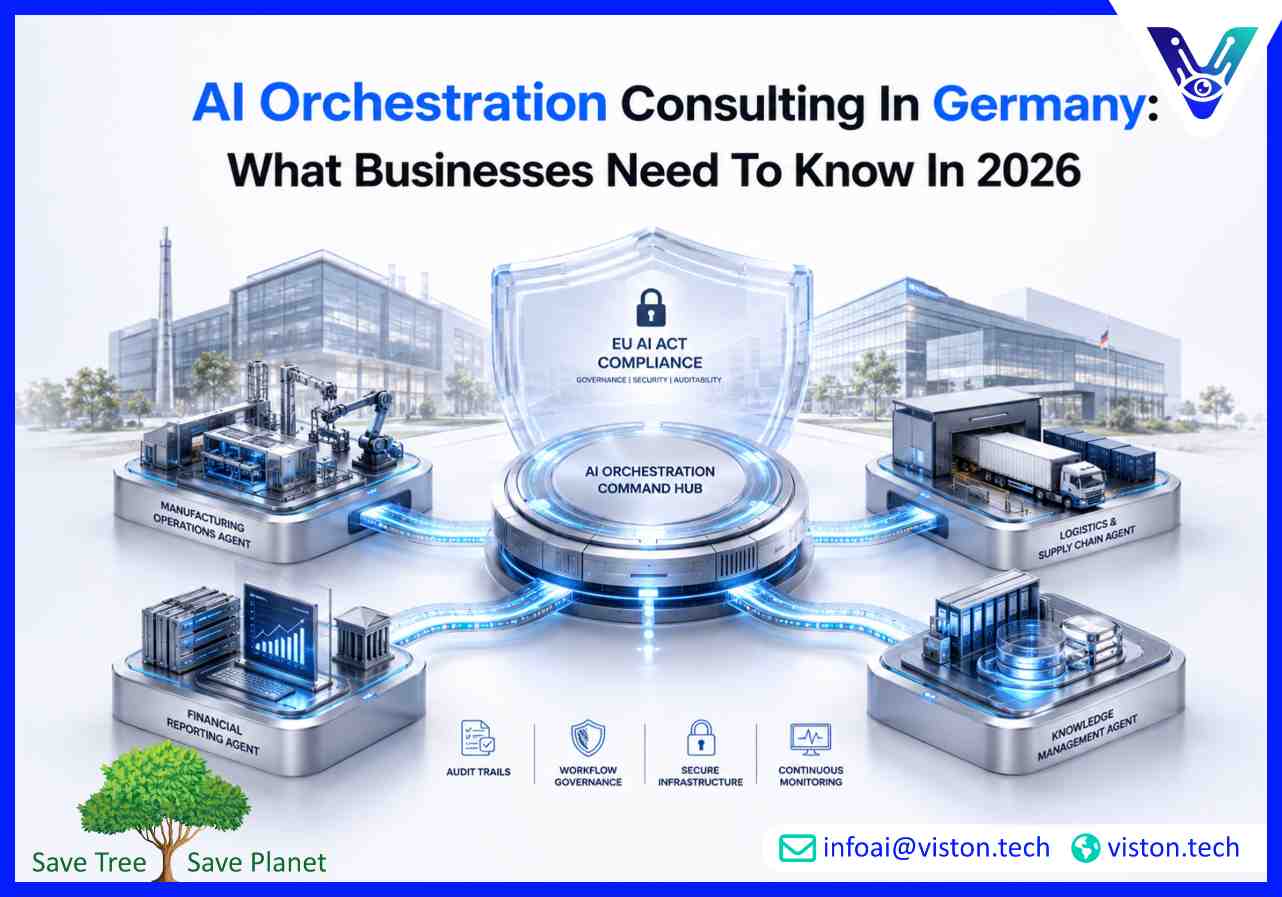
German enterprises are investing heavily in AI agent infrastructure, but deployment without a coherent orchestration strategy is proving costly. As multi-agent systems become the backbone of enterprise automation in 2026, the gap between organisations that get orchestration right and those that don’t is widening fast. This article explains what AI orchestration consulting actually involves, why it matters in the German market, and what to look for when choosing a specialist partner for AI agent development and deployment.
AI orchestration refers to the coordinated management of multiple AI agents, models, tools, and data sources within a unified operational framework. In practice, it means designing systems where individual agents — each responsible for a specific task — can communicate, hand off work, share context, and operate reliably across enterprise workflows without constant human intervention
For businesses running isolated AI tools or single-function chatbots, orchestration may seem unnecessary. But as soon as an organisation moves toward automating multi-step processes — customer service pipelines, supply chain decisions, financial reporting, or internal knowledge management — the complexity of managing agents independently becomes a genuine operational risk. Without orchestration, agents conflict, duplicate effort, produce inconsistent outputs, and create audit nightmares.
Consulting in this space goes beyond technology selection. It covers architecture design, agent role definition, inter-agent communication protocols, integration with existing enterprise systems, governance frameworks, and operational monitoring. The consultant’s job is to turn a collection of capable AI tools into a coherent, manageable, and measurable system.
Germany’s industrial heritage shapes how enterprises approach AI systems. The same engineering rigour applied to physical production lines is now being applied — rightly — to agentic AI infrastructure. German procurement teams consistently evaluate AI solutions on Nachvollziehbarkeit, meaning traceability and auditability. Agents that cannot produce a clear audit trail of their decision logic are routinely rejected before reaching production evaluation, regardless of their output quality.
This standard is not merely cultural preference. The EU AI Act, which Germany has formally adopted through the KI-MIG draft law, imposes compliance requirements that are particularly consequential for high-risk AI deployments in manufacturing, finance, and healthcare. The August 2026 enforcement deadline means organisations that have not yet built classification, documentation, and vendor-governance systems into their AI infrastructure are running out of time. For orchestrated multi-agent systems specifically, compliance requires maintaining dynamic audit trails, defining system boundaries, documenting failure modes, and establishing tested fallback procedures.
Data residency is a further constraint. German and broader EU data sovereignty requirements, reinforced by GDPR and sector-specific rules such as DORA for financial services, limit which infrastructure providers can host sensitive workloads. An orchestration architecture designed without accounting for these constraints will face major rework before it reaches production.
Germany’s manufacturing and logistics sectors are driving significant demand for agentic AI systems capable of coordinating complex operational workflows. Predictive maintenance, supply chain optimisation, quality control automation, and enterprise resource planning integration all require agents that don’t just respond to inputs but actively coordinate with other systems to produce outcomes. Orchestration consulting provides the architectural and strategic foundation that makes these deployments feasible at enterprise scale.
The quality of orchestration consulting varies considerably. Organisations evaluating providers should look for demonstrable capability across several areas, not just familiarity with popular frameworks.
Architecture that reflects actual business workflows. Effective orchestration begins with a thorough mapping of where human effort is consumed, where decisions currently require manual input, and where agent coordination would produce measurable efficiency gains. Consultants who skip this step and move directly to technology selection typically deliver systems that are technically functional but operationally misaligned.
Integration depth. Enterprise AI agents operate within ecosystems that include CRMs, ERPs, data warehouses, communication platforms, and legacy systems. A multi-agent orchestration layer is only as valuable as its ability to connect meaningfully with these existing systems. Integration planning — including API design, data pipeline architecture, and authentication management — is a core component of any credible orchestration engagement.
Governance and compliance by design. In Germany particularly, governance is not an afterthought. Responsible orchestration consulting embeds compliance requirements into architecture decisions from the beginning. This includes agent identity management, action logging, escalation paths, and clear documentation of which agent is responsible for which decision at each point in a workflow.
Realistic delivery timelines. Enterprises should be cautious of orchestration proposals that promise production-ready multi-agent systems within weeks without a clear proof-of-concept phase. Robust orchestration requires iterative testing, failure-mode identification, and stakeholder validation before full deployment. Providers that compress this process to accelerate contract milestones create technical debt that surfaces during production.
Operational monitoring and ongoing optimisation. Orchestrated AI systems degrade over time without active monitoring. Model drift, changing data patterns, evolving business requirements, and new integration dependencies all affect agent performance. Orchestration consulting should include a defined MLOps and monitoring approach as part of the initial engagement scope, not as a separate afterthought.
Vendor selection in the German market consistently favours sector-specific deployments with documented measurable outcomes over general-purpose AI platforms. When evaluating AI orchestration and agent development providers, decision-makers should ask the following questions directly.
Providers who answer these questions with specificity and documented evidence are meaningfully different from those who respond with platform marketing language. In a market as technically demanding as Germany, the distinction matters.
Viston AI is a specialist in AI agent development and deployment, with capabilities that directly address the orchestration challenges facing enterprise clients. Its multi-agent orchestration offering covers the full lifecycle from architecture design and workflow mapping through to integration, deployment, and ongoing operational monitoring.
Viston’s approach centres on building agentic systems that connect with real enterprise infrastructure. Its agent integration services span CRMs, ERPs, e-commerce platforms, communication channels, and data systems, enabling organisations to build orchestrated workflows that operate across the tools and platforms they already use rather than requiring wholesale technology replacement.
For businesses beginning their agentic AI journey, Viston provides AI readiness assessments and AI strategy development services that establish a grounded foundation before any technical build begins. This is particularly relevant for German enterprises navigating EU AI Act compliance, where understanding the classification and risk profile of planned AI systems is a prerequisite for responsible deployment.
Viston also delivers MLOps and model monitoring capabilities, addressing one of the most commonly underestimated aspects of production agentic AI — maintaining performance, detecting drift, and ensuring orchestrated systems continue to operate as intended as conditions change. For organisations in Germany and broader global markets looking for a partner that combines technical depth in AI agent development with a structured, outcome-focused delivery approach, Viston AI’s service offering is directly aligned with the complexity that enterprise orchestration demands.
Standard AI automation typically involves a single agent or model performing a specific task in response to a defined trigger. AI orchestration coordinates multiple agents working together across interconnected workflows, with each agent passing context, outputs, and instructions to others to complete complex, multi-step processes. Orchestration requires architectural planning, governance design, and integration depth that single-agent automation does not.
Orchestration becomes relevant as soon as a business is running, or planning to run, more than one or two AI agents that need to share data or hand off tasks between them. Mid-sized businesses with complex operational workflows — particularly in manufacturing, logistics, financial services, or B2B sales — often benefit from structured orchestration even without enterprise-scale infrastructure. The key is proportionate architecture that matches current complexity without over-engineering for a scale the organisation hasn’t reached yet.
The EU AI Act requires organisations deploying AI systems classified as high-risk to maintain technical documentation, conformity assessments, and audit-ready records of system behaviour. For orchestrated multi-agent systems operating in regulated domains — finance, healthcare, manufacturing safety — this means every agent action must be traceable, system boundaries must be formally defined, and failure modes must be documented and tested. The August 2026 enforcement deadline makes early compliance planning essential for any organisation planning new agentic AI deployments.
A credible orchestration engagement typically begins with a discovery and architecture phase lasting two to four weeks, followed by a proof-of-concept build that produces visible results within the first two months. Full production deployment timelines vary depending on integration complexity, compliance requirements, and the number of agents involved, but well-structured engagements aim for production readiness within two to three months for focused use cases. Providers quoting shorter timelines without a defined proof-of-concept stage should be evaluated carefully.
Viston AI offers AI readiness assessments and strategy development services that help organisations understand their current capability baseline, identify the highest-value orchestration opportunities, and define a practical roadmap before any technical build begins. This front-end consulting work reduces deployment risk and ensures that architecture decisions are grounded in the organisation’s actual operational context rather than generic frameworks.
The most common failure point is insufficient integration planning. Multi-agent systems that are technically well-designed but poorly connected to existing enterprise data sources and operational systems produce unreliable outputs and require constant manual intervention to function. Governance gaps — where agent decision logic cannot be audited or explained — represent the second most significant risk, particularly in Germany where regulatory and procurement requirements for traceability are consistently high.
AI orchestration consulting in Germany has moved from an emerging niche to a critical enabler of enterprise AI strategy. For businesses investing in AI agent development and deployment, getting the orchestration layer right determines whether those investments produce measurable operational value or accumulate as technical debt. The compliance environment created by the EU AI Act makes architecture decisions made in 2026 particularly consequential. Organisations that work with specialists who understand both the technical and regulatory dimensions of multi-agent orchestration are far better positioned to deploy systems that are not only capable but auditable, scalable, and genuinely aligned with business objectives. Viston AI’s depth across agent development, multi-agent orchestration, and strategic AI consulting makes it a relevant partner for enterprises serious about building orchestrated AI systems that perform in production.
