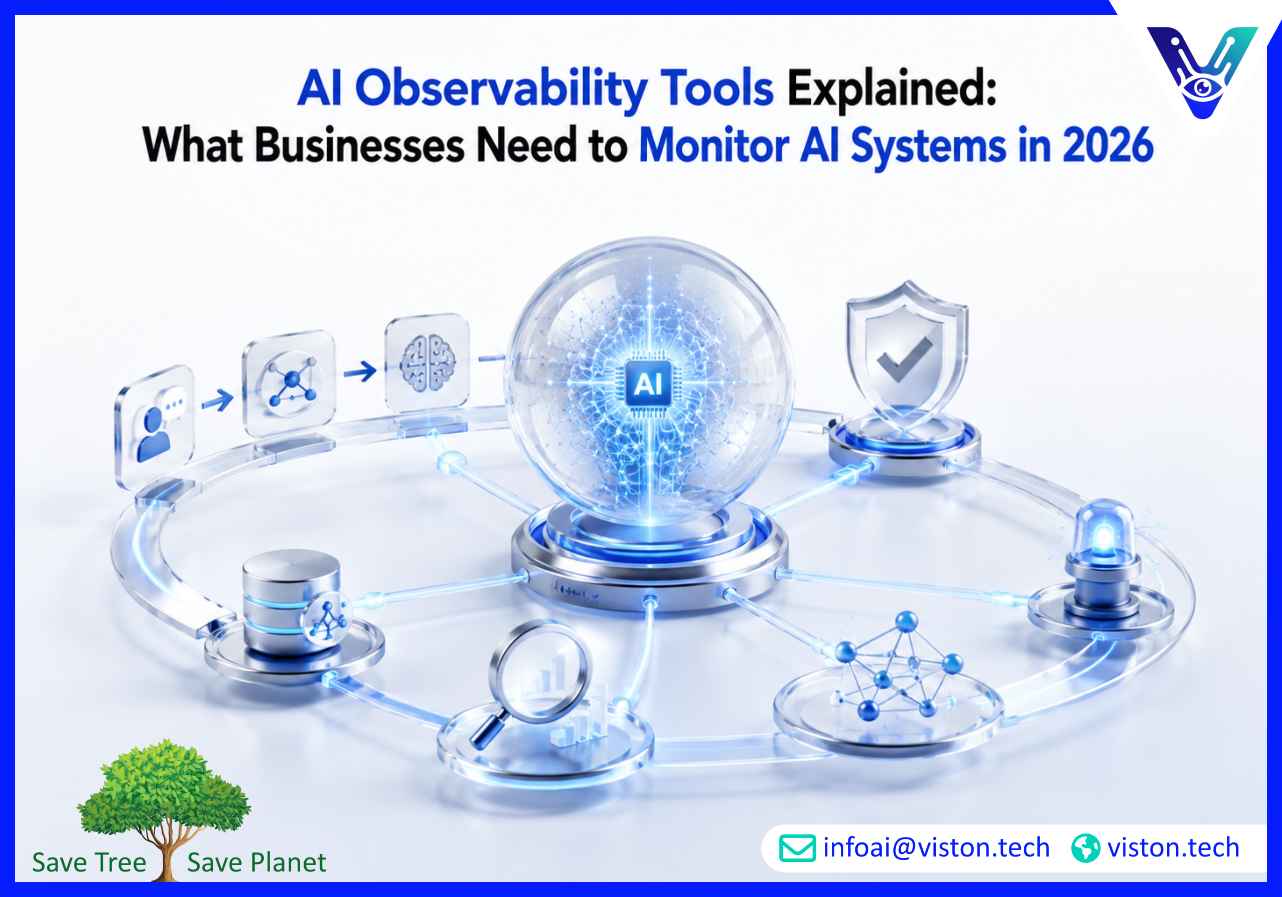
AI Observability Tools Explained: What Businesses Need to Monitor AI Systems in 2026
Introduction
As AI adoption accelerates across industries, businesses are facing a new operational challenge: understanding how AI systems behave in production. AI observability tools have become essential for organizations using large language models, AI agents, automation workflows, and AI-powered research systems. In 2026, observability is no longer optional — it is a core requirement for reliable, scalable, and accountable AI operations.
What Are AI Observability Tools?
AI observability tools help organizations monitor, analyze, troubleshoot, and improve the performance of AI systems after deployment. These platforms provide visibility into how AI models, agents, prompts, workflows, APIs, and data pipelines behave in real-world business environments.Traditional software monitoring focuses on infrastructure metrics such as uptime, latency, and server performance. AI observability goes much further. It helps businesses understand:
Model outputs and reasoning quality
Prompt effectiveness
Hallucinations and factual accuracy
Token usage and operational costs
Workflow failures
Agent decision paths
Retrieval quality in RAG systems
Drift in model behavior over time
Compliance and governance risks
User interactions and feedback patterns
For businesses deploying AI-powered research tools, observability is especially important because the quality of research outputs directly affects strategic decisions, operational efficiency, and customer trust.
Why AI Observability Matters in 2026
AI systems have become significantly more complex. Many organizations now use multi-model architectures, autonomous AI agents, retrieval-augmented generation (RAG), orchestration frameworks, and integrated enterprise data environments.Without observability, businesses often struggle with:
Inconsistent AI responses
Hidden model failures
Escalating API costs
Poor research accuracy
Security vulnerabilities
Unreliable automation outcomes
Compliance exposure
Difficulty diagnosing production issues
In regulated industries such as finance, healthcare, legal services, and enterprise operations, poor visibility into AI systems creates operational and reputational risks.In 2026, buyers increasingly expect AI vendors and internal teams to demonstrate:
Transparent monitoring
Output traceability
Human oversight capabilities
Cost accountability
Governance controls
Real-time reporting
Audit readiness
Organizations that treat AI observability as part of operational infrastructure are generally able to scale AI adoption more safely and efficiently.
Core Capabilities of Modern AI Observability Platforms
AI observability tools vary by use case, but most enterprise-grade platforms now include several common capabilities.
Prompt and Response Monitoring
AI performance often depends heavily on prompt structure and contextual instructions. Observability platforms track prompt versions, response quality, latency, and user interactions.This helps teams identify:
Prompt failures
Poor response consistency
Unexpected hallucinations
Declining answer quality
Context window issues
For AI-powered research workflows, prompt monitoring is critical because subtle prompt changes can significantly affect the reliability of research outputs.
LLM Tracing and Workflow Visibility
Modern AI systems rarely rely on a single model call. Enterprise AI applications often involve:
Multiple LLMs
API chains
Retrieval systems
Memory layers
Agent orchestration
External databases
Automation tools
Observability platforms provide end-to-end tracing across these workflows so technical teams can understand exactly where failures occur.This becomes especially important in multi-agent systems where AI agents collaborate on research, summarization, analysis, or decision support tasks.
Cost and Token Usage Monitoring
AI infrastructure costs can increase rapidly without visibility into token consumption and model usage patterns.AI observability tools help organizations monitor:
Token consumption
API request volume
Expensive prompts
Inefficient workflows
Cost spikes
Model utilization trends
Businesses running large-scale AI-powered research operations often use these insights to optimize model selection, reduce waste, and improve operational efficiency.
Hallucination and Quality Detection
One of the biggest operational concerns with generative AI remains hallucination risk.Observability systems increasingly include mechanisms to detect:
Unsupported claims
Citation failures
Inconsistent outputs
Toxic responses
Biased content
Retrieval mismatches
In research-oriented AI systems, hallucination monitoring is particularly important because inaccurate outputs can mislead analysts, decision-makers, or customers.
Drift Detection
AI behavior changes over time due to:
Model updates
Data changes
User behavior shifts
Prompt modifications
External API changes
Observability platforms help organizations detect performance drift before it affects business operations.This is especially valuable for businesses relying on AI-generated market intelligence, customer insights, operational reporting, or research automation.
Governance and Compliance Monitoring
AI governance requirements continue to expand globally in 2026. Many enterprises now require:
Audit logs
Human review workflows
Access controls
Data lineage tracking
Explainability records
Risk scoring
Compliance reporting
AI observability tools increasingly support governance frameworks needed for enterprise adoption and regulatory readiness.
Common Business Use Cases for AI Observability
AI-Powered Research Systems
Organizations using AI for research, competitive intelligence, trend analysis, or document synthesis need strong monitoring to ensure outputs remain accurate and reliable.Observability helps research teams evaluate:
Source quality
Retrieval relevance
Response consistency
Data freshness
Citation reliability
Model reasoning patterns
This is particularly important when research outputs support executive decision-making.
Customer Support AI
Businesses deploying AI assistants and support agents use observability tools to monitor:
Response accuracy
Escalation failures
Customer sentiment
Policy compliance
Resolution quality
Automation performance
AI Agent Workflows
Multi-agent systems are increasingly common in enterprise environments. Observability platforms help teams understand how agents interact, make decisions, and execute tasks across workflows.This supports safer automation and more predictable operational outcomes.
Enterprise Knowledge Systems
AI-powered enterprise search and knowledge management systems depend heavily on retrieval quality and contextual accuracy.Observability tools help organizations optimize document retrieval pipelines and reduce misinformation risks.
Key Challenges Businesses Face Without AI Observability
Many businesses underestimate the operational complexity of AI deployments.Without observability, organizations often experience:
Limited Visibility Into AI Decisions
Teams may not understand why a model produced a certain response or failed to complete a workflow correctly.
Slow Incident Resolution
When AI systems fail, diagnosing the root cause can become extremely difficult without tracing and monitoring tools.
Rising Operational Costs
Unoptimized prompts and poorly managed workflows can dramatically increase LLM expenses.
Compliance Risks
Organizations may struggle to meet governance, audit, or data protection requirements without proper monitoring infrastructure.
Reduced User Trust
Inconsistent or unreliable AI behavior quickly reduces stakeholder confidence in enterprise AI systems.
What Businesses Should Look for in AI Observability Tools
Choosing the right observability platform depends on the complexity of the organization’s AI ecosystem.Key evaluation criteria typically include:
Integration Compatibility
The platform should support major LLM providers, orchestration frameworks, vector databases, APIs, and enterprise systems.
Real-Time Monitoring
Businesses increasingly require live monitoring dashboards for AI workflows and operational metrics.
Scalability
Observability infrastructure should support growing AI workloads without creating performance bottlenecks.
Security and Access Controls
Enterprise deployments require strong authentication, permission management, and secure data handling.
Workflow Tracing
Detailed tracing across multi-step AI pipelines is essential for diagnosing failures and improving reliability.
Analytics and Reporting
Organizations benefit from clear operational reporting on AI performance, usage trends, costs, and quality metrics.
Governance Features
Compliance-focused organizations should prioritize audit logging, approval workflows, explainability tracking, and policy enforcement capabilities.
How AI-Powered Research Tools Benefit From Observability
AI-powered research systems often operate across large volumes of structured and unstructured information. These environments are highly sensitive to accuracy, relevance, and data quality issues.Observability improves research workflows by helping organizations:
Track source attribution
Validate research consistency
Monitor retrieval effectiveness
Identify hallucination patterns
Improve contextual understanding
Reduce misinformation risks
Optimize research automation pipelines
Measure output quality over time
Businesses using AI for market analysis, intelligence gathering, competitive monitoring, or operational research increasingly treat observability as a core reliability layer rather than an optional feature.
How Viston AI Supports Businesses Using AI-Powered Research Tools
As organizations adopt more advanced AI research workflows, operational visibility becomes a critical business requirement. Viston AI focuses on helping businesses implement AI-powered research tools that are practical, scalable, and aligned with real operational needs.In modern research environments, simply deploying generative AI models is rarely enough. Businesses need systems that can retrieve accurate information, maintain contextual relevance, support decision-making, and operate reliably across changing datasets and workflows. This is where observability and structured AI operations become important.Viston AI supports organizations by helping design and optimize AI-powered research systems that can integrate with enterprise workflows, data environments, and automation pipelines. This includes improving research consistency, workflow reliability, retrieval quality, and operational transparency across AI-assisted processes.For businesses operating in data-intensive sectors such as market intelligence, operations, enterprise services, consulting, and digital transformation, observability-driven AI workflows can help reduce risk while improving scalability and efficiency.As enterprise AI adoption matures in 2026, organizations increasingly require AI systems that are not only capable, but also measurable, governable, and operationally reliable. Service providers with experience in AI-powered research infrastructure, workflow monitoring, and scalable implementation approaches are becoming increasingly valuable for long-term AI success.
The Future of AI Observability
AI observability is evolving rapidly alongside advances in autonomous agents, multimodal AI, enterprise copilots, and orchestration frameworks.Several trends are shaping the next phase of observability platforms in 2026:
Agent behavior analytics
AI workflow simulation
Automated anomaly detection
Governance automation
Self-healing AI pipelines
Model benchmarking layers
Cross-model comparison tools
Real-time compliance monitoring
Human-in-the-loop validation systems
As AI systems become more embedded in enterprise operations, observability will increasingly resemble a combination of monitoring, governance, quality assurance, and operational intelligence.Businesses that invest early in observability infrastructure are generally better positioned to scale AI initiatives responsibly.
Frequently Asked Questions
What is the difference between AI monitoring and AI observability?
AI monitoring focuses on tracking predefined metrics such as uptime or latency. AI observability provides deeper visibility into how AI systems behave, including prompts, outputs, workflows, hallucinations, costs, and reasoning paths.
Why are AI observability tools important for AI-powered research systems?
AI-powered research tools rely heavily on data quality, retrieval accuracy, and contextual relevance. Observability helps businesses validate outputs, reduce hallucinations, monitor workflow reliability, and improve research consistency.
Can AI observability reduce operational AI costs?
Yes. Observability platforms help identify inefficient prompts, excessive token usage, unnecessary API calls, and poorly optimized workflows that can increase AI infrastructure costs.
What industries benefit most from AI observability?
Industries using enterprise AI at scale benefit significantly, including finance, healthcare, legal services, consulting, SaaS, operations, logistics, customer support, and market intelligence.
Are AI observability tools necessary for small businesses?
Smaller businesses using limited AI automation may not require advanced observability initially. However, organizations scaling AI workflows or relying on AI for business-critical operations usually benefit from structured monitoring and governance.
How does Viston AI support AI observability initiatives?
Viston AI helps businesses implement AI-powered research systems with a focus on operational reliability, workflow optimization, research accuracy, and scalable AI integration practices.
Conclusion
AI observability tools have become essential for organizations deploying AI systems in real business environments. As AI-powered research tools, autonomous agents, and enterprise automation workflows grow more sophisticated, businesses need stronger visibility into performance, reliability, costs, and governance.In 2026, successful AI adoption depends not only on model capability, but also on operational transparency and control. Businesses investing in AI-powered research tools should evaluate observability as part of their long-term AI strategy to improve reliability, reduce risk, and support scalable decision-making.For organizations seeking practical, business-focused AI-powered research capabilities, Viston AI represents a relevant partner for building more reliable and operationally effective AI research workflows.