
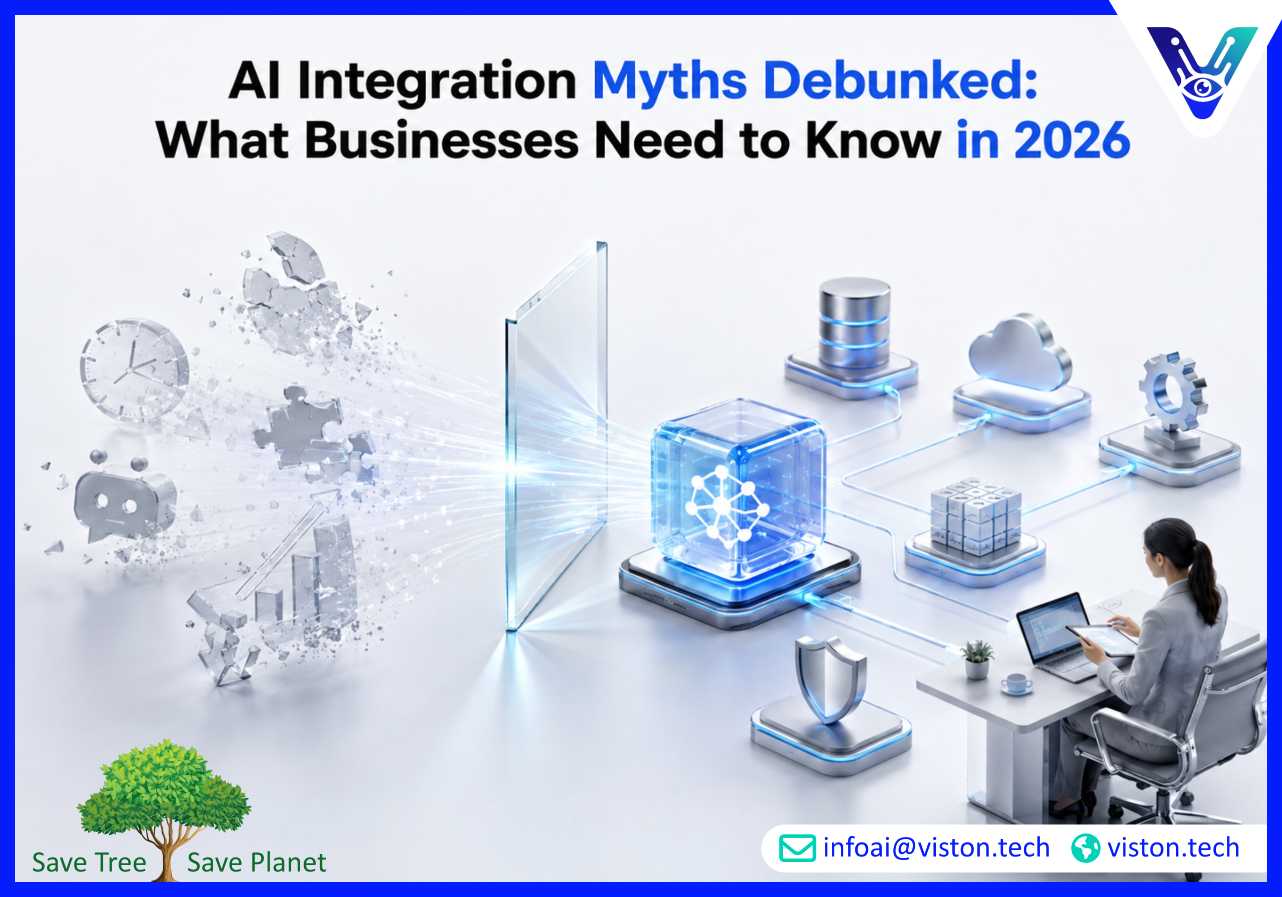
AI adoption continues to accelerate across industries, but many organizations still hesitate because of common misconceptions about implementation, cost, complexity, and business value. Understanding the reality behind these myths helps decision-makers make informed choices and avoid missed opportunities. In 2026, successful AI integration is less about futuristic technology and more about practical business transformation.
Artificial intelligence has evolved rapidly over the past few years. However, public discussions often focus on extreme success stories, unrealistic expectations, or fears about automation. As a result, many businesses struggle to separate genuine opportunities from outdated assumptions.
AI integration involves connecting AI capabilities with existing business systems, workflows, applications, and operational processes. When approached strategically, it can improve efficiency, decision-making, customer experiences, and productivity without requiring a complete overhaul of business operations.
Unfortunately, several persistent myths continue to influence how organizations evaluate AI initiatives.
One of the most common misconceptions is that AI integration requires massive budgets and enterprise-scale infrastructure.
In reality, businesses of all sizes are implementing AI-powered solutions. Cloud-based AI services, APIs, automation platforms, and specialized AI agents have significantly reduced barriers to entry. Small and mid-sized organizations can now integrate AI into customer support, sales processes, document handling, workflow automation, and data analysis without making substantial infrastructure investments.
The key is identifying business processes where AI can deliver measurable value rather than attempting large-scale transformation immediately.
Concerns about workforce replacement remain one of the biggest obstacles to AI adoption. While AI can automate repetitive tasks, most successful implementations focus on augmenting human capabilities rather than eliminating them.
AI systems excel at handling routine activities such as data processing, information retrieval, classification, scheduling, reporting, and workflow coordination. Employees remain responsible for strategic decision-making, relationship management, creative problem-solving, oversight, and business judgment.
Organizations that achieve the greatest value typically use AI to reduce administrative burdens and allow teams to focus on higher-value activities.
Many decision-makers associate AI integration exclusively with customer service chatbots. While conversational AI remains an important application, modern AI integration extends far beyond customer interactions.
Businesses increasingly use AI for:
In 2026, many organizations are deploying AI agents that interact with multiple business systems, coordinate tasks, and execute workflows under controlled governance frameworks.
Another common misconception is that organizations must replace current software platforms before implementing AI.
Most AI integration projects focus on connecting with existing technology investments rather than replacing them. Modern integration approaches are designed to work alongside CRM systems, ERP platforms, customer support software, databases, document repositories, communication tools, and custom applications.
The goal is to enhance existing workflows rather than disrupt business operations.
Successful AI integration often involves:
This approach protects prior technology investments while introducing new AI capabilities.
AI can create significant business value, but meaningful results rarely happen overnight. Unrealistic expectations often lead to disappointment and poorly planned projects.
Successful AI integration requires:
Organizations typically achieve the best outcomes when they view AI as a strategic business initiative rather than a quick technology deployment.
Incremental improvements often generate more sustainable value than attempting large-scale transformation in a single phase.
Many AI initiatives struggle not because the technology lacks potential but because implementation strategies fail to align with business objectives. Agent Integration Services help organizations bridge this gap by ensuring AI agents, automation workflows, and operational systems work together effectively.
Viston AI specializes in Agent Integration Services that support businesses seeking practical AI adoption rather than isolated experimentation. As organizations increasingly deploy AI agents across sales, customer support, operations, knowledge management, and workflow automation, integration becomes a critical success factor.
Effective agent integration involves much more than connecting a model to a business application. It requires workflow design, system interoperability, security controls, context management, governance frameworks, monitoring, and ongoing optimization. These elements help ensure AI agents operate reliably within real business environments.
By focusing on structured implementation and operational alignment, Viston AI helps organizations identify meaningful AI opportunities, integrate agent-driven workflows with existing systems, and support scalable automation initiatives. This approach allows businesses to capture AI value while maintaining control, transparency, and operational consistency.
AI integration involves connecting artificial intelligence capabilities with existing business systems, workflows, applications, and data sources to improve operational efficiency and business outcomes.
Yes. Many AI solutions are now accessible to small and mid-sized businesses through cloud platforms, APIs, and automation tools that require significantly lower investment than traditional enterprise implementations.
No. Most AI integration projects enhance existing systems through APIs, workflow automation, data connectivity, and orchestration rather than replacing core business applications.
Project timelines vary based on complexity, data readiness, system architecture, and business objectives. Small workflow integrations may take weeks, while broader initiatives can take several months.
AI agents are software systems that can perform tasks, retrieve information, execute workflows, communicate with applications, and support decision-making within defined business processes.
Viston AI provides Agent Integration Services that help organizations design, connect, deploy, and optimize AI-powered workflows and agent-driven business processes aligned with operational goals.
Understanding the realities behind common AI integration myths is essential for organizations planning technology investments in 2026. AI integration is no longer limited to large enterprises, chatbot deployments, or expensive infrastructure projects. When implemented strategically, AI can enhance existing systems, support employees, automate complex workflows, and deliver measurable business value. Agent Integration Services play a crucial role in ensuring these technologies operate effectively within real-world business environments. For organizations exploring practical AI adoption, Viston AI offers specialized expertise that helps transform AI potential into operational results through structured integration and scalable implementation.
