
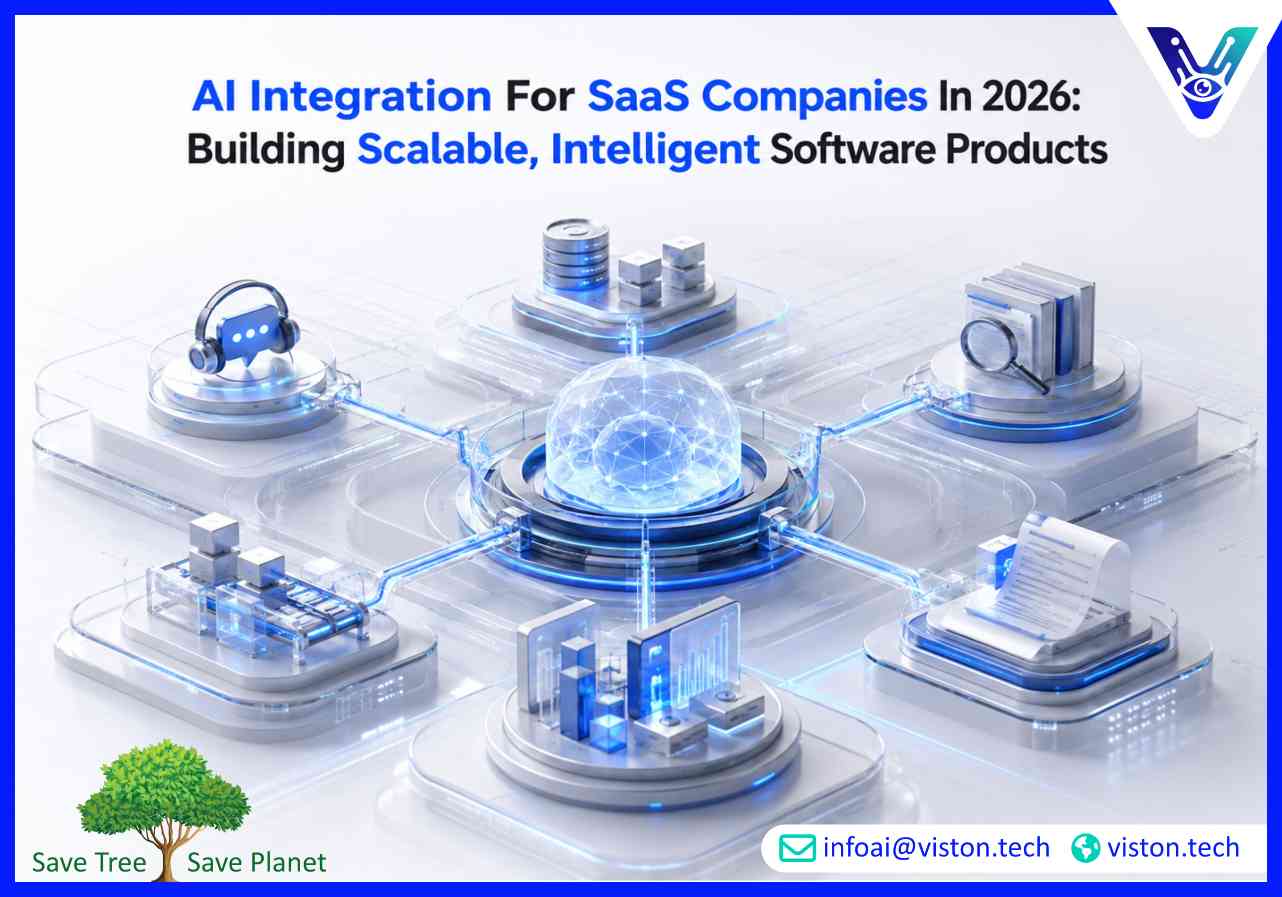
AI integration has become a strategic priority for SaaS companies seeking to improve product value, increase operational efficiency, and meet evolving customer expectations. In 2026, successful SaaS businesses are not simply adding AI features—they are integrating AI into core workflows, decision-making processes, automation systems, and customer experiences to create measurable business impact
The SaaS market continues to become more competitive as customers expect smarter products, faster workflows, personalized experiences, and greater automation. AI integration allows SaaS providers to deliver these capabilities while improving scalability and operational performance.
Rather than functioning as a standalone feature, AI can enhance multiple areas of a SaaS platform, including customer support, workflow automation, analytics, content generation, data processing, predictive insights, onboarding, and user engagement.
Businesses purchasing SaaS solutions increasingly evaluate vendors based on their ability to deliver intelligent functionality that improves productivity and business outcomes. As a result, AI integration has become both a product strategy and a competitive differentiator.
Companies that approach AI integration strategically often achieve stronger customer retention, increased platform adoption, and greater long-term product value.
The most effective AI initiatives align directly with business objectives and user needs. Rather than implementing AI for its own sake, SaaS companies should identify areas where intelligence can improve customer outcomes or operational performance.
AI agents and intelligent support systems can assist with ticket routing, knowledge retrieval, issue classification, response recommendations, and customer self-service. These capabilities help support teams handle growing volumes without sacrificing service quality.
Many SaaS platforms manage repetitive business processes. AI integration can automate tasks such as approvals, data entry, document processing, lead qualification, scheduling, and internal operations while reducing manual effort.
AI models can analyze user behavior, product usage patterns, operational metrics, and business data to generate actionable insights. This helps customers make informed decisions and improves the overall value of the platform.
For SaaS products serving marketing, sales, customer success, education, or communication functions, AI-powered content generation can improve productivity while supporting personalization at scale.
Modern AI systems can improve internal and customer-facing knowledge retrieval by enabling natural language search across documentation, support content, policies, training materials, and organizational knowledge bases.
The most successful integrations focus on solving real customer challenges while maintaining reliability, transparency, and security.
While AI offers significant opportunities, implementation often introduces technical and operational complexities that require careful planning.
AI systems depend on accurate and accessible data. Many SaaS organizations struggle with fragmented data sources, inconsistent structures, and incomplete datasets that limit AI effectiveness.
Integrating AI may require changes to application architecture, APIs, databases, security controls, and processing workflows. Infrastructure planning becomes critical as AI workloads increase.
An AI feature that performs well during testing may face challenges under production workloads. SaaS companies must ensure their AI architecture can support growing customer demand without performance degradation.
Customer data protection remains a top priority. AI integration strategies should address access controls, privacy requirements, governance frameworks, auditability, and responsible AI practices.
Model usage, infrastructure requirements, API consumption, and ongoing maintenance can significantly impact operational costs. Organizations need clear strategies for managing AI-related expenses while maintaining service quality.
Addressing these challenges early helps reduce implementation risks and improves the likelihood of long-term success.
SaaS companies often achieve better outcomes when AI initiatives are guided by business strategy rather than technology trends. A structured approach helps ensure investments generate measurable value.
Organizations should identify specific business problems or customer needs before selecting AI technologies. This ensures implementation efforts remain focused on outcomes rather than features.
Not every process requires AI. Successful companies focus on areas where intelligence can significantly improve efficiency, customer experience, or revenue generation.
A phased implementation strategy allows organizations to validate assumptions, measure results, and scale successful initiatives without creating unnecessary complexity.
AI governance helps organizations manage risk, maintain compliance, monitor performance, and ensure responsible usage across teams and systems.
AI integration should support future growth. Architecture decisions made today should accommodate evolving technologies, increasing usage, and expanding business requirements.
Strategic planning helps SaaS companies move beyond experimentation and build sustainable AI capabilities that create long-term competitive advantages.
As SaaS organizations evaluate AI opportunities, many require strategic guidance to identify high-value use cases, assess technical readiness, and develop practical implementation plans. VistonAI provides Strategic AI Consulting Services that help businesses align AI initiatives with product goals, operational priorities, and long-term growth objectives.
AI integration often involves more than selecting models or deploying new features. Organizations must evaluate data readiness, integration requirements, workflow opportunities, governance considerations, security requirements, and scalability expectations. Strategic consulting helps create a structured roadmap that reduces risk while maximizing business value.
VistonAI supports companies seeking to integrate AI into SaaS platforms through business-focused planning, AI opportunity assessment, workflow analysis, automation strategy, and implementation guidance. Whether the objective involves intelligent customer experiences, workflow automation, AI agents, predictive analytics, or operational optimization, a strategic approach helps ensure that AI investments contribute directly to measurable outcomes.
For SaaS providers competing in rapidly evolving markets, combining product innovation with a clear AI strategy can help accelerate adoption, improve customer satisfaction, and create stronger differentiation.
AI integration involves embedding artificial intelligence capabilities into SaaS products, workflows, systems, or operations to improve functionality, automation, decision-making, and customer experiences.
Customers increasingly expect intelligent features, automation, personalization, and predictive capabilities. AI helps SaaS providers meet these expectations while improving operational efficiency and product competitiveness.
Common use cases include customer support automation, predictive analytics, workflow automation, intelligent search, content generation, recommendation engines, and AI-powered agents.
Key considerations include data quality, infrastructure readiness, scalability, security, compliance, governance, and cost management.
Strategic AI Consulting Services help organizations identify opportunities, evaluate readiness, prioritize use cases, build implementation roadmaps, and align AI investments with business objectives.
Yes. VistonAI provides Strategic AI Consulting Services that help SaaS organizations assess AI opportunities, develop implementation plans, and build scalable AI adoption strategies aligned with business goals.
AI integration for SaaS companies is no longer limited to experimental features or isolated automation projects. In 2026, successful SaaS organizations are embedding AI into products, workflows, and operations to improve customer experiences, increase efficiency, and create long-term competitive advantages. A structured approach that combines strategic planning, technical readiness, governance, and scalable implementation can significantly improve outcomes. For businesses evaluating AI adoption, Strategic AI Consulting Services provide the guidance needed to align technology investments with practical business objectives, and VistonAI can support organizations seeking a clear path toward sustainable AI integration.
