
AI Infrastructure for Enterprise Agents in 2026: Building Scalable Multi-Agent Systems for Business
Introduction
Enterprise AI is moving beyond isolated chatbots and task automation. In 2026, organizations are increasingly deploying networks of AI agents that collaborate across departments, systems, and workflows. However, AI agents alone do not create enterprise value. The infrastructure behind them determines whether they operate reliably, securely, and at scale.
Why AI Infrastructure for Enterprise Agents Matters
Many businesses initially approach AI agents as standalone tools designed to solve specific problems. A customer support agent answers queries, a sales assistant summarizes CRM activity, and an operations agent monitors inventory levels.
The challenge emerges when organizations attempt to scale.
As multiple agents begin operating simultaneously, new issues appear:
- Agents work with inconsistent data
- Duplicate actions occur across workflows
- Security and access controls become fragmented
- Costs increase unexpectedly
- Decision processes become difficult to audit
- Teams lose visibility into AI behavior
Enterprise environments require much more than model deployment. They require infrastructure capable of coordinating intelligence across systems and teams.
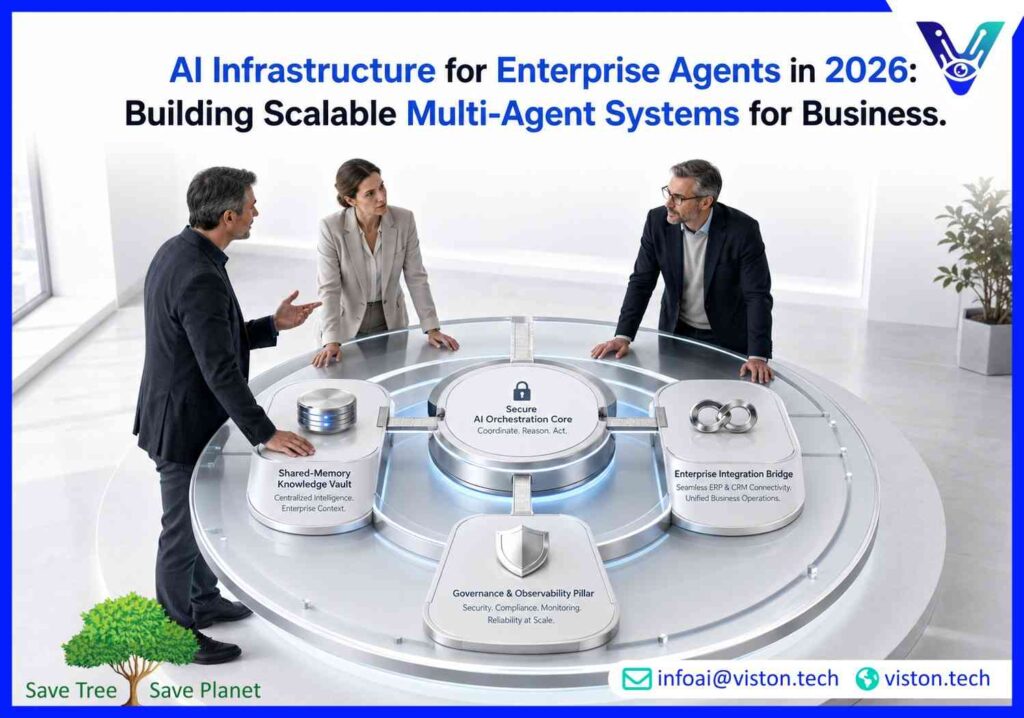
AI infrastructure for enterprise agents is the operational foundation that allows multiple AI systems to function as a connected, governed environment rather than isolated tools. Modern enterprise orchestration has become increasingly important because multi-agent systems require coordination layers, shared context, policy enforcement, and observability capabilities.
What AI Infrastructure for Enterprise Agents Includes
Strong enterprise AI infrastructure is not simply cloud hosting or model access.
It typically includes several interconnected layers.
Agent Orchestration Layer
The orchestration layer acts as the coordination engine.
Its responsibilities include:
- Task routing
- Agent selection
- Workflow sequencing
- Context passing
- Dependency management
- Conflict resolution
- Human approval triggers
Without orchestration, multiple agents often create fragmented automation rather than meaningful business outcomes.
Industry adoption increasingly shows a shift from individual AI agents toward orchestrated networks of specialized agents working toward shared objectives.
Shared Context and Memory Systems
Enterprise agents cannot operate effectively with isolated information.
Shared memory systems enable agents to:
- Access customer history
- Use business policies
- Reference operational rules
- Maintain workflow continuity
- Preserve institutional knowledge
This creates consistency across interactions and decisions.
Integration Infrastructure
Most enterprise environments already contain complex technology stacks:
- ERP platforms
- CRM systems
- HR systems
- Data warehouses
- APIs
- Document systems
- Communication tools
Infrastructure must connect AI agents to these systems securely and reliably.
Governance and Security Controls
In 2026, governance has become a critical requirement rather than an optional consideration.
Organizations increasingly require:
- Role-based access control
- Audit trails
- Data lineage tracking
- Human review workflows
- Compliance monitoring
- Policy enforcement
As AI systems move into financial, healthcare, legal, and operational processes, unmanaged agents create unacceptable risk.
Research on enterprise multi-agent environments increasingly emphasizes policy-aware orchestration and compliance-driven runtime controls.
Observability and Monitoring
Enterprise teams need visibility into:
- Agent decisions
- Workflow failures
- Resource consumption
- Response quality
- Operational costs
- System health
Without observability, organizations often discover problems only after business impact occurs.
Why 2026 Is Different for Enterprise Agent Infrastructure
Several changes are driving infrastructure requirements.
Businesses Are Moving From Single Agents to Multi-Agent Systems
A single agent performs one task.
Multi-agent systems distribute responsibilities among specialized agents.
Examples include:
Customer Service
- Query classification agent
- Knowledge retrieval agent
- Resolution agent
- Compliance agent
- Escalation agent
Supply Chain Operations
- Demand forecasting agent
- Inventory optimization agent
- Vendor communication agent
- Risk monitoring agent
Sales Operations
- Lead qualification agent
- CRM intelligence agent
- Proposal generation agent
- Follow-up automation agent
This approach improves flexibility but also creates coordination complexity.
Multi-agent orchestration is increasingly becoming the operational model supporting enterprise AI scalability.
AI Is Moving Into Core Business Processes
Earlier AI initiatives often focused on experimentation.
Current deployments increasingly affect:
- Revenue operations
- Customer experiences
- Procurement
- Compliance workflows
- Internal productivity
- Strategic decision support
When AI influences critical business processes, infrastructure requirements become significantly stricter.
Buyers Expect Enterprise-Grade Controls
Decision-makers evaluating AI systems now commonly ask:
- How are decisions audited?
- What happens if an agent fails?
- Can we monitor behavior?
- How are permissions controlled?
- Can workflows scale globally?
- How is sensitive data protected?
These questions focus less on model capabilities and more on operational reliability.
Common Enterprise Challenges Without Proper Infrastructure
Organizations frequently encounter predictable issues when infrastructure maturity does not match AI ambitions.
Agent Sprawl
Teams deploy multiple AI tools independently.
Results include:
- Overlapping functionality
- Redundant costs
- Data inconsistency
- Poor visibility
Workflow Failures
Individual agents may perform correctly, yet overall workflows fail because coordination mechanisms are weak.
For example:
A sales agent generates pricing while a finance agent updates policy rules. Without synchronization, proposals may contain outdated information.
Security Exposure
Agents interacting with sensitive systems require controlled permissions.
Poor infrastructure design can unintentionally expose:
- Customer records
- Financial data
- Internal documents
- Proprietary information
Cost Escalation
Uncontrolled model calls, duplicated tasks, and inefficient workflows can create unpredictable operational expenses.
How Enterprise Multi-Agent Orchestration Solves These Problems
Organizations increasingly address these challenges through enterprise multi-agent orchestration solutions.
Orchestration creates a centralized operational framework where specialized agents function together rather than independently.
Key benefits include:
Coordinated Decision Making
Agents operate using shared business objectives rather than isolated logic.
Dynamic Task Assignment
Workloads can shift automatically based on:
- Complexity
- Resource availability
- Priorities
- Business rules
Greater Resilience
If one component fails, workflows can reroute intelligently.
Improved Scalability
New agents can be added without redesigning entire systems.
Stronger Governance
Policy enforcement becomes embedded into workflow execution.
Modern orchestration frameworks increasingly combine coordination, governance, and context-sharing into a unified operating model.
How Viston AI Supports Enterprise Multi-Agent Infrastructure
Viston AI specializes in Enterprise Multi-Agent Orchestration Solutions designed for businesses implementing AI beyond isolated use cases.
As organizations adopt AI agents across operations, customer engagement, internal workflows, and decision systems, the challenge often shifts from building agents to managing them effectively.
Enterprise environments require more than model integration. They need coordinated execution, scalable architecture, and operational control.
Viston AI focuses on helping businesses create practical multi-agent ecosystems that support real operational requirements. This includes connecting specialized agents across workflows, integrating with existing enterprise systems, managing shared context, and establishing governance mechanisms that support reliability and business oversight.
For organizations operating across global markets or complex industries, orchestration becomes particularly important because workflows often span multiple systems, teams, and decision layers.
Rather than treating agents as isolated automation tools, the emphasis is on creating connected environments where AI systems can collaborate, adapt, and scale while maintaining visibility and control.
As enterprise adoption matures in 2026, businesses increasingly require orchestration capabilities that support long-term operational value rather than short-term experimentation.
Considerations When Evaluating Enterprise Agent Infrastructure
When assessing infrastructure options, business leaders should evaluate several practical areas.
Architecture Flexibility
Can the environment support:
- Multiple AI models
- Different agent types
- Future integrations
- Changing business requirements
Governance Capabilities
Look for:
- Access management
- Policy enforcement
- Audit logging
- Human oversight
Scalability
Infrastructure should support growth without requiring major redesigns.
Integration Readiness
Enterprise environments rarely operate in isolation.
Compatibility with existing systems matters significantly.
Observability
Organizations should understand:
- What agents are doing
- Why decisions happen
- How resources are used
Frequently Asked Questions
What is AI infrastructure for enterprise agents?
AI infrastructure for enterprise agents refers to the systems, architecture, governance, integrations, and orchestration layers that allow multiple AI agents to operate securely and effectively within enterprise environments.
What is multi-agent orchestration?
Multi-agent orchestration is the process of coordinating multiple specialized AI agents so they can collaborate toward shared business goals rather than functioning independently.
Why do enterprises need orchestration instead of standalone agents?
Standalone agents work well for isolated tasks, but enterprise workflows typically involve multiple systems, dependencies, and decisions. Orchestration creates coordination, governance, and scalability.
What industries benefit from enterprise agent infrastructure?
Industries with complex workflows and large data environments often benefit significantly, including healthcare, finance, retail, manufacturing, logistics, and technology services.
How does Viston AI relate to enterprise agent infrastructure?
Viston AI provides Enterprise Multi-Agent Orchestration Solutions that help organizations coordinate AI agents across business processes while supporting scalability, integrations, and operational control.
Conclusion
AI infrastructure for enterprise agents is becoming a critical foundation for organizations pursuing meaningful AI adoption in 2026. As businesses move from isolated automation toward connected multi-agent environments, coordination, governance, and operational visibility become essential requirements.
Enterprise Multi-Agent Orchestration Solutions help organizations create systems where AI can operate reliably across workflows rather than functioning as disconnected tools. For businesses evaluating long-term AI capabilities, infrastructure decisions increasingly determine whether AI becomes a scalable operational asset or another fragmented technology initiative. Organizations working with specialists such as Viston AI can approach that transition with a stronger focus on practical implementation and sustainable business outcomes.
