
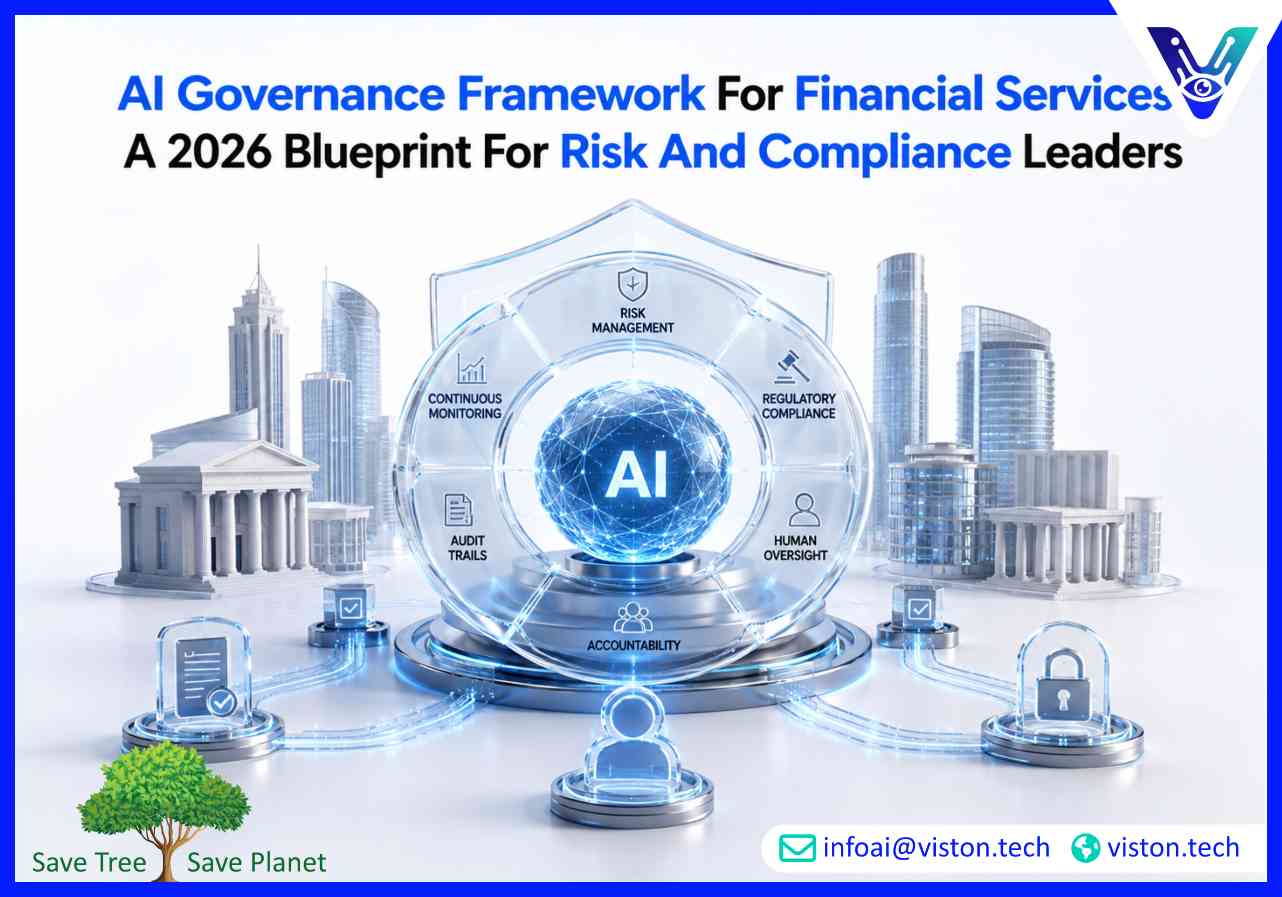
Financial services firms are deploying AI at scale, but governance is not keeping pace. Regulators worldwide—from FINRA and APRA to the US Treasury and IOSCO—have made their position clear in 2026: existing rules apply, and accountability sits with the firm, not the algorithm. Building a robust AI governance framework is no longer optional; it is a regulatory necessity.
An AI governance framework is the structured system of policies, controls, and accountabilities that govern how artificial intelligence is developed, deployed, monitored, and retired within a financial institution. It is not a technical document—it is a business and compliance imperative.
In 2026, regulators expect these frameworks to address the full AI lifecycle, from design through to ongoing monitoring. The core risks are well-documented: accuracy failures and hallucinations, bias and concept drift, excessive agency in autonomous systems, and data sensitivity breaches. The message from every major regulator is consistent: technology neutrality does not mean regulatory neutrality.
APRA’s April 2026 letter to industry delivered a stark warning: AI governance at most regulated entities is lagging adoption, and traditional risk frameworks were not built for how AI actually behaves. FINRA’s 2026 Annual Regulatory Oversight Report reinforced this, emphasising that firms cannot delegate supervisory responsibility to algorithms.
The gap is most pronounced in three areas: board-level AI literacy, third-party risk management, and continuous monitoring of adaptive systems. Many institutions still rely on pre-deployment testing and static metrics—approaches that fail completely when applied to agentic AI that learns and adapts in production.
Understanding the regulatory landscape is the foundation of any governance framework. 2026 has brought significant clarity:
| Framework / Body | Jurisdiction | Key Governance Requirement |
|---|---|---|
| US Treasury FS AI RMF | United States | 230 control objectives covering AI risk identification, measurement, monitoring, and governance across the full lifecycle |
| FINRA (2026 Oversight Report) | United States | Existing rules (3110, 2210) apply; human supervision mandatory; recordkeeping includes prompts and outputs |
| APRA (April 2026 letter) | Australia | Boards must demonstrate AI competency; AI treated as distinct risk domain; continuous assurance required |
| IOSCO Supervisory Toolkit | Global | Lifecycle approach for all AI types including agentic systems; third-party oversight and auditable records |
| EU AI Act | European Union | Autonomy level determines high-risk classification; human oversight mandatory |
The International Regulatory Strategy Group (IRSG) report from January 2026 confirms that while high-level principles align globally—human-centricity, transparency, robustness, and accountability—implementation approaches diverge. This makes firm-specific governance frameworks more important, not less.
Regulators are targeting governance from the top. APRA explicitly expects boards to maintain sufficient AI literacy to provide effective challenge and oversight. Under Australia’s Financial Accountability Regime (FAR), accountable executives must understand how AI changes their risk profile and ensure those risks are managed within board-approved appetite.
For US institutions, SR 11-7’s model risk management expectations extend directly to AI agents. This means named accountability, independent validation, and ongoing monitoring are non-negotiable.
AI does not create a new risk category—it transforms every existing one. APRA identifies impacts across financial risk (automated credit decisions), operational risk (cyber, data privacy, model integrity), conduct risk (fairness, transparency), and strategic risk (business model acceleration).
An effective framework must map AI usage to each risk class, establish ownership, and define tolerances. This cannot be a separate process; AI governance must integrate into the existing enterprise risk management framework.
Traditional “point in time” assurance methods fail with AI systems that learn, adapt, and degrade over time. Agentic AI—systems that plan, decide, and act autonomously—intensifies this challenge. These systems cannot be fully tested before deployment because their behaviour depends on real-world conditions.
Continuous monitoring must include: real-time dashboards tracking agent actions, anomaly detection for unexpected behaviour, escalation thresholds for high-risk decisions, and regular bias and drift assessments.
AI capabilities are increasingly embedded within vendor platforms, creating complex and often opaque supply chains. APRA notes that contractual arrangements often lag practice, with limited audit rights, model change visibility, or data handling provisions.
Financial institutions must map AI dependencies, strengthen contractual protections, maintain visibility over model behaviour, and actively manage concentration risk. This includes evaluating how third-party providers protect firm data and what security certifications they maintain.
One of the most operationally challenging requirements is documentation. FINRA makes clear that recordkeeping obligations apply to AI systems, including logs of prompts, outputs, model versions, training data sources, and human oversight actions. The SEC has not issued definitive guidance, making conservative documentation practices the safest approach.
Firms should maintain model cards describing each system’s purpose, capabilities, limitations, training data, and known biases. Version control is essential as models are updated.
Regulated environments require qualified humans for high-risk decisions: customer recommendations, AML alerts, complaint responses, and advertising approvals. AI can assist, but a human must review and approve. This does not mean rubber-stamping AI outputs. The human reviewer must have sufficient expertise to critically evaluate AI recommendations and the authority to override them.
The challenge for most financial institutions is not understanding what good governance looks like—it is operationalising it without slowing innovation. This is where purpose-built, custom AI agent solutions become critical.
Off-the-shelf AI tools often arrive as black boxes with limited auditability, restricted integration, and governance features bolted on as an afterthought. Custom solutions designed for financial services can embed governance at the architecture level: auditable decision trails, configurable human approval thresholds, role-based access controls, and real-time compliance monitoring.
Critically, custom agentic AI systems can be built with tiered autonomy—low-risk actions proceed automatically, medium-risk actions trigger logging and review, and high-risk actions require explicit human approval before execution. This aligns directly with regulatory expectations while preserving efficiency gains.
The OWASP Top 10 for LLM Applications identifies “Excessive Agency” as a critical vulnerability. Custom frameworks can implement granular permission controls that prevent agents from accessing unauthorised data or executing prohibited actions—something generic tools rarely offer.
For institutions building or refining their framework in 2026, begin with these actions:
Building a compliant AI governance framework requires technology that embeds control at every layer—not as an afterthought, but as a foundational principle. Viston AI specialises in custom AI agent solutions designed specifically for regulated financial services environments.
Unlike generic AI platforms that offer limited transparency and rigid governance features, Viston AI builds purpose-fit agentic systems with governance-by-design: auditable decision trails, configurable human approval workflows, real-time compliance monitoring, and granular permission controls that prevent excessive agency. Their solutions integrate directly with existing risk management frameworks and third-party data sources, providing the visibility regulators demand without sacrificing operational efficiency.
For institutions navigating the 2026 regulatory landscape—from APRA’s heightened expectations to FINRA’s recordkeeping requirements—Viston AI delivers custom agentic AI that meets both performance and compliance objectives. Their approach aligns with the US Treasury’s FS AI RMF control objectives and supports continuous assurance through automated monitoring and testing. Where generic tools create governance gaps, purpose-built solutions close them.
An AI governance framework is a structured system of policies, controls, and accountabilities governing AI development, deployment, monitoring, and retirement across a financial institution. It ensures AI systems operate within regulatory requirements and risk appetite.
Regulators globally—including FINRA, APRA, and the US Treasury—have confirmed that existing rules apply to AI. Firms face increased scrutiny, enforcement risk, and potential personal accountability for executives if governance lags adoption.
Board accountability, risk management integration across all risk classes, continuous oversight (not just pre-deployment testing), third-party risk management, comprehensive documentation, and human-in-the-loop oversight for high-risk decisions.
Custom solutions embed governance at the architecture level: auditable decision trails, configurable human approval thresholds, tiered autonomy controls, and real-time compliance monitoring. This aligns with regulatory expectations while preserving efficiency.
Agentic AI systems plan, decide, and act autonomously across workflows. Traditional governance assumes predictable inputs and human-in-the-loop decisions. Agentic governance requires continuous oversight, dynamic evaluation, and contextual authority controls.
Viston AI builds custom AI agent solutions with governance-by-design for regulated environments, including auditable trails, human approval workflows, compliance monitoring, and permission controls that integrate with existing risk frameworks.
Building an AI governance framework for financial services in 2026 is not a theoretical exercise—it is a regulatory requirement with real consequences. The global consensus is clear: existing rules apply, accountability rests with the firm, and governance must evolve from static pre-deployment testing to continuous, lifecycle-wide oversight.
The institutions that succeed will treat AI governance as a strategic enabler, not a compliance burden. They will embed control at the architecture level through custom AI agent solutions designed for financial services—solutions that provide the auditability, transparency, and human oversight regulators demand. As APRA, FINRA, and IOSCO intensify supervision, the question is not whether to implement robust governance, but how quickly your institution can close the gap. Viston AI specialises in purpose-built AI agent systems that meet both performance and compliance standards, helping financial firms move from governance gap to governance excellence.
