
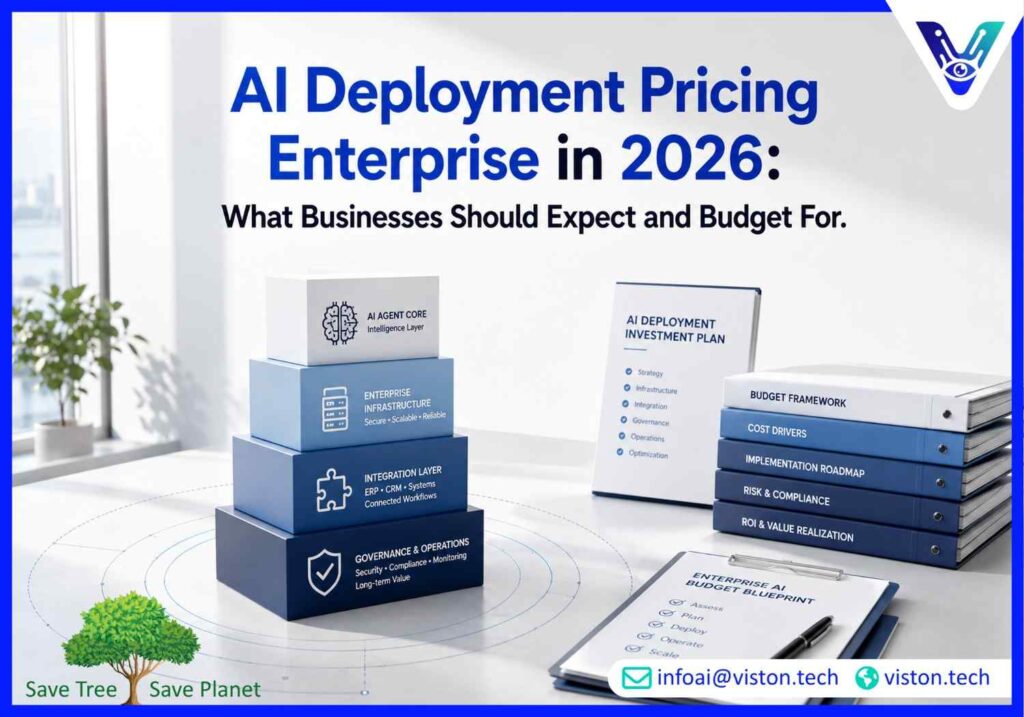
AI investment discussions have shifted from experimentation to operational planning. In 2026, enterprise leaders are no longer asking whether to adopt AI but how much deployment will realistically cost and what value those investments will generate. Understanding AI deployment pricing enterprise considerations helps organizations avoid budget surprises, align technology decisions with business goals, and build scalable AI initiatives.
Enterprise AI pricing is no longer based on a simple software licensing model. Deployment costs now depend on a combination of technology infrastructure, AI model selection, integration complexity, security requirements, governance expectations, and long-term operational support.
For many organizations, the biggest misconception is assuming that AI deployment cost equals model cost.
The reality is different.
Deploying AI into production environments requires much more than purchasing access to a large language model. Enterprises typically invest across multiple operational layers:
These factors create different pricing outcomes depending on the business use case.
Many businesses entered the AI market through small pilot programs or departmental experiments. In 2026, organizations are scaling from isolated use cases toward enterprise-wide AI ecosystems.
This shift introduces new financial considerations:
As AI becomes integrated into customer support, internal operations, analytics, and decision workflows, inference usage grows rapidly.
Organizations now operate under stricter expectations around:
Compliance requirements can significantly affect implementation cost.
Many enterprises combine:
Managing these environments increases deployment complexity.
Leadership teams increasingly expect AI investments to show:
Deployment decisions therefore become business decisions rather than purely technical decisions.
No universal pricing model exists because deployment requirements vary widely.
Several variables influence cost structures.
Organizations may choose:
Advantages:
Considerations:
Advantages:
Considerations:
Model selection often determines a substantial portion of deployment expense.
AI systems are only as effective as the data they access.
Deployment frequently requires:
Many enterprises underestimate this stage despite it being one of the largest implementation efforts.
Simple AI assistants generally require less engineering effort than autonomous enterprise agents.
Examples include:
As agent capabilities increase, deployment architecture becomes more sophisticated.
Enterprise deployments increasingly require:
Industries such as healthcare, finance, and legal services often face additional implementation requirements.
AI systems are not static software products.
Production environments require:
Long-term operational planning should be included in pricing discussions.
Organizations typically encounter several pricing approaches.
Businesses pay according to:
This model works well for predictable usage patterns but can become difficult to forecast at scale.
Providers may offer:
This approach provides easier budgeting but may not reflect actual consumption needs.
Organizations deploying customized AI solutions often pay for:
Initial implementation costs can vary significantly depending on requirements.
Some businesses prefer ongoing support models covering:
This shifts responsibility from internal teams to specialized providers.
Traditional software deployment and AI agent deployment differ significantly.
AI agents operate as decision-support and workflow-execution systems rather than fixed applications.
For example, an AI customer support agent may need to:
This requires:
While the upfront implementation effort may increase, organizations often achieve value through reduced manual work and faster operations.
The goal is not minimizing deployment cost at all costs.
The goal is achieving sustainable business outcomes.
Organizations evaluating AI deployment should focus on overall business impact rather than isolated implementation costs.
Several questions help guide decision-making.
Examples include:
Clear business objectives create clearer investment decisions.
Enterprise environments rarely operate in isolation.
Common integrations include:
Integration requirements often influence cost more than expected.
An AI solution serving 50 internal users differs substantially from one supporting:
Long-term scale planning prevents expensive redesign efforts later.
Organizations should determine whether they need:
Operational responsibility affects total cost ownership.
AI deployment pricing discussions become more practical when businesses move beyond theoretical models and evaluate implementation realities.
Viston AI focuses on AI Agent Development & Deployment for organizations seeking production-ready AI systems rather than isolated experiments. The work typically involves designing and deploying AI agents that connect directly into business workflows, operational systems, and enterprise data environments.
For organizations planning AI initiatives, cost challenges often emerge around integration complexity, scalability, infrastructure decisions, and operational reliability. A technically impressive AI model can still fail if deployment architecture, governance, or workflow design are not aligned with business requirements.
The deployment approach emphasizes several practical considerations:
This approach is particularly relevant for businesses operating in India and global markets where enterprises increasingly require AI systems capable of supporting customer interactions, operational automation, analytics, and internal productivity use cases.
Rather than treating deployment as a one-time technical event, enterprise AI increasingly requires continuous optimization and operational support.
Enterprise AI pricing typically includes infrastructure, model usage, integrations, development, security controls, deployment work, monitoring, and ongoing support requirements.
Costs differ because organizations have unique requirements involving data complexity, integrations, compliance standards, user volume, and AI agent functionality.
Cloud deployment often reduces upfront infrastructure investment and enables faster implementation. Private deployments may provide stronger control and customization but typically require greater operational resources.
Organizations can improve cost control by defining clear use cases, prioritizing high-value workflows, monitoring usage, optimizing prompts, and deploying scalable architectures.
AI agents can improve efficiency by automating workflows, reducing manual effort, accelerating response times, and supporting better operational decisions. ROI depends on implementation quality and alignment with business objectives.
Organizations evaluating AI Agent Development & Deployment may consider providers like Viston AI when they require workflow-focused implementation, enterprise integrations, scalability planning, and operational deployment support.
AI deployment pricing enterprise discussions in 2026 involve much more than estimating model expenses. Businesses must account for infrastructure, integrations, governance, security, operational maintenance, and long-term scalability. Organizations that evaluate total business impact instead of focusing only on initial implementation costs generally make stronger investment decisions.
AI Agent Development & Deployment plays an important role in transforming AI from isolated technology experiments into operational business systems. For companies planning long-term AI initiatives, specialized implementation expertise can help reduce deployment risks and support practical, scalable outcomes. Viston AI’s focus on AI agent deployment aligns with this growing need for production-ready enterprise AI solutions.
