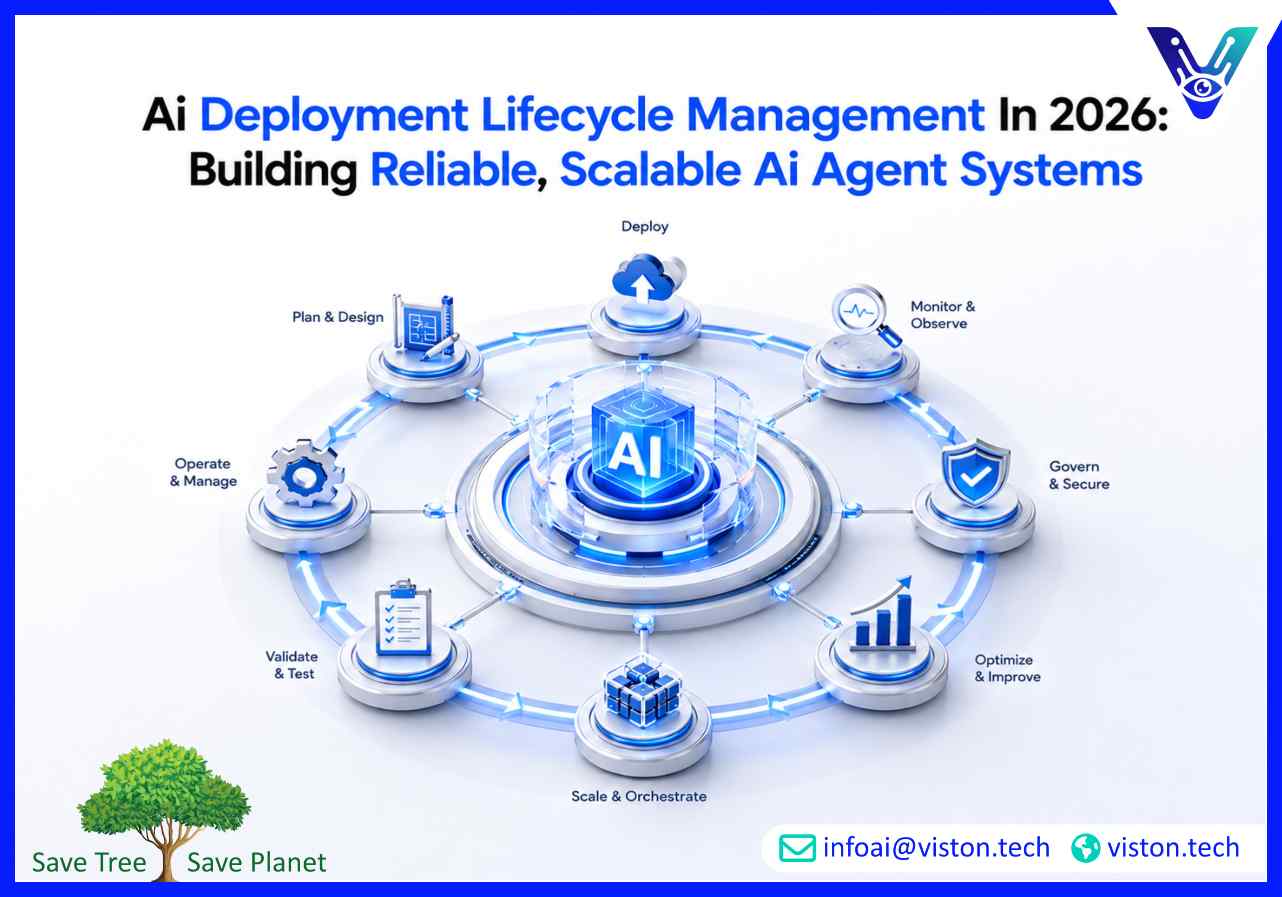
AI Deployment Lifecycle Management in 2026: Building Reliable, Scalable AI Agent Systems
Introduction
AI projects no longer end at model development. In 2026, businesses are prioritizing AI deployment lifecycle management to ensure AI agents remain scalable, secure, compliant, and operationally reliable after launch. For organizations investing in AI agent development & deployment, lifecycle management has become essential for controlling risk, maintaining performance, and achieving measurable business outcomes.
What Is AI Deployment Lifecycle Management?
AI deployment lifecycle management refers to the processes, governance frameworks, infrastructure controls, monitoring systems, and operational workflows used to manage AI systems throughout their entire production lifecycle.This includes:
Planning and architecture
Model and agent deployment
Integration with enterprise systems
Security and compliance validation
Monitoring and observability
Performance optimization
Continuous updates and retraining
Version control and rollback management
Scaling and orchestration
Retirement or replacement of outdated AI systems
For businesses deploying AI agents into production environments, lifecycle management ensures the technology remains usable, compliant, cost-efficient, and aligned with operational goals over time.In 2026, this is particularly important because modern AI systems are increasingly autonomous, multi-agent, API-connected, and integrated into critical workflows such as operations, customer support, ERP systems, finance, logistics, and enterprise decision-making.
Why AI Deployment Lifecycle Management Matters in 2026
Many organizations successfully prototype AI systems but struggle during production deployment. Common challenges include inconsistent outputs, infrastructure instability, rising operational costs, poor governance, and lack of monitoring visibility.As AI adoption scales across industries, businesses are realizing that unmanaged deployments create long-term operational risks.Key reasons lifecycle management matters now include:
Increased Complexity of AI Agent Architectures
Modern AI agents often interact with:
Multiple LLM providers
Internal databases
Enterprise APIs
Workflow orchestration platforms
Retrieval systems
Vector databases
Automation tools
Third-party SaaS platforms
Without structured lifecycle management, these interconnected systems become difficult to maintain and secure.
Regulatory and Compliance Expectations
Organizations operating in sectors such as healthcare, finance, manufacturing, logistics, and enterprise SaaS increasingly face requirements related to:
Data governance
AI explainability
Auditability
Access controls
Privacy protection
Human oversight
Model traceability
AI lifecycle management helps businesses establish operational controls that support regulatory readiness.
Cost Control and Infrastructure Efficiency
AI infrastructure costs can escalate rapidly when deployments lack optimization strategies.Lifecycle management helps organizations monitor:
Token usage
GPU consumption
Inference costs
Latency
Resource allocation
Agent execution efficiency
This becomes especially important for enterprises running high-volume AI workflows across multiple departments or customer-facing systems.
Reliability and Business Continuity
Production AI systems require ongoing monitoring and operational resilience.Businesses must account for:
Model drift
API outages
Hallucinations
Failed automations
Security vulnerabilities
Workflow interruptions
Performance degradation
Lifecycle management reduces operational instability by introducing structured monitoring, fallback systems, and controlled update processes.
Core Stages of the AI Deployment Lifecycle
AI deployment lifecycle management is not a single activity. It is a continuous operational framework spanning several interconnected stages.
1. Strategy and Architecture Planning
Successful deployments begin with clear business alignment.Organizations must define:
Business objectives
AI use cases
Success metrics
Security requirements
Integration needs
Governance responsibilities
Infrastructure constraints
At this stage, businesses also evaluate whether the AI system should use:
Single-agent or multi-agent architectures
Cloud or hybrid infrastructure
Open-source or commercial LLMs
RAG pipelines
Autonomous workflows
Human-in-the-loop controls
Poor architectural planning often leads to scalability problems later in deployment.
2. AI Agent Development and Testing
During development, organizations build and validate:
Agent logic
Prompt workflows
Memory systems
API integrations
Automation rules
Tool-calling frameworks
Retrieval pipelines
Security permissions
Testing requirements in 2026 extend beyond simple functionality checks.Organizations now evaluate:
Output consistency
Hallucination frequency
Response reliability
Bias risks
Latency performance
Multi-step workflow execution
Adversarial prompt resistance
Compliance behavior
Comprehensive pre-deployment testing significantly reduces operational failures after launch.
3. Deployment and Infrastructure Configuration
Production deployment involves more than pushing a model into a live environment.Businesses must configure:
Containerized infrastructure
API gateways
Authentication layers
Load balancing
Observability tooling
Failover systems
Vector databases
Logging pipelines
Workflow orchestration systems
Many enterprises now use Kubernetes-based AI orchestration frameworks to support scalable deployment environments.Security hardening is also critical at this stage, particularly for AI systems accessing sensitive operational or customer data.
4. Monitoring and AI Observability
AI observability has become a major operational requirement in 2026.Unlike traditional software systems, AI agents can produce unpredictable outputs that evolve over time.Effective lifecycle management includes monitoring for:
Accuracy degradation
Prompt failures
Tool execution errors
API latency spikes
Cost anomalies
Security events
Workflow completion rates
User satisfaction indicators
Drift in retrieval quality
Observability platforms help teams identify operational problems before they affect customers or business operations.
5. Continuous Optimization and Governance
AI deployment is an ongoing operational process.Businesses regularly update:
Prompts
Agent workflows
Security rules
Model versions
Retrieval pipelines
Compliance policies
Automation logic
Integration configurations
Governance frameworks are increasingly important for maintaining accountability and operational oversight.Organizations now establish policies around:
Human approvals
Escalation workflows
AI usage permissions
Audit logging
Access controls
Responsible AI practices
Data retention
Incident response
Continuous optimization ensures AI systems remain aligned with evolving business requirements.
Common Challenges in AI Deployment Lifecycle Management
Even organizations with strong technical teams encounter deployment challenges when AI systems move into production environments.
Integration Complexity
AI agents frequently require integration with legacy systems, CRMs, ERPs, support platforms, analytics tools, and internal databases.Integration failures can disrupt operational workflows and reduce AI effectiveness.
Lack of Production Governance
Many organizations focus heavily on development while underestimating governance requirements.Without governance frameworks, businesses face risks related to:
Unauthorized AI actions
Poor auditability
Compliance gaps
Data exposure
Inconsistent operational behavior
Scaling Difficulties
AI systems that perform well during pilot stages may struggle under enterprise-level usage volumes.Scaling challenges often involve:
Latency issues
Infrastructure bottlenecks
Cost escalation
Token limitations
Workflow orchestration inefficiencies
Monitoring Blind Spots
Traditional monitoring tools are often insufficient for AI systems.Businesses require visibility into:
Agent reasoning chains
Retrieval accuracy
Prompt execution paths
Workflow completion quality
AI decision consistency
Without AI-specific observability, operational issues can remain undetected for extended periods.
Industry Use Cases for AI Deployment Lifecycle Management
Lifecycle management requirements vary significantly across industries.
Manufacturing
Manufacturers deploy AI agents for:
Predictive maintenance
Supply chain coordination
Production optimization
Quality assurance
Inventory management
These environments require high operational reliability and integration with industrial systems.
Financial Services
Financial organizations prioritize:
Compliance controls
Auditability
Fraud detection
Risk analysis
Customer service automation
Governance and explainability are essential in regulated environments.
Healthcare
Healthcare deployments often involve:
Patient support workflows
Clinical documentation
Operational automation
Data summarization
Scheduling optimization
Strict privacy and data governance standards significantly affect deployment strategies.
Enterprise SaaS
SaaS companies increasingly deploy AI agents for:
Customer onboarding
Technical support
Workflow automation
Knowledge retrieval
Internal operations
Lifecycle management helps maintain service reliability and customer trust.
How Viston AI Supports AI Agent Deployment and Lifecycle Management
As AI adoption grows, businesses increasingly require partners that understand both AI technology and operational deployment realities.Viston AI specializes in AI agent development & deployment for organizations building scalable, production-ready AI systems. Its approach focuses on practical deployment architecture, operational reliability, and long-term lifecycle management rather than isolated prototype development.For businesses implementing AI agents across enterprise workflows, Viston AI supports areas such as:
AI agent architecture and orchestration
Enterprise workflow automation
Multi-agent system deployment
AI integration with operational platforms
Secure deployment pipelines
AI observability and monitoring
Retrieval-augmented generation systems
Scalable infrastructure planning
Governance-aware deployment strategies
Organizations deploying AI into customer operations, internal workflows, or enterprise automation environments often require more than model development expertise alone. They need deployment frameworks that address scalability, integration reliability, security, operational monitoring, and long-term maintainability.Viston AI’s focus on deployment-oriented AI implementation aligns with the growing demand for production-grade AI systems capable of operating reliably in real business environments across global markets, including rapidly digitizing industries in India.
Best Practices for Managing the AI Deployment Lifecycle
Businesses planning AI deployment initiatives in 2026 should prioritize several operational best practices.
Establish Governance Early
Governance should be integrated from the planning stage rather than added after deployment.This includes:
Approval workflows
Access management
Audit logging
Compliance reviews
Incident response planning
Design for Scalability
AI systems should be architected with future growth in mind.Scalable deployment strategies often include:
Modular workflows
Containerized infrastructure
Distributed orchestration
Usage-based scaling models
Invest in AI Observability
Operational visibility is critical for maintaining AI reliability.Businesses should implement monitoring systems capable of tracking:
Agent actions
Workflow outcomes
Retrieval performance
Cost efficiency
Security anomalies
Prioritize Human Oversight
Human review remains important for high-risk or business-critical workflows.Organizations should define:
Escalation triggers
Approval checkpoints
Intervention policies
Exception handling procedures
Continuously Optimize
AI systems evolve rapidly.Ongoing optimization helps businesses maintain:
Performance quality
Infrastructure efficiency
Compliance alignment
Operational relevance
Frequently Asked Questions
What is AI deployment lifecycle management?
AI deployment lifecycle management refers to the processes used to deploy, monitor, govern, optimize, and maintain AI systems throughout their operational lifespan.
Why is lifecycle management important for AI agents?
AI agents operate dynamically and interact with multiple systems. Lifecycle management helps maintain reliability, scalability, security, governance, and operational performance over time.
What are the biggest risks in unmanaged AI deployments?
Common risks include security vulnerabilities, compliance failures, hallucinations, operational instability, integration breakdowns, uncontrolled costs, and lack of monitoring visibility.
How does AI observability support lifecycle management?
AI observability provides visibility into AI behavior, workflow execution, latency, costs, and operational performance, helping businesses detect and resolve issues quickly.
Which industries benefit most from AI deployment lifecycle management?
Industries with complex operations, regulatory requirements, or large-scale automation initiatives—such as manufacturing, finance, healthcare, logistics, and SaaS—benefit significantly.
How does Viston AI help businesses with AI deployment?
Viston AI helps organizations develop and deploy scalable AI agent systems with a focus on operational reliability, workflow integration, observability, and production-ready infrastructure.
Conclusion
AI deployment lifecycle management has become a critical operational discipline for businesses adopting AI agent systems in 2026. Successful deployments now depend on far more than model performance alone. Organizations must manage scalability, governance, observability, integration reliability, security, and long-term optimization throughout the entire AI lifecycle.For businesses investing in AI agent development & deployment, structured lifecycle management reduces operational risk while improving reliability and measurable business outcomes. Companies such as Viston AI are helping organizations move beyond experimental AI initiatives toward scalable, production-ready deployment strategies that support sustainable operational growth.