
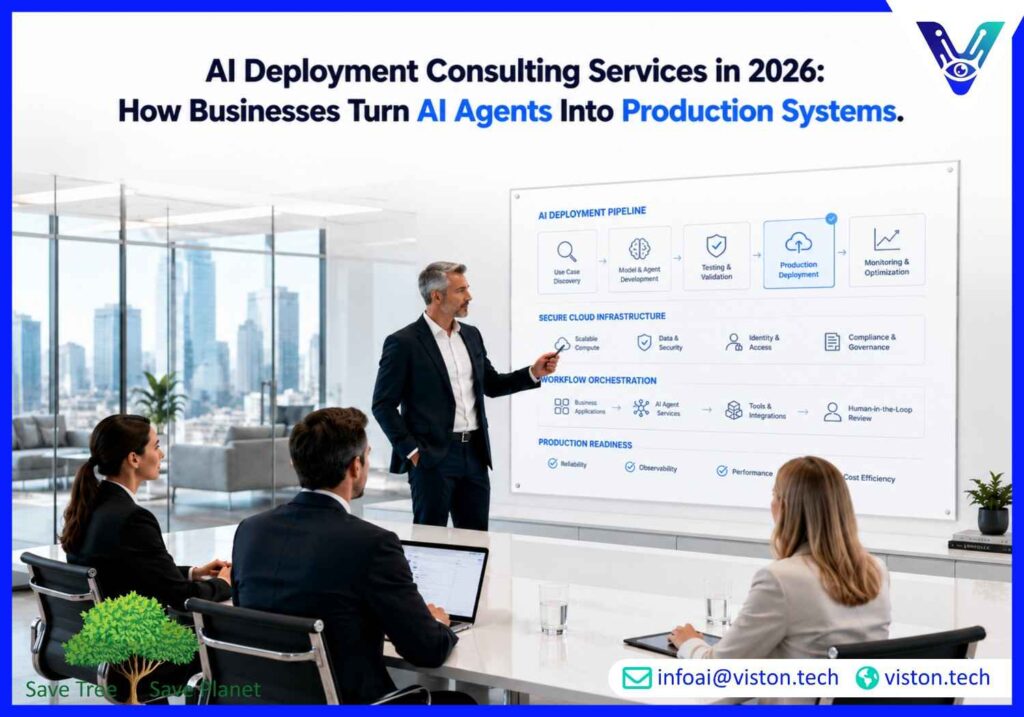
Building an AI model or AI agent is no longer the hardest part of an AI initiative. For many businesses in 2026, the bigger challenge is turning AI experiments into stable, secure, and measurable business systems. AI deployment consulting services help organizations bridge that gap by moving AI from proof-of-concept to production with fewer operational risks and better business outcomes.
AI deployment consulting services focus on planning, implementing, integrating, and operationalizing AI systems within real business environments.
Deployment is much more than launching a model or connecting an API. Organizations now expect AI systems to work reliably across internal tools, workflows, customer interactions, and business processes.
For companies implementing AI agents specifically, deployment consulting often includes:
In practice, deployment determines whether an AI initiative becomes a productive business asset or another isolated experiment.
AI adoption has shifted significantly over the last few years.
Organizations are no longer asking whether they should use AI. They are asking:
The rise of AI agents has also changed deployment expectations.
Modern AI agents do more than generate responses. They can:
As AI systems gain greater autonomy, deployment becomes a business-critical process rather than a technical step.
Many organizations discover that building AI capabilities and operating them effectively are very different tasks.
AI systems rarely operate independently.
A customer support agent may require:
Poor integration planning often creates fragmented workflows and inconsistent outputs.
AI systems rely heavily on data quality.
Incomplete, outdated, or inconsistent information can reduce performance and create unreliable results.
Deployment consulting frequently involves designing cleaner data pipelines and retrieval processes.
Business leaders increasingly worry about:
AI deployment strategies now commonly include governance frameworks and role-based access controls.
Launching an AI solution without monitoring creates long-term risks.
Teams need visibility into:
Without observability, issues often appear only after business impact occurs.
A prototype may work for ten users but fail under enterprise demand.
Scaling requires:
AI agent development has evolved beyond chatbot implementation.
Modern AI agents are increasingly designed as workflow participants capable of executing business functions.
Effective AI deployment consulting aligns agent design with business operations.
Successful implementations usually begin with process analysis.
Examples include:
Not every process should become fully autonomous.
Deployment specialists help determine:
AI agents become significantly more useful when connected to business tools.
Common integrations include:
AI systems improve through operational feedback.
Consultants typically establish:
Selecting a deployment partner requires more than evaluating technical capability.
Businesses should examine several areas carefully.
A provider should understand production environments, not only prototypes.
Questions worth asking include:
Deployment teams should understand enterprise systems and APIs.
AI rarely creates value in isolation.
Depending on industry requirements, organizations may need:
AI ecosystems continue changing rapidly.
Businesses often benefit from providers that can work across multiple environments rather than forcing rigid technology stacks.
AI deployment is not a one-time event.
Systems typically require:
AI deployment consulting becomes particularly valuable when organizations move beyond isolated automation experiments and begin implementing operational AI systems.
Viston AI focuses on AI agent development and deployment services designed around practical business use cases rather than standalone AI features. Instead of treating AI as a separate technology layer, the emphasis is on integrating AI agents into existing workflows where they can contribute measurable operational value.
For organizations implementing AI-driven customer support, sales operations, internal knowledge systems, process automation, or multi-step workflows, deployment requirements often extend beyond model selection. Reliable delivery typically involves system integration, workflow orchestration, performance monitoring, and operational controls.
Specialized AI agent deployment approaches may include:
For businesses operating in India and global markets, deployment considerations can also include infrastructure preferences, data handling requirements, and industry-specific operational expectations.
As organizations move toward AI-enabled workflows in 2026, implementation quality increasingly determines whether AI becomes a productivity tool or an operational burden. Practical deployment strategies help reduce friction between experimentation and business adoption.
Deployment demand continues increasing across multiple sectors.
Organizations use AI systems for:
Deployment considerations often include privacy requirements and secure data handling.
Use cases include:
Governance and auditability frequently become central requirements.
Businesses deploy AI for:
AI agents increasingly support:
AI deployment consulting services help businesses move AI systems into production environments through planning, integration, implementation, monitoring, and optimization.
Development focuses on creating AI capabilities. Deployment focuses on making those capabilities work reliably within business operations and technology environments.
Timelines vary depending on complexity. Small workflow implementations may take weeks, while enterprise-scale deployments involving integrations and governance requirements can take several months.
Yes. AI agents generally require monitoring, optimization, workflow updates, prompt adjustments, and performance improvements over time.
Healthcare, finance, ecommerce, logistics, manufacturing, customer support, and operational teams often see strong value because they involve repeatable workflows and high-volume processes.
Where businesses need custom AI agent development and deployment support aligned with operational workflows, Viston AI can provide services focused on integrating AI capabilities into practical business processes.
AI deployment consulting services have become an important part of turning AI investments into working business systems. In 2026, organizations increasingly need AI solutions that are secure, integrated, scalable, and capable of supporting real operational goals rather than isolated experiments.
For businesses investing in AI agent development and deployment services, success depends on more than building intelligent systems. It depends on implementing them effectively within existing workflows and ensuring they continue delivering value over time. Organizations that approach deployment strategically are better positioned to achieve reliable adoption, measurable outcomes, and sustainable AI-driven growth.
