
AI Consulting Firms Near Me: What to Look for in 2026 When AI Agent Development Is the Priority
Why Proximity Isn’t the Point Anymore
When businesses search for AI consulting firms near me, they’re rarely looking for a company down the street. They’re looking for the shortest path to a credible, capable partner — someone who understands their operational reality and can deliver working AI systems, not polished slide decks. In 2026, with AI agent development moving from proof-of-concept into core business infrastructure, choosing the right consulting partner matters more than geography ever will.
What the Search Really Means
The phrase “AI consulting firms near me” reflects a specific buyer mindset: accessible, responsive, and practically focused. Decision-makers using this search are typically past the awareness stage. They’ve already accepted that AI has a role in their operations. What they’re evaluating now is who to trust with the execution.
That evaluation increasingly centres on one capability: AI agent development and deployment. Not generic automation. Not basic chatbot builds. Enterprises in 2026 are asking whether a consulting firm can design, build, and deploy autonomous agents that actually integrate with existing systems, handle multi-step workflows reliably, and scale without constant engineering intervention.
That’s a meaningfully different capability set from what most “AI consultancies” offer.
The Gap Between AI Consultancies and AI Agent Specialists
Most firms that market themselves as AI consultants can audit your data, recommend tools, or help you draft an AI strategy. A smaller group can actually build. An even smaller group specialises specifically in agentic AI — multi-agent systems, LLM orchestration, stateful pipelines, human-in-the-loop workflows, and production-grade deployment.
This distinction matters because:
Strategy without execution isn’t sufficient anymore. Boards and leadership teams have already approved AI investment. The bottleneck in 2026 is implementation — moving from intent to operational systems that reduce cost, improve throughput, and drive measurable outcomes.
Generic automation isn’t agentic AI. Workflow automation tools have existed for years. AI agents are fundamentally different — they reason, adapt, use tools, maintain context across long task sequences, and handle ambiguous inputs. Building them well requires specialist skills in LangGraph, CrewAI, AutoGen, and similar frameworks, combined with robust MLOps infrastructure.
Deployment is where most projects fail. Developing a working prototype is relatively straightforward. Deploying agents into production environments, connecting them to legacy systems, enforcing compliance guardrails, and maintaining performance over time is where engineering depth becomes essential.
When you search for AI consulting firms nearby, the real filter should be: does this firm have the specialist capability to deliver production-grade AI agents, or are they offering generic advisory?
What Good AI Agent Development Actually Involves
If you’re evaluating firms against a genuine AI agent build, understand what the scope actually covers.
Architecture and Framework Selection
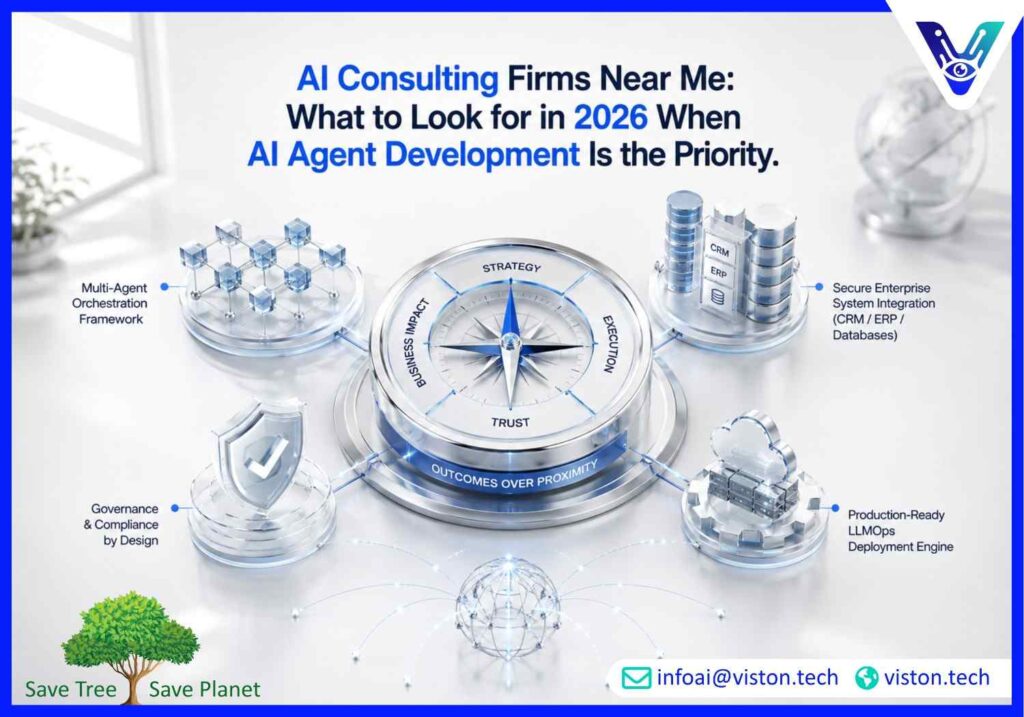
Not every agentic framework suits every use case. LangGraph is well-suited to complex, stateful workflows that require deterministic control flows and explicit routing logic. CrewAI fits scenarios where multiple specialised agents need to collaborate on shared objectives. AutoGen works well for code-heavy, multi-turn task environments. A credible partner will recommend the right architecture for your problem — not default to the one their team happens to know best.
System Integration
AI agents only create value when connected to the systems that hold your data and drive your operations. That means secure integration with CRMs, ERPs, data warehouses, ticketing platforms, and proprietary internal tools. This is engineering work, not consulting work, and it requires developers who understand enterprise infrastructure.
Compliance and Governance by Design
In regulated industries — financial services, healthcare, legal, logistics — agents cannot operate without governance frameworks. That means validation layers that check agent outputs before action is taken, audit trails, human escalation paths, and data handling that meets applicable compliance requirements. Firms that treat governance as an afterthought create significant downstream risk.
LLMOps and Ongoing Performance Management
Deploying an agent isn’t the end of the engagement. LLM behaviour changes as models are updated. Operational conditions shift. Performance monitoring, prompt tuning, and infrastructure management are ongoing requirements. Firms that offer post-deployment support and LLMOps capabilities provide substantially more durable value than those that hand off at go-live.
Industry-Specific Considerations in 2026
AI agent use cases have matured significantly across core verticals.
Financial Services: Agents are now being deployed for financial research synthesis, regulatory compliance monitoring, and automated client reporting — applications that require not just technical capability but genuine understanding of compliance obligations and data sensitivity.
Healthcare: Clinical workflow automation, patient inquiry management, and claims processing automation require agents with strict validation layers and privacy-first architecture. The margin for error is minimal.
Retail and E-commerce: Dynamic personalisation, inventory management automation, and customer intelligence systems have moved from experimentation to operational dependency.
Manufacturing: Predictive maintenance agents, quality control automation, and supply chain orchestration are delivering measurable downtime reduction and cost savings.
Across all sectors, the common thread is that AI agent projects succeed when the consulting firm brings both domain awareness and deep technical delivery capability — not just familiarity with the technology.
How Viston AI Approaches AI Agent Development
For organisations searching for AI consulting firms with genuine AI agent development capability, Viston AI operates as an end-to-end specialist partner — not a generalist advisory firm.
Viston works with Chief AI Officers, VPs of Digital Transformation, and engineering leaders across the USA, UK, Europe, and Australia to design and deploy custom AI agent solutions built on frameworks including CrewAI, LangGraph, AutoGen Studio, and Vertex AI. With over 15 years of engineering experience and more than 2,860 client engagements across global markets, its teams bring production-grade delivery experience to both greenfield agent builds and integration into existing enterprise architecture.
The firm covers the full delivery scope: architecture selection, system integration, multi-agent orchestration, compliance guardrails, and ongoing LLMOps management. For organisations without established in-house AI teams, Viston can act as a complete delivery partner. For those with existing data science functions, it provides the LLMOps infrastructure and specialist framework expertise needed to move from prototype to production at scale.
Viston’s emphasis on responsible AI — embedding governance and compliance into agent design rather than appending it post-deployment — makes it a relevant choice for enterprises operating in regulated industries where oversight, auditability, and data security are non-negotiable.
What to Ask Any AI Consulting Firm Before Committing
Whether you’re evaluating Viston or any other firm, the right questions filter capability from marketing quickly.
- What agentic frameworks do your developers work with in production, not just in demos?
- Can you show how you’ve integrated agents with legacy enterprise systems?
- How do you handle compliance requirements in regulated industries?
- What does your post-deployment support and LLMOps capability look like?
- How do you measure agent performance — technically and against business KPIs?
- Who owns the code, prompts, and agent configurations at the end of the engagement?
Firms that answer these questions with specifics rather than generalities have usually earned the right to be on your shortlist.
Frequently Asked Questions
What should I actually be looking for when searching for AI consulting firms near me?
Prioritise specialist capability over location. The most important factors in 2026 are experience with AI agent development and deployment, proven integration with enterprise systems, and a clear post-deployment support model. Remote and distributed delivery is standard across the industry, so geographic proximity rarely affects quality of outcome.
What is the difference between AI consulting and AI agent development?
AI consulting typically covers strategy, readiness assessments, and technology recommendations. AI agent development involves actually building, integrating, and deploying autonomous agents — a technical execution capability that requires specialist engineering skills beyond advisory. Many firms offer consulting; fewer can deliver production-grade agents.
How long does a typical AI agent development project take?
Timelines vary based on complexity. A focused single-agent deployment with defined scope can be operational within weeks. Multi-agent orchestration systems with deep enterprise integration typically take two to six months for production deployment, depending on architecture complexity, number of integrations, and governance requirements.
How do AI agents differ from standard workflow automation tools?
Traditional automation executes predefined, rule-based sequences. AI agents reason over inputs, use tools dynamically, maintain context across multi-step tasks, and adapt to ambiguous or changing conditions. They are significantly more capable — and require significantly more engineering rigour to deploy reliably.
What industries benefit most from AI agent deployment?
Financial services, healthcare, retail, manufacturing, and logistics are seeing the strongest returns in 2026. That said, any industry with high-volume, multi-step operational processes — research workflows, compliance monitoring, customer operations, data processing — can benefit from well-designed agentic systems.
Can Viston AI support organisations without an in-house AI team?
Yes. Viston operates as a complete end-to-end partner for organisations that don’t have in-house AI or data science capability. It handles strategy, development, deployment, and ongoing LLMOps management, removing the need for clients to build specialised internal teams before their AI initiatives can progress.
The Right Partner Changes the Outcome
Searching for AI consulting firms is ultimately a search for trusted execution capability. The businesses making the strongest gains from AI in 2026 aren’t those with the most ambitious strategies — they’re those with partners who can translate strategy into working production systems, maintain them responsibly, and adapt them as requirements evolve.
AI agent development is no longer experimental. It’s operational infrastructure. The consulting firms worth engaging are those who treat it that way — with engineering rigour, governance standards, and a clear accountability for outcomes beyond the initial build. That’s the standard to hold any prospective partner to, regardless of where they’re located.
