AI Chatbot Scripts Templates for Business Automation in 2026
AI chatbot scripts templates help businesses create clearer, faster, and more consistent automated conversations. In 2026, effective chatbot scripting is no longer about fixed replies alone. It requires structured conversation design, system integration, personalization, escalation logic, and measurable business outcomes.
What AI Chatbot Scripts Templates Mean for Businesses
AI chatbot scripts templates are reusable conversation frameworks that guide how a chatbot greets users, understands intent, asks questions, provides answers, collects information, and moves users toward a useful outcome.For businesses, templates reduce the time needed to plan chatbot interactions while improving consistency across customer support, sales, onboarding, booking, ecommerce, internal service desks, and lead qualification workflows.A strong chatbot script template usually includes:
A clear opening message
Intent-based response paths
Guided questions
Fallback responses
Escalation rules
CRM or helpdesk data capture fields
Personalized follow-up messages
Conversation completion prompts
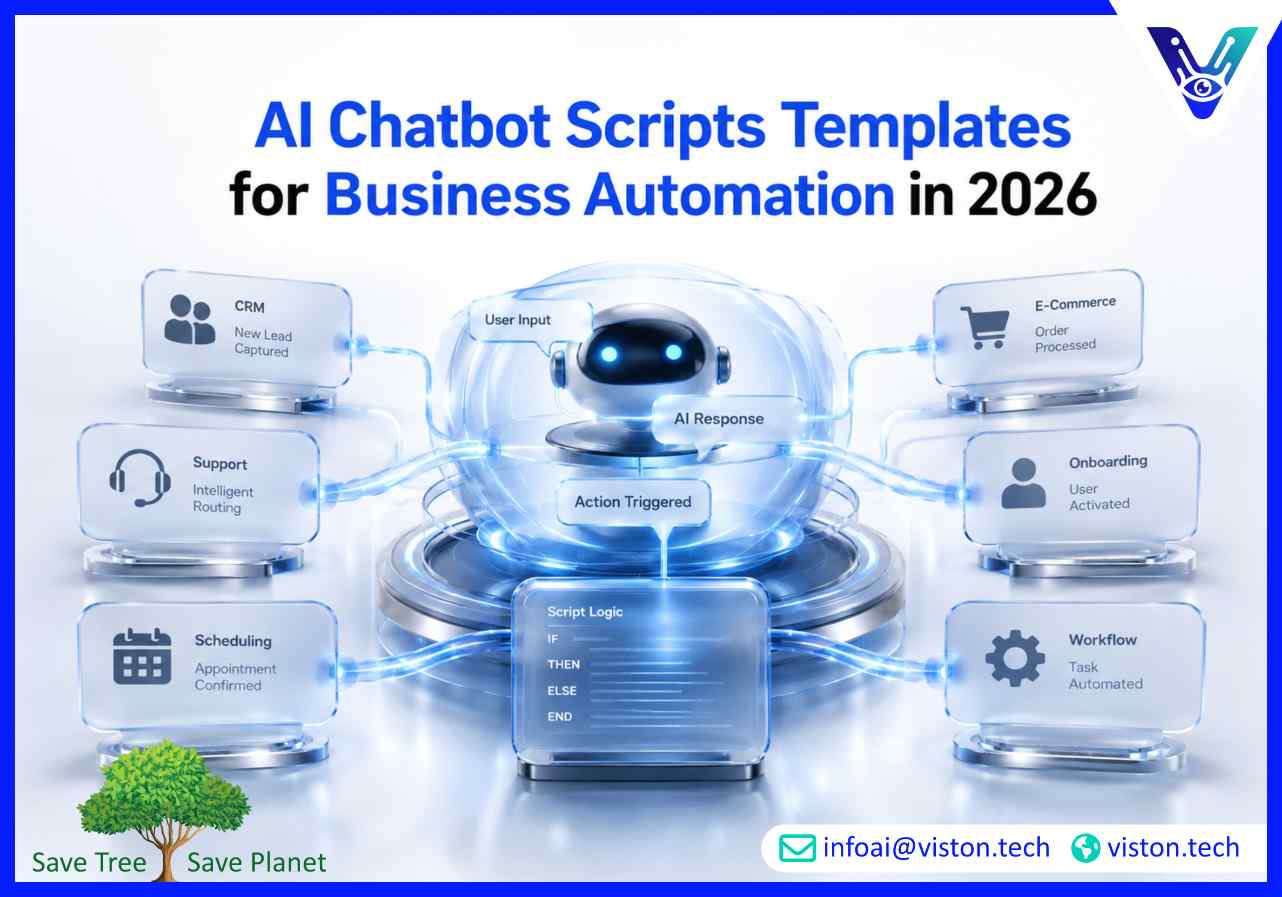
In modern AI Chatbot Integration projects, these scripts are not isolated text blocks. They are connected to business systems such as CRM platforms, support tools, ecommerce systems, scheduling software, marketing automation platforms, and analytics dashboards.
Why AI Chatbot Scripts Templates Matter in 2026
Customers now expect chatbot experiences to be quick, accurate, helpful, and connected to their actual needs. A chatbot that gives vague answers or asks unnecessary questions can damage trust instead of improving service.AI chatbot scripts templates help businesses create reliable conversation flows before integrating the chatbot into live systems. They also make it easier for teams to review tone, compliance, data capture, escalation, and workflow logic.
They Improve Conversation Consistency
Templates ensure customers receive clear and consistent answers across common scenarios. This is especially important for businesses handling repetitive support requests, sales inquiries, appointment bookings, order updates, or onboarding questions.
They Reduce Implementation Risk
Without defined scripts, chatbot projects often become unclear during development. Teams may disagree on what the chatbot should say, what information it should collect, when it should escalate, and how it should connect with internal systems.Templates create a practical starting point for developers, marketers, operations teams, and customer support leaders.
They Support Better AI Training
AI chatbots perform better when they are trained around clear intents, sample phrases, expected responses, and approved knowledge sources. Script templates help structure these elements before deployment.
They Make Integration More Useful
A chatbot script becomes more valuable when it triggers real actions. For example, a lead generation script can create a CRM record, a support script can open a ticket, and a booking script can check calendar availability.
Practical AI Chatbot Scripts Templates by Use Case
The best chatbot template depends on the business goal. A sales chatbot should not behave like a support chatbot, and an onboarding chatbot should not ask the same questions as an ecommerce assistant.
Customer Support Script Template
Purpose: Help users solve common problems and escalate complex issues.Template:Hello, welcome to [Company Name]. I can help with orders, billing, technical support, account access, or general questions. What do you need help with today?
Order or delivery issue
Billing question
Technical problem
Account access
Speak with support
Thanks. Please share your order number or registered email so I can check the details.I found your request. Here is the next step: [response based on issue].If this does not solve the issue, I can connect you with a support specialist.
Lead Qualification Script Template
Purpose: Capture useful prospect information and route leads to sales teams.Template:Hi, thanks for your interest. I can help you find the right solution. What are you looking for?
Pricing information
Product or service details
Book a consultation
Compare options
Custom solution
Great. What type of business do you run?How soon are you planning to start?
Immediately
Within 30 days
Within 3 months
Still researching
Thanks. Please share your name, email, and preferred contact time. I will pass this to the right team.
Appointment Booking Script Template
Purpose: Help users book meetings, demos, consultations, or service appointments.Template:Hello. I can help you schedule an appointment. What type of appointment would you like to book?
Consultation
Product demo
Support call
Service appointment
Please choose your preferred date and time.Thanks. I have found available slots for [date]. Which option works best for you?Your appointment is confirmed for [date and time]. You will receive confirmation by email.
Ecommerce Product Recommendation Script Template
Purpose: Guide shoppers toward relevant products based on preferences.Template:Welcome. I can help you find the right product. What are you shopping for today?Do you have a preferred budget range?Are there any features that matter most to you?
Price
Quality
Delivery speed
Brand
Reviews
Based on your answers, here are the best options: [product recommendations].Would you like help comparing these products or completing your order?
Customer Onboarding Script Template
Purpose: Help new customers understand next steps and start using a product or service.Template:Welcome to [Company Name]. I can help you get started. What would you like to do first?
Set up my account
Connect tools
Learn key features
Contact support
Let’s start with the most important setup step. Please confirm [required detail].Great. Your next recommended step is [action].You can return anytime for setup help, feature guidance, or support.
How to Customize AI Chatbot Scripts Templates for Better Integration
Templates should never be copied into a chatbot without adaptation. Every business has different customer journeys, data requirements, systems, support processes, and compliance expectations.
Map Scripts to Real User Intent
Start by identifying why users contact your business. Common intents include pricing, troubleshooting, booking, refund requests, product questions, order updates, account access, and sales inquiries.Each intent should have a dedicated script path with a clear outcome.
Connect Scripts to Business Systems
AI Chatbot Integration makes scripts operational. A chatbot should not only ask questions but also update records, retrieve information, trigger workflows, and notify teams when needed.Useful integrations may include:
CRM systems for lead capture
Helpdesk tools for support tickets
Calendars for appointment booking
Ecommerce platforms for order status
Knowledge bases for approved answers
Analytics tools for performance tracking
Build Human Handoff Into Every Critical Flow
Even advanced AI chatbots need escalation logic. If a user is frustrated, asks a complex question, shares sensitive information, or requests a human, the chatbot should route the conversation appropriately.
Use Personalization Carefully
Personalization improves chatbot relevance when it is based on accurate and permitted data. Businesses should avoid over-personalized responses that feel intrusive or rely on uncertain assumptions.
Measure and Improve Scripts Over Time
Chatbot scripts should be reviewed using real conversation data. Useful metrics include completion rate, fallback rate, escalation rate, customer satisfaction, lead conversion, response accuracy, and time saved.
How Viston AI Helps Businesses Build Integrated Chatbot Script Workflows
Viston AI supports businesses with AI Chatbot Integration by helping connect conversational workflows with the systems and processes that make automation useful. For companies using AI chatbot scripts templates, the real value comes from turning static conversation paths into integrated customer journeys.This may include connecting chatbot scripts with CRM platforms, support systems, lead routing workflows, knowledge bases, scheduling tools, analytics, and internal automation processes. Instead of treating scripts as standalone messages, Viston AI helps businesses structure chatbot conversations around business goals such as faster support, better lead qualification, improved customer onboarding, and more efficient operations.Effective integration also requires attention to user experience, data handling, security, fallback logic, and performance measurement. In 2026, businesses need chatbot systems that can support natural conversations while still producing reliable structured outputs for teams and platforms. Viston AI’s approach is relevant for organizations that want practical chatbot workflows that are connected, scalable, and aligned with real operational needs.
Frequently Asked Questions
What are AI chatbot scripts templates?
AI chatbot scripts templates are reusable conversation structures that define how a chatbot greets users, asks questions, responds to intents, captures data, and guides users toward an outcome.
Can chatbot scripts be used with AI-powered chatbots?
Yes. Scripts help define approved flows, tone, fallback responses, and business logic, while AI improves intent recognition, personalization, and contextual response handling.
Why are scripts important for AI Chatbot Integration?
Scripts define what the chatbot should do, while integration connects those conversations to CRM systems, helpdesks, calendars, ecommerce platforms, databases, and automation tools.
How often should chatbot scripts be updated?
Businesses should review chatbot scripts regularly using conversation analytics, customer feedback, support trends, product updates, and changes in internal workflows.
Can Viston AI help customize chatbot scripts for business workflows?
Yes. Viston AI helps businesses structure chatbot workflows and integrate them with operational systems so scripts support practical automation, lead capture, support, and customer engagement goals.
Conclusion
AI chatbot scripts templates give businesses a practical foundation for creating clearer and more effective automated conversations. When combined with AI Chatbot Integration, these templates can support real business workflows such as support automation, lead qualification, appointment booking, onboarding, and ecommerce assistance. The key is to customize scripts around user intent, connect them to the right systems, and continuously improve them using performance data. For businesses planning chatbot automation in 2026, structured scripts are not just conversation copy; they are the operational blueprint for reliable customer engagement.