
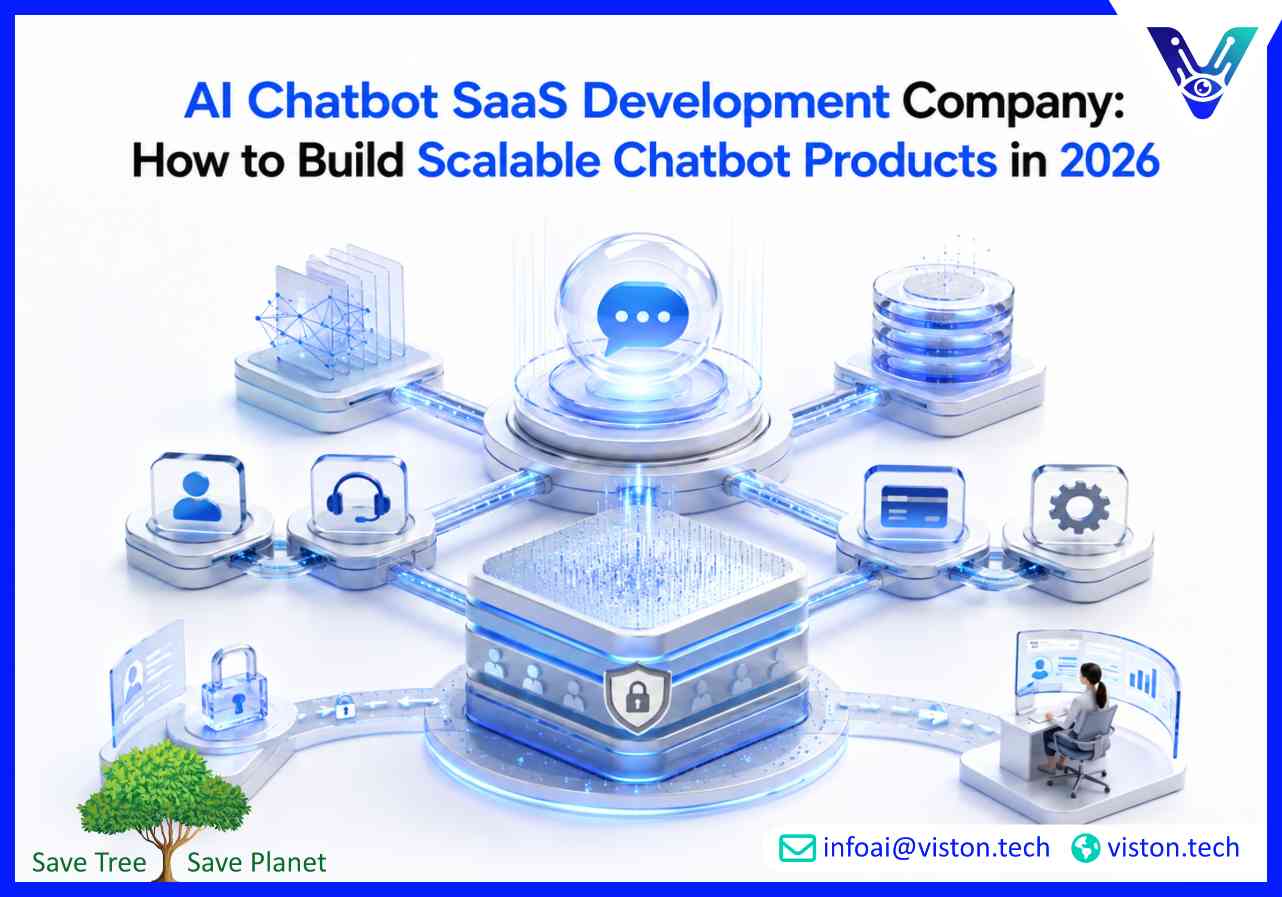
Choosing an AI chatbot SaaS development company in 2026 is no longer just about launching a simple support bot. Businesses now need secure, scalable, data-connected chatbot platforms that improve customer engagement, automate workflows, support product growth, and integrate smoothly with existing SaaS ecosystems.
An AI chatbot SaaS development company helps businesses design, build, deploy, and improve chatbot products that operate as cloud-based software platforms. Unlike a basic website chatbot, a SaaS chatbot solution usually supports multiple users, accounts, teams, workflows, integrations, permissions, analytics, and subscription-based access.
For SaaS businesses, the chatbot is often part of the product experience itself. It may answer customer questions, guide users through onboarding, recommend features, qualify leads, manage support tickets, or help internal teams retrieve information faster. This makes AI chatbot development both a product engineering task and a conversational AI strategy task.
A strong development partner typically works across several layers:
The goal is not simply to make a bot respond. The goal is to build a reliable AI-enabled SaaS experience that can support real customers, scale across accounts, protect data, and continue improving after launch.
In 2026, SaaS buyers expect faster answers, cleaner onboarding, lower support friction, and more personalized product experiences. They are also more cautious about AI accuracy, privacy, hallucinations, security, and vendor reliability. This creates a clear need for AI chatbot development that balances automation with trust.
Support teams in SaaS companies often deal with repetitive questions about pricing, setup, integrations, account access, billing, troubleshooting, and product usage. A well-developed AI chatbot can handle common queries, retrieve accurate help content, create tickets, collect context before escalation, and reduce the workload on human agents.
The best results come when the chatbot is connected to approved knowledge sources and business systems. Generic responses are not enough. Users expect the chatbot to understand the product, the customer’s plan, the user’s role, and the action they are trying to complete.
SaaS growth depends heavily on activation. If users do not understand the product quickly, they abandon it. AI chatbots can support onboarding by answering setup questions, recommending next steps, explaining features, guiding users through workflows, and reducing dependence on manual customer success calls.
This is especially valuable for SaaS platforms with complex dashboards, integrations, technical configuration, or multiple user roles. A chatbot can act as an always-available product guide that helps users move from signup to value faster.
An AI chatbot SaaS platform can also support lead generation and sales enablement. Instead of relying only on static forms, businesses can use conversational flows to understand buyer intent, company size, budget, use case, integration needs, and urgency. The chatbot can then route qualified leads to sales teams, update CRM records, or recommend relevant resources.
For B2B SaaS companies, this creates a smoother buyer journey. Prospects can get immediate answers while the company collects useful context for follow-up.
Modern AI chatbot development must include guardrails, testing, monitoring, fallback handling, privacy controls, and human escalation. Buyers are more aware of prompt injection, data leakage, inaccurate answers, biased outputs, and unauthorized system actions. A serious SaaS chatbot solution needs technical safeguards from the start, not as an afterthought.
Not every development team is ready to build AI chatbot SaaS products. A capable partner needs experience across SaaS architecture, AI models, data workflows, integrations, product UX, and long-term optimization.
A SaaS chatbot must be designed around the business model. A single-tenant internal assistant, a multi-tenant customer support bot, and an AI chatbot platform sold to multiple clients all require different architecture. The development company must plan user accounts, permissions, billing logic, storage, API usage, model access, and tenant isolation correctly.
Modern chatbots use large language models, natural language understanding, intent recognition, entity extraction, sentiment analysis, and retrieval systems. The right setup depends on the use case. Some businesses need controlled FAQ automation. Others need advanced conversational reasoning, multilingual support, document search, or workflow execution.
A good development partner should help select the right model approach instead of defaulting to one technology. Cost, accuracy, latency, privacy, customization, and maintainability all matter.
Many SaaS chatbot failures happen because the chatbot does not have reliable access to accurate information. Retrieval-augmented generation helps by connecting the chatbot to product documentation, help articles, policy pages, internal notes, onboarding guides, and structured data sources.
However, retrieval quality depends on content structure, chunking, metadata, source ranking, permissions, and update workflows. A professional AI chatbot development process should include knowledge preparation and continuous content maintenance.
A chatbot becomes more valuable when it can interact with business systems. Common integrations include CRM platforms, helpdesk tools, payment systems, product databases, marketing automation software, Slack, Microsoft Teams, email platforms, analytics tools, and workflow automation platforms.
For SaaS companies, integrations are often the difference between a chatbot that only talks and a chatbot that actually helps users complete tasks.
AI chatbot SaaS products may process customer messages, account details, support issues, billing questions, product usage data, and business-sensitive information. Security requirements should include authentication, authorization, encryption, audit logs, secure API handling, rate limiting, data retention rules, and role-based access control.
Responsible AI controls are equally important. These include prompt injection protection, restricted tool access, approved knowledge sources, content filters, confidence thresholds, human handoff, and monitoring for unusual behavior.
A chatbot should improve after launch. Businesses need visibility into resolution rate, unanswered questions, escalation triggers, user satisfaction, conversation quality, failed intents, cost per interaction, and model performance. These insights help product, support, and operations teams refine both the chatbot and the underlying SaaS experience.
Successful AI chatbot SaaS development starts with clear business objectives. Before choosing tools or models, companies should define what the chatbot must accomplish and how success will be measured.
The best first use cases are specific, measurable, and connected to business value. Examples include reducing repetitive support tickets, improving trial onboarding, qualifying inbound leads, helping users search documentation, automating internal helpdesk requests, or guiding customers through setup steps.
Trying to automate every conversation from day one usually creates poor results. A focused pilot gives teams a safer way to test accuracy, adoption, and workflow fit before scaling.
Businesses should decide whether the chatbot will be informational, transactional, advisory, or workflow-driven. An informational chatbot answers questions. A transactional chatbot can update records or trigger actions. A workflow-driven chatbot may connect multiple systems and complete multi-step processes.
The more action the chatbot can take, the more important permissions, approval flows, logging, and safeguards become.
Even advanced AI models cannot fix poor source material. Product documentation, support articles, FAQs, policy pages, and integration guides should be reviewed before being connected to the chatbot. Outdated or conflicting content will reduce answer quality.
For SaaS companies, this is also a product management opportunity. The questions users ask the chatbot can reveal where documentation, onboarding, UI copy, or feature education needs improvement.
A reliable AI chatbot should know when not to answer. If the question involves sensitive account issues, legal concerns, payment disputes, security problems, or uncertain information, the chatbot should collect context and route the user to the right team.
Human escalation is not a weakness. It is a quality feature that protects customer trust.
A polished chatbot demo does not prove production readiness. Businesses should evaluate whether the development company understands SaaS architecture, multi-tenant design, data privacy, API integration, model monitoring, cost control, and long-term support.
Useful evaluation questions include:
Viston AI is relevant to this topic because its service portfolio includes AI Chatbot Development, Enterprise AI Chatbots, AI Chatbot Integration, multilingual support, voice-enabled assistants, NLP and text analysis, AI automation, and business system integration. These capabilities align closely with what SaaS companies need when building chatbot products that support users, customers, sales teams, and internal operations.
For SaaS businesses, Viston AI can support chatbot initiatives that require more than a basic conversational interface. Its AI chatbot development offering connects customer engagement with practical capabilities such as advanced natural language processing, LLM-based conversation handling, CRM synchronization, omnichannel deployment, sentiment analysis, fallback and escalation protocols, and intent recognition. These are important for SaaS platforms where chatbot accuracy, customer context, and system integration directly affect product experience.
Viston AI’s broader AI service ecosystem also supports adjacent needs such as AI strategy, custom AI development, MLOps, model monitoring, automation workflows, and data-driven business intelligence. This matters for organizations that want to launch a chatbot as part of a larger AI roadmap rather than as an isolated tool. Its approach is especially relevant for companies looking to improve support efficiency, automate lead qualification, strengthen onboarding, and connect conversational AI with existing business systems in a scalable and secure way.
An AI chatbot SaaS development company builds cloud-based chatbot products or chatbot-enabled SaaS features. It handles conversation design, AI model integration, backend development, user management, analytics, security, and integrations with business systems.
A basic chatbot may only answer questions on a website. A SaaS chatbot usually supports user accounts, permissions, subscriptions, dashboards, integrations, analytics, multi-tenant architecture, and ongoing product updates.
Important features include natural language understanding, knowledge base retrieval, user authentication, CRM or helpdesk integration, analytics, escalation handling, role-based access, conversation history, multilingual support, and security controls.
The timeline depends on complexity. A focused pilot may be developed faster, while a full SaaS chatbot platform with multi-tenant architecture, integrations, billing, analytics, and advanced AI workflows requires deeper planning, testing, and deployment.
Yes. Viston AI provides AI Chatbot Development and related services such as chatbot integration, enterprise AI chatbots, NLP, multilingual support, voice-enabled assistants, AI automation, and MLOps capabilities that are relevant to SaaS chatbot projects.
Key risks include inaccurate responses, poor data quality, weak security, unclear escalation paths, excessive AI usage costs, lack of monitoring, privacy issues, and chatbot workflows that do not match real customer needs.
An AI chatbot SaaS development company helps businesses turn conversational AI into a scalable product capability, not just a support widget. In 2026, successful AI chatbot development requires strong architecture, reliable knowledge retrieval, secure integrations, responsible AI controls, and continuous optimization. For SaaS companies, the right chatbot can improve onboarding, reduce support pressure, qualify leads, and create a more responsive customer experience. Viston AI is a relevant specialist for organizations seeking AI Chatbot Development support connected to business workflows, enterprise chatbot capabilities, automation, and scalable AI implementation.
