
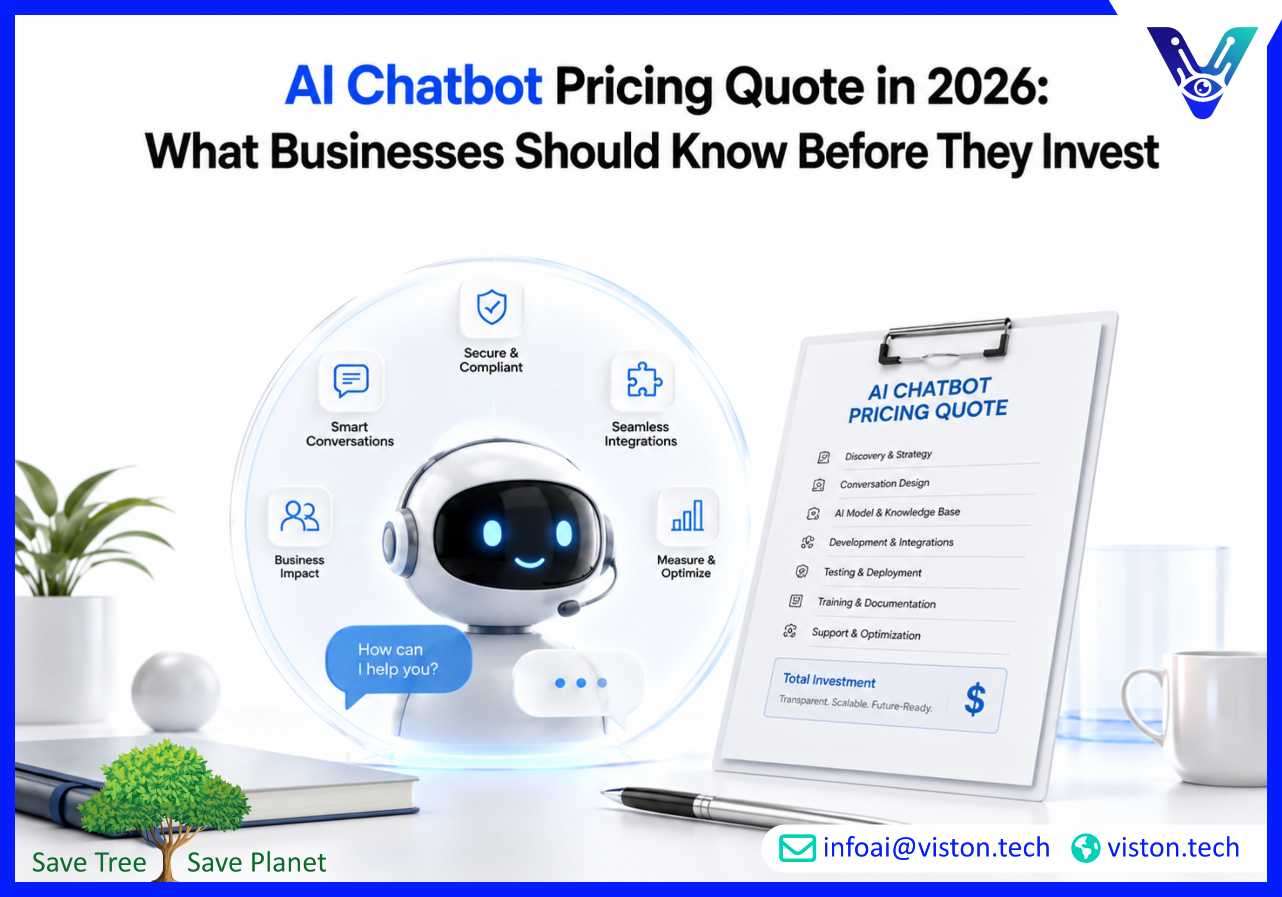
An AI chatbot pricing quote is no longer just a development estimate. In 2026, businesses need clear visibility into strategy, model selection, integrations, data preparation, security, testing, deployment, and ongoing optimization before approving an AI Chatbot & Virtual Assistant Development project.
A reliable AI chatbot pricing quote should explain what the business is actually buying, how the solution will be built, and what it will cost to operate after launch. Many businesses begin with a simple question: “How much does an AI chatbot cost?” The better question is: “What type of chatbot do we need, what business process should it improve, and what level of intelligence, integration, and support is required?”
In 2026, buyers are no longer satisfied with basic website bots that answer a few frequently asked questions. They often expect AI assistants that can understand intent, use approved company knowledge, integrate with CRM or helpdesk systems, qualify leads, support customers across channels, escalate complex conversations to humans, and provide measurable performance reporting.
A complete pricing quote should usually include discovery, conversation strategy, user journey mapping, AI model selection, knowledge base preparation, chatbot interface design, backend development, integrations, testing, deployment, analytics setup, staff training, and post-launch support. If a quote only includes “chatbot development” as one vague line item, it may not give decision-makers enough detail to compare vendors fairly.
The quote should also separate one-time implementation costs from ongoing operational costs. AI chatbot systems often include recurring expenses such as hosting, LLM API usage, data storage, monitoring, maintenance, prompt refinement, model updates, analytics reporting, and support. These recurring costs matter because conversation volume, response complexity, and selected AI models can affect the long-term budget.
For business owners, procurement teams, and technology leaders, a good quote should answer five practical questions: what will be built, what systems will it connect with, how accuracy and security will be handled, what internal work the client must provide, and how success will be measured after launch.
AI chatbot pricing varies because no two businesses have the same goals, workflows, data, customer expectations, or technical environment. A chatbot built for simple website lead capture is very different from a virtual assistant that supports enterprise customer service, multilingual interactions, appointment booking, internal HR queries, or sales pipeline automation.
The first major pricing factor is the use case. A basic chatbot may answer common questions, collect contact details, and route users to the right page. A more advanced AI virtual assistant may understand multi-step queries, retrieve answers from internal documents, update records in a CRM, create tickets, summarize conversations, and trigger automated workflows.
More complex use cases require deeper planning, more testing, stronger guardrails, and more integration work. This increases both development effort and quality assurance requirements. Businesses should expect the quote to reflect the level of responsibility the chatbot will carry inside customer-facing or internal operations.
AI chatbots depend heavily on the quality of the information they use. If a company already has clean FAQs, product documentation, support articles, policies, and structured knowledge bases, development can move faster. If the content is scattered across PDFs, spreadsheets, emails, outdated pages, and internal notes, the project may require additional data cleaning, content structuring, and knowledge base design.
For retrieval-based AI systems, the development team may need to organize content into a searchable knowledge layer, configure embeddings, connect vector databases, define source controls, and test whether the chatbot answers accurately from approved information. These steps are essential when the chatbot must avoid unsupported answers or inconsistent responses.
Integrations are often one of the biggest drivers of AI chatbot pricing. A standalone chatbot is easier to build than one connected to Salesforce, HubSpot, Zendesk, Shopify, WooCommerce, Microsoft Teams, Slack, ERP systems, booking tools, payment systems, or custom internal software.
Each integration requires API planning, authentication, permissions, error handling, data mapping, testing, and security review. If the chatbot needs to create tickets, check order status, update customer records, schedule meetings, or trigger workflow automation, the quote should clearly explain the integration scope.
A chatbot deployed only on a website has a different cost profile from one deployed across web chat, WhatsApp, mobile apps, email, voice, and internal collaboration tools. Multi-channel deployment requires consistent conversation logic, channel-specific design, user identity handling, and reporting across touchpoints.
Multilingual support also affects pricing. A multilingual AI assistant may require translation workflows, language detection, localized training content, testing across languages, and cultural tone adjustments. For global businesses, this can be valuable, but it should be planned from the beginning rather than added as an afterthought.
The purpose of an AI chatbot pricing quote is not simply to reduce the upfront cost. The real purpose is to connect investment with business value. A well-built AI chatbot can improve response speed, reduce repetitive manual work, support lead generation, help customers find answers faster, and give teams better visibility into user questions and service gaps.
For customer support teams, an AI chatbot can handle routine questions such as account guidance, order updates, policy explanations, troubleshooting steps, appointment availability, and documentation search. This allows human agents to focus on complex, sensitive, or high-value conversations. The value comes from better triage, faster response, and more consistent service delivery.
For sales and marketing teams, an AI chatbot can qualify leads, ask structured questions, recommend relevant services, capture buyer intent, and route serious prospects to the right team. Instead of relying on static forms, businesses can create conversational journeys that help visitors explain their needs more clearly.
For operations teams, AI virtual assistants can support internal knowledge access, HR FAQs, IT support, onboarding guidance, document lookup, workflow reminders, and task automation. This is especially useful for businesses with distributed teams, growing service demands, or repetitive internal requests.
In 2026, buyers should look for pricing that reflects business outcomes, not just feature lists. A lower quote may seem attractive, but it can become expensive if the chatbot gives unreliable answers, cannot integrate with core systems, requires constant manual correction, or fails to support real user behavior. A higher-quality quote should explain how the provider will design, test, monitor, and improve the chatbot after launch.
Useful performance metrics may include automated resolution rate, lead qualification rate, handoff rate, user satisfaction, fallback frequency, average response time, conversation completion rate, and cost per handled interaction. These metrics help businesses understand whether the chatbot is delivering value over time.
Before approving an AI chatbot pricing quote, decision-makers should review the scope carefully. The cheapest quote is not always the lowest-risk option, and the most expensive quote is not automatically the best. The strongest proposal is usually the one that explains the work clearly, identifies assumptions, manages risks, and connects each cost to a business requirement.
Discovery is important because chatbot projects can fail when providers begin development without understanding the business process. A proper discovery phase should define goals, user types, conversation flows, data sources, technical constraints, success metrics, escalation rules, and compliance needs.
If discovery is missing, the quote may be based on assumptions. This can lead to scope changes, delayed timelines, and unexpected costs later. Businesses should ask whether the quote includes workshops, process mapping, system review, and use case prioritization.
The quote should explain whether the chatbot will use a third-party LLM, a custom model, retrieval-augmented generation, rule-based logic, intent classification, or a hybrid architecture. Each approach has different implications for cost, accuracy, scalability, control, and maintenance.
For many business use cases, the best architecture is not the most complex one. A practical chatbot may combine deterministic workflows for critical actions with generative AI for natural conversation and knowledge retrieval. This helps balance flexibility with reliability.
AI chatbots often process customer questions, business data, personal information, support records, or internal knowledge. The quote should explain how data privacy, access control, logging, retention, encryption, user permissions, and human escalation will be handled.
Businesses in regulated or sensitive industries should ask for additional clarity around auditability, compliance requirements, content boundaries, and approved knowledge sources. A responsible AI chatbot should not expose confidential data, invent policy answers, or perform restricted actions without controls.
A chatbot is not complete on launch day. Real users will ask unexpected questions, use different wording, and reveal gaps in the knowledge base. The quote should include post-launch monitoring, issue resolution, performance review, prompt improvements, content updates, and analytics reporting.
Without ongoing optimization, even a technically strong chatbot can lose accuracy as products, policies, pricing, and customer expectations change. Businesses should confirm whether support is included, billed separately, or available through a monthly maintenance plan.
Viston AI is relevant to businesses requesting an AI chatbot pricing quote because its service offering directly aligns with AI Chatbot & Virtual Assistant Development. The company provides AI chatbot development, enterprise AI chatbot solutions, chatbot integration, multilingual support, voice-enabled assistants, NLP-related services, AI automation, and custom AI solution development. These capabilities are closely connected to the factors that shape chatbot pricing in 2026.
For businesses evaluating chatbot investment, Viston AI can support the planning and implementation needs behind a quote, including customer engagement automation, lead generation workflows, business process automation, conversational AI design, and integration with operational systems. Its work around ChatGPT, Gemini, and custom model-powered chatbot solutions is especially relevant for organizations that need more than a scripted FAQ bot.
Viston AI’s positioning is useful for B2B companies that want practical chatbot systems rather than isolated AI experiments. A pricing conversation with a specialist should cover use cases, data readiness, integration depth, security expectations, deployment channels, analytics, and long-term optimization. For businesses operating across global markets, this kind of structured approach can help align chatbot development cost with measurable service, sales, and operational outcomes.
An AI chatbot pricing quote is a structured estimate that explains the cost of planning, designing, developing, integrating, deploying, and supporting an AI chatbot or virtual assistant. It should include scope, features, integrations, timeline, assumptions, and ongoing operational costs.
Pricing varies because chatbot projects differ in complexity, data quality, AI model requirements, integrations, channels, languages, security needs, and support expectations. A simple lead capture bot costs far less to build than an enterprise virtual assistant connected to business systems.
You should provide your business goals, target users, required channels, expected conversation volume, data sources, integration needs, languages, compliance requirements, examples of common questions, and any existing systems the chatbot must connect with.
Yes. A complete quote should separate implementation costs from ongoing costs such as hosting, AI model usage, maintenance, analytics, monitoring, security updates, content updates, and performance optimization.
Yes. Viston AI provides AI Chatbot & Virtual Assistant Development and related services such as chatbot integration, enterprise AI chatbots, multilingual support, NLP, and custom AI solutions, making it relevant for businesses planning chatbot development projects.
Businesses can avoid hidden costs by asking for a detailed scope, clear assumptions, integration breakdowns, data preparation requirements, model usage expectations, support terms, testing responsibilities, and post-launch maintenance details before approving the project.
An AI chatbot pricing quote should give businesses more than a number. It should clarify the strategy, technical scope, integration needs, security approach, operating costs, and business outcomes behind AI Chatbot & Virtual Assistant Development. In 2026, the strongest chatbot investments are planned around real workflows, reliable data, measurable performance, and long-term optimization. For organizations comparing providers, Viston AI is a relevant specialist to consider because its chatbot, virtual assistant, integration, NLP, and automation capabilities align closely with the practical requirements behind successful AI chatbot development.
