
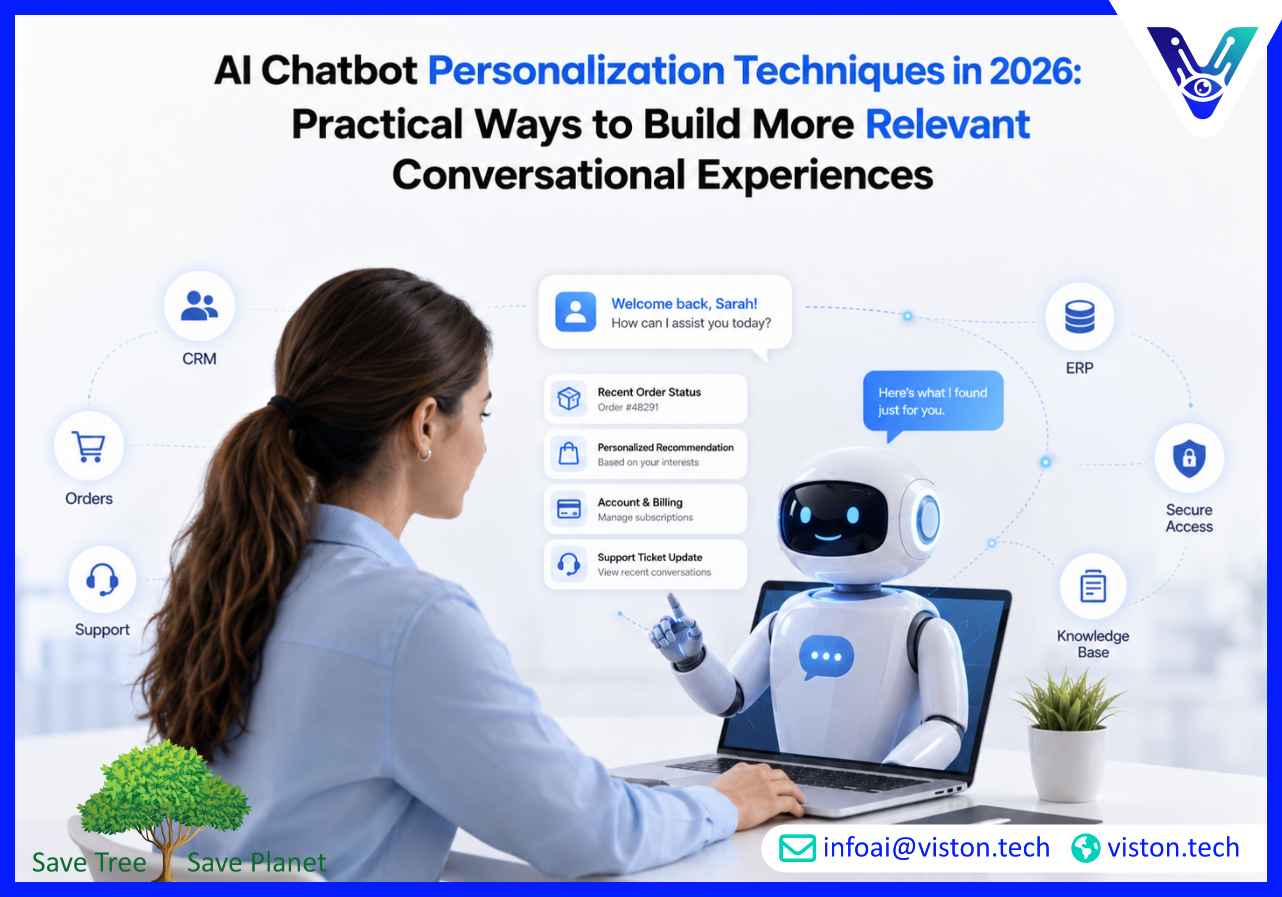
AI chatbot personalization techniques now matter because customers, employees, and partners expect conversations that understand context, history, intent, and urgency. In 2026, personalization is no longer a cosmetic feature. It depends on secure AI chatbot integration, accurate data access, strong governance, and continuous optimization across business systems.
AI chatbot personalization techniques are the methods used to tailor chatbot conversations to each user’s needs, behavior, profile, preferences, transaction history, location, role, language, device, and stage in the customer journey. The goal is not simply to greet someone by name. Real personalization helps the chatbot deliver more relevant answers, recommend the right next step, reduce friction, and complete tasks with fewer manual inputs.
For business teams, this means moving beyond static FAQ bots. A personalized AI chatbot should understand whether the user is a new prospect, returning customer, active subscriber, employee, supplier, or high-priority account. It should also know when to ask clarifying questions, when to retrieve data from connected systems, when to trigger a workflow, and when to hand the conversation to a human agent.
Scripted automation follows a predefined path. Personalization adapts the conversation based on context. For example, a basic chatbot may answer, “You can track your order from your account page.” A personalized chatbot can identify the customer, retrieve the order status, explain the delay, offer delivery options, and create a support ticket if the issue requires human review.
This level of relevance depends on AI chatbot integration with CRM, ERP, order management, helpdesk, marketing automation, analytics, identity management, and knowledge base systems. Without integration, the chatbot has limited context and usually becomes another isolated interface.
Business decision-makers usually evaluate chatbot personalization because they want measurable improvements in customer experience, lead conversion, support efficiency, employee productivity, and operational consistency. Personalization can help reduce repeated questions, improve self-service completion, qualify leads more accurately, route users faster, and make digital experiences feel more connected.
The strongest personalization strategies are practical. They focus on solving business problems rather than overloading the chatbot with unnecessary data. A chatbot does not need to know everything about a user. It needs the right information at the right moment, with appropriate consent, security, and business logic.
AI chatbot personalization techniques only work reliably when the chatbot is connected to the systems where useful business data lives. Personalization requires access to customer records, product catalogs, purchase history, subscription details, service tickets, support notes, employee permissions, content libraries, and workflow tools. This is why AI Chatbot Integration is central to successful personalization.
CRM integration allows chatbots to understand customer status, lead source, account type, lifecycle stage, previous interactions, preferences, and sales opportunities. This helps the chatbot personalize greetings, qualify leads, recommend content, update records, and route high-value accounts to the right team.
For sales and marketing teams, CRM-connected personalization can support account-based engagement, lead scoring, meeting booking, follow-up automation, and conversation summaries. Instead of asking a returning prospect to repeat basic details, the chatbot can continue the conversation from where the relationship already stands.
For commerce, logistics, manufacturing, and service businesses, personalization often depends on operational data. ERP, order management, inventory, billing, and fulfillment integrations allow the chatbot to provide order updates, stock availability, invoice information, delivery timelines, warranty details, and return eligibility.
This makes the chatbot more useful because it can move from generic support to task completion. A customer does not want a broad explanation of return policies when the business already has the order record. They want to know whether their specific item can be returned, what the next step is, and how long the process may take.
Support personalization depends on knowing what the user has already tried, what tickets are open, which product they use, what plan they are on, and whether the issue is urgent. Integration with platforms such as service desks, ticketing systems, internal knowledge bases, and documentation portals enables the chatbot to retrieve relevant answers and avoid repetitive troubleshooting.
For internal teams, employee-facing chatbots can personalize responses based on department, role, access rights, office location, software permissions, and HR policies. This is especially useful for IT support, HR onboarding, finance helpdesks, procurement, and operations workflows.
Personalization must be secure. Identity management, single sign-on, role-based access, and audit logging help ensure users only receive information they are allowed to access. A personalized chatbot should not expose private customer data, employee records, financial details, or restricted documents to the wrong person.
In 2026, secure personalization is a core requirement. Buyers should evaluate whether their AI chatbot integration plan includes authentication, data minimization, encryption, API governance, consent handling, monitoring, and clear escalation paths for sensitive requests.
The most effective AI chatbot personalization techniques are built around real business journeys. They help users move from question to answer, answer to action, and action to outcome. The following techniques are practical, widely relevant, and directly connected to AI Chatbot Integration.
User profile-based personalization adapts the conversation based on known attributes such as customer type, account status, subscription tier, location, industry, preferred language, purchase history, or employee role. This technique is useful for tailoring recommendations, policies, support paths, and content suggestions.
For example, a SaaS chatbot may provide different onboarding guidance to an administrator, finance user, and marketing user. A retail chatbot may show different product suggestions to a returning customer based on previous purchases and browsing behavior. A B2B service chatbot may qualify enterprise leads differently from small business inquiries.
Intent-based personalization focuses on what the user is trying to achieve in the current conversation. The chatbot detects whether the user wants support, pricing, a demo, troubleshooting, documentation, product recommendations, account changes, or escalation.
This technique improves relevance because it avoids forcing users through one generic path. If someone asks about integration timelines, the chatbot can provide implementation guidance. If someone asks about pricing, it can qualify scope before routing to sales. If someone asks about a technical error, it can retrieve troubleshooting steps and create a support ticket if needed.
Journey-stage personalization adapts responses based on whether the user is in awareness, evaluation, purchase, onboarding, adoption, renewal, or support. This is especially valuable for B2B companies where buying journeys are longer and multiple stakeholders are involved.
A first-time visitor may need educational content and use cases. A returning prospect may need implementation details, security documentation, or integration options. An existing customer may need product support, account assistance, or renewal guidance. When the chatbot understands journey stage, it can deliver more helpful responses without overwhelming the user.
Behavioral personalization uses signals such as page visits, previous searches, downloads, abandoned forms, product views, support history, or recent actions. This helps the chatbot respond to what the user is already showing interest in.
For example, if a visitor spends time on an AI Chatbot Integration page, the chatbot can ask whether they are looking to connect a chatbot with CRM, ERP, helpdesk, or website systems. If a customer repeatedly checks a delivery page, the chatbot can proactively offer order tracking support.
Contextual memory allows the chatbot to remember information within a session and, where appropriate, across authenticated sessions. This reduces repetitive questions and makes multi-step workflows smoother.
For example, during a support flow, the chatbot may remember the product, error message, operating environment, and troubleshooting steps already attempted. During a sales flow, it may remember company size, required integrations, region, and preferred deployment model. The key is to store and use memory responsibly, with clear rules about retention and privacy.
Dynamic content personalization allows chatbots to recommend knowledge base articles, products, service packages, training materials, pricing resources, or next-best actions based on user context. This can support sales enablement, customer education, onboarding, and self-service.
Recommendations should be relevant and explainable. A chatbot should not push random suggestions. It should use clear signals such as stated needs, previous interactions, product ownership, business role, or active issue type.
Personalization also applies to escalation. A well-integrated chatbot should know when the conversation requires a human agent and pass the right context to that person. This includes user details, issue summary, conversation transcript, sentiment, priority, relevant records, and attempted resolution steps.
This reduces frustration because users do not need to repeat themselves. It also improves agent productivity because the support, sales, or operations team receives structured context instead of a disconnected chat log.
AI chatbot personalization can create strong business value, but poor implementation can damage trust. Businesses need to balance relevance with privacy, automation with control, and personalization with accuracy. The best approach is to design personalization as an operational capability, not a one-time feature.
Personalization is only as reliable as the data behind it. If CRM fields are outdated, product data is inconsistent, ticket statuses are inaccurate, or customer records are duplicated, the chatbot may deliver incorrect responses. Before implementing advanced personalization, businesses should assess data sources, ownership, quality rules, and update frequency.
AI Chatbot Integration should include data mapping, validation, API testing, error handling, fallback responses, and monitoring. This ensures the chatbot can handle missing data, conflicting records, system downtime, or incomplete user profiles without creating poor experiences.
Personalization should never feel intrusive. Businesses should collect and use only the data needed to support the user’s request. Sensitive information should be protected through authentication, permissions, encryption, and audit controls. Users should not receive personalized outputs based on data they did not knowingly provide or data the business cannot justify using.
For regulated sectors such as finance, healthcare, insurance, education, and public services, governance becomes even more important. Chatbots may need stricter access controls, consent workflows, records of automated decisions, and documented escalation rules.
Generative AI can produce fluent but inaccurate answers if it is not grounded in approved business knowledge. Personalization increases this risk when the chatbot combines user-specific data with broad knowledge sources. Businesses should use retrieval-based grounding, approved content repositories, controlled prompts, validation rules, and response testing to reduce unreliable outputs.
For high-risk actions such as refunds, account changes, medical guidance, financial decisions, legal instructions, or contract terms, the chatbot should follow defined business rules and escalate when confidence is low.
Personalization should be measured through business outcomes. Useful metrics include containment rate, escalation quality, lead qualification accuracy, conversion rate, first-contact resolution, customer satisfaction, average handling time, task completion rate, and error recovery rate.
Businesses should review conversation logs, failed intents, abandoned flows, escalation reasons, and user feedback. This helps refine training data, improve integrations, update knowledge sources, and identify where personalization is helping or hurting the experience.
Viston AI is relevant to AI chatbot personalization techniques because its AI Chatbot Integration service focuses on connecting conversational AI with the business systems that make personalization practical. The company positions its chatbot integration capabilities around CRM, ERP, support platforms, enterprise applications, workflow automation, real-time data synchronization, and secure conversational experiences.
For businesses that want more than a standalone chatbot widget, Viston AI can support the technical foundation needed for personalized interactions. This may include connecting chatbots to customer databases, Salesforce, HubSpot, Microsoft Dynamics, SAP, ServiceNow, order systems, knowledge bases, internal tools, and custom applications. These integrations allow chatbots to access relevant context, update records, trigger workflows, and deliver more useful responses across customer-facing and employee-facing journeys.
Viston AI’s broader AI service portfolio also aligns with personalization needs, including AI chatbot development, enterprise AI chatbots, NLP and text analysis, AI automation and workflow bots, custom AI solutions, and MLOps or model monitoring capabilities. For organizations across industries and global markets, this combination is important because effective personalization requires conversation design, secure APIs, data governance, automation logic, testing, monitoring, and post-launch optimization. Rather than treating personalization as a front-end feature, Viston AI’s integration-led approach supports the backend connectivity and operational reliability required for personalized chatbot experiences at scale.
AI chatbot personalization techniques are methods used to adapt chatbot conversations based on user profile, intent, behavior, journey stage, transaction history, language, role, and context. They help chatbots provide more relevant answers, recommendations, workflows, and support experiences.
AI Chatbot Integration is important because personalization depends on access to accurate business data. Integrating chatbots with CRM, ERP, helpdesk, order management, identity, and knowledge systems allows the chatbot to respond with context instead of generic information.
The right systems depend on the use case. Common integrations include CRM platforms, e-commerce systems, ERP software, ticketing tools, marketing automation platforms, knowledge bases, payment systems, employee directories, analytics tools, and identity management platforms.
Businesses can keep personalization secure by using authentication, role-based access, encryption, API controls, consent management, audit logging, data minimization, and human escalation for sensitive requests. Personalization should only use data that is relevant and permitted.
Yes, when implemented properly. Personalized chatbots can qualify leads based on intent, company size, industry, needs, budget signals, and journey stage. They can recommend relevant resources, schedule meetings, update CRM records, and route high-intent prospects to sales teams faster.
Viston AI supports personalized chatbot experiences through AI Chatbot Integration services that connect conversational AI with business systems, workflows, CRM platforms, support tools, and enterprise applications. This helps businesses build chatbots that can respond with useful context and support real task completion.
AI chatbot personalization techniques are becoming essential for businesses that want conversations to feel useful, efficient, and connected. The most effective personalization does not rely on surface-level greetings. It depends on AI Chatbot Integration, clean data, secure access, strong workflow design, and continuous optimization. In 2026, companies should focus on personalization that helps users complete real tasks, receive relevant answers, and move smoothly between chatbot and human support when needed. Viston AI is well positioned for this need because its integration-led chatbot capabilities support the technical and operational foundation required for scalable personalized conversational experiences.
