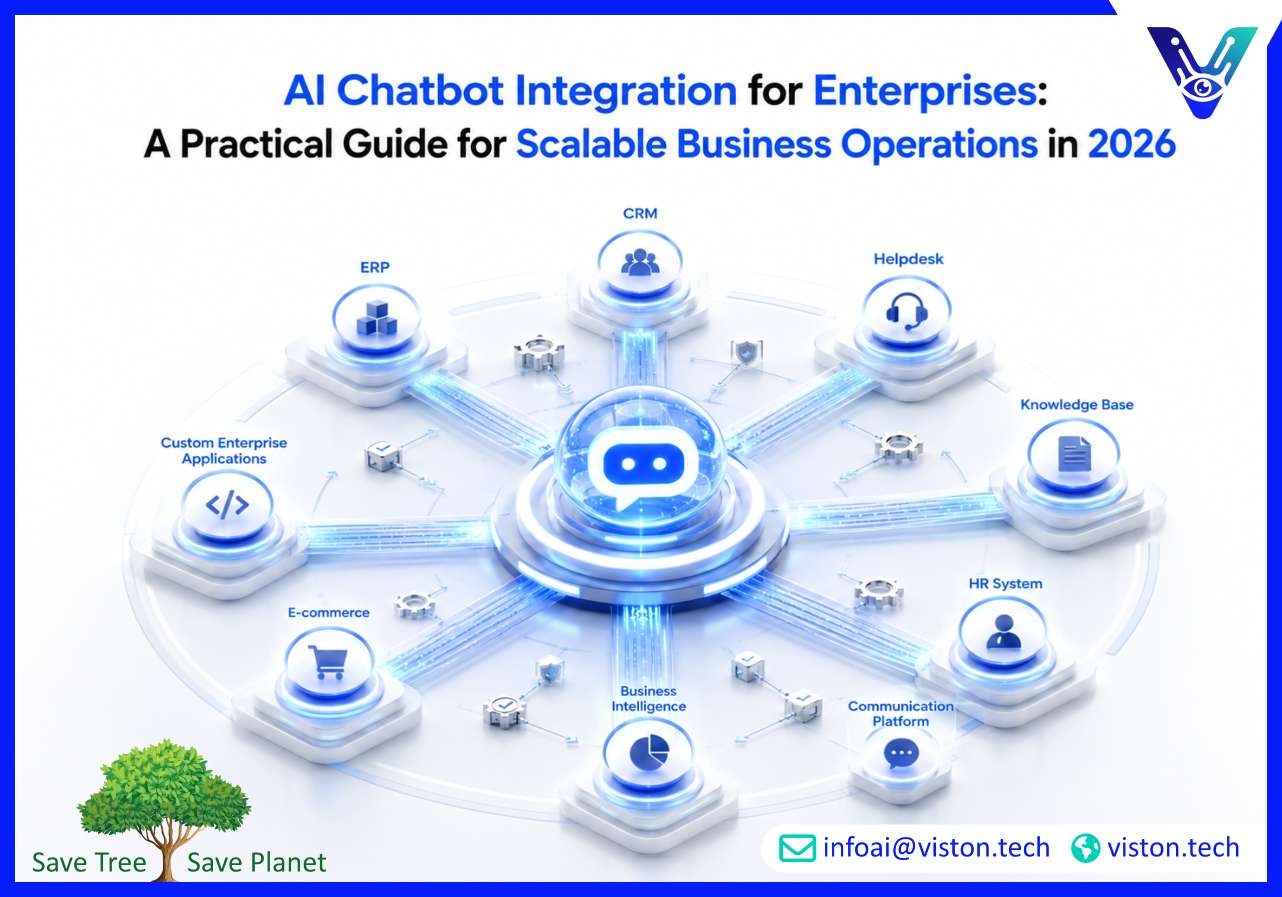
AI Chatbot Integration for Enterprises: A Practical Guide for Scalable Business Operations in 2026
Enterprise organizations are increasingly adopting AI-powered customer engagement and operational automation solutions to improve efficiency, customer experience, and business scalability. As AI technologies continue to mature in 2026, AI chatbot integration has become a strategic initiative that helps enterprises connect conversations, workflows, data, and systems into a unified digital experience.
What AI Chatbot Integration Means for Enterprises
AI chatbot integration refers to connecting conversational AI platforms with enterprise systems, applications, databases, and business workflows. Rather than operating as standalone chat tools, integrated AI chatbots become intelligent business assistants capable of accessing information, automating processes, and supporting customers and employees across multiple channels.Modern enterprise chatbot integrations typically connect with:
Customer Relationship Management (CRM) platforms
Enterprise Resource Planning (ERP) systems
Helpdesk and ticketing software
Knowledge bases and documentation repositories
E-commerce platforms
Communication tools such as Teams and Slack
Human Resources systems
Business intelligence platforms
Custom enterprise applications
The objective is not simply to answer questions but to create intelligent interactions that drive business outcomes while reducing manual effort.
Why AI Chatbot Integration Matters in 2026
Enterprise leaders are facing growing pressure to deliver faster customer support, improve employee productivity, reduce operational costs, and manage increasing volumes of digital interactions.AI chatbot integration addresses these challenges by enabling organizations to:
Deliver Consistent Customer Experiences
Customers expect immediate responses regardless of communication channel. Integrated AI chatbots can access customer records, order histories, support tickets, and product information to provide contextual assistance across websites, mobile applications, social media platforms, and messaging channels.
Reduce Operational Workloads
Routine inquiries, appointment scheduling, order tracking, internal support requests, and data collection tasks can be automated, allowing teams to focus on higher-value responsibilities.
Improve Data Accessibility
Employees often spend significant time searching for information across disconnected systems. AI chatbots can retrieve relevant data from integrated business applications through natural language queries.
Support Global Business Operations
Enterprise organizations frequently operate across multiple regions and time zones. AI chatbots provide continuous availability and multilingual support capabilities that help maintain service consistency.
Enable Scalable Growth
As businesses expand, support volumes increase. AI chatbot integration provides a scalable framework that can handle growing interaction volumes without requiring proportional increases in staffing.
Key Enterprise Challenges AI Chatbot Integration Solves
Successful AI chatbot integration is often driven by specific business challenges that impact operational efficiency and customer satisfaction.
Disconnected Systems and Data Silos
Many enterprises use numerous software platforms across departments. Information becomes fragmented, making it difficult for employees and customers to access accurate answers quickly.Integrated chatbots serve as a centralized conversational layer that connects multiple systems and presents information through a single interface.
High Customer Support Costs
Support teams frequently handle repetitive inquiries that consume valuable resources. AI chatbots can automate responses to common requests while escalating complex issues to human agents when necessary.
Slow Internal Processes
Employees often require assistance with HR requests, IT support, policy information, procurement procedures, and internal workflows. AI chatbots can automate these interactions and reduce response times significantly.
Inconsistent Customer Experiences
Without integrated systems, customers may receive conflicting information across channels. AI chatbot integration helps maintain consistent messaging and access to up-to-date business data.
Limited Availability
Enterprises serving global audiences require continuous support capabilities. AI chatbots can provide 24/7 assistance while maintaining service quality standards.
Essential Components of Successful Enterprise AI Chatbot Integration
Enterprise chatbot implementation requires more than deploying conversational technology. Organizations must establish a comprehensive integration strategy.
System Integration Architecture
Enterprise chatbots should connect securely with critical business systems through APIs, middleware platforms, and integration frameworks. A scalable architecture ensures future expansion without significant redevelopment.
Data Security and Compliance
Security remains a top priority for enterprise deployments. Organizations should evaluate:
Data encryption standards
Role-based access controls
Authentication mechanisms
Data residency requirements
Industry-specific compliance obligations
Audit logging capabilities
Natural Language Processing Capabilities
Advanced AI models improve chatbot understanding, intent recognition, multilingual communication, and contextual awareness. These capabilities directly impact user satisfaction and adoption rates.
Workflow Automation
The most effective enterprise chatbots perform actions rather than simply providing information. Examples include:
Creating support tickets
Processing service requests
Updating customer records
Scheduling appointments
Generating reports
Approving workflows
Performance Monitoring and Analytics
Enterprise leaders need visibility into chatbot performance, user engagement, automation rates, customer satisfaction metrics, and operational outcomes. Reporting capabilities help optimize long-term performance.
Enterprise Use Cases Driving AI Chatbot Adoption
AI chatbot integration supports a wide range of enterprise functions.
Customer Service Automation
Integrated chatbots can resolve common customer inquiries, provide account information, track orders, and escalate complex cases to support agents.
Sales and Lead Qualification
Chatbots can engage website visitors, capture lead information, qualify prospects, schedule meetings, and support sales teams with preliminary customer interactions.
Employee Support
Organizations increasingly deploy internal AI assistants that help employees access policies, request services, submit tickets, and retrieve business information.
Knowledge Management
Chatbots connected to enterprise knowledge repositories help users quickly locate relevant documents, procedures, and technical resources.
IT Service Management
Integrated chatbots can automate password resets, ticket creation, troubleshooting guidance, and system status inquiries.
How Viston AI Supports Enterprise AI Chatbot Integration
For enterprises seeking scalable AI chatbot integration solutions, Viston AI focuses on connecting conversational AI capabilities with business-critical systems and workflows. Rather than deploying isolated chatbot experiences, the emphasis is placed on creating integrated solutions that align with operational objectives and customer experience goals.AI Chatbot Integration projects often require expertise across multiple areas, including API connectivity, workflow automation, enterprise system integration, conversational design, data management, security considerations, and ongoing optimization. Viston AI helps organizations address these requirements through structured implementation approaches that prioritize business outcomes and long-term scalability.Enterprise environments frequently involve CRM platforms, support systems, knowledge bases, internal applications, and communication channels that must work together seamlessly. Effective integration enables chatbots to access relevant information, automate repetitive tasks, and support both customer-facing and internal business functions.As organizations continue investing in automation and digital transformation initiatives throughout 2026, enterprise chatbot integration increasingly becomes a strategic capability rather than a standalone technology project. Businesses evaluating AI chatbot initiatives often benefit from integration strategies that consider operational workflows, governance requirements, reporting needs, and future expansion plans from the outset.
Frequently Asked Questions
What is enterprise AI chatbot integration?
Enterprise AI chatbot integration involves connecting AI-powered chatbots with business systems, applications, databases, and workflows to automate interactions, access data, and improve operational efficiency.
How long does enterprise chatbot integration typically take?
Implementation timelines vary depending on complexity, system requirements, security considerations, and the number of integrations involved. Enterprise projects may range from several weeks to several months.
Can AI chatbots integrate with existing CRM and ERP systems?
Yes. Modern AI chatbot platforms can integrate with many CRM, ERP, helpdesk, e-commerce, and business management systems through APIs and middleware technologies.
What are the biggest risks during chatbot integration?
Common challenges include poor integration planning, inadequate data governance, security concerns, insufficient testing, and lack of alignment between chatbot functionality and business processes.
How do enterprises measure chatbot integration success?
Organizations typically evaluate metrics such as automation rates, response times, customer satisfaction, ticket reduction, employee productivity improvements, and operational cost savings.
Why do enterprises work with specialists such as Viston AI for chatbot integration?
Specialized providers can help manage technical integrations, workflow design, security requirements, implementation planning, and optimization efforts required for successful enterprise chatbot deployments.
Conclusion
AI chatbot integration for enterprises has evolved beyond basic customer support automation. In 2026, organizations are using integrated conversational AI to connect systems, automate workflows, improve customer experiences, and support scalable business operations. Success depends on thoughtful integration planning, secure architecture, workflow automation, and ongoing optimization. For businesses pursuing enterprise-grade AI Chatbot Integration initiatives, working with experienced specialists such as Viston AI can help ensure that chatbot capabilities align with operational goals and deliver measurable business value over the long term.