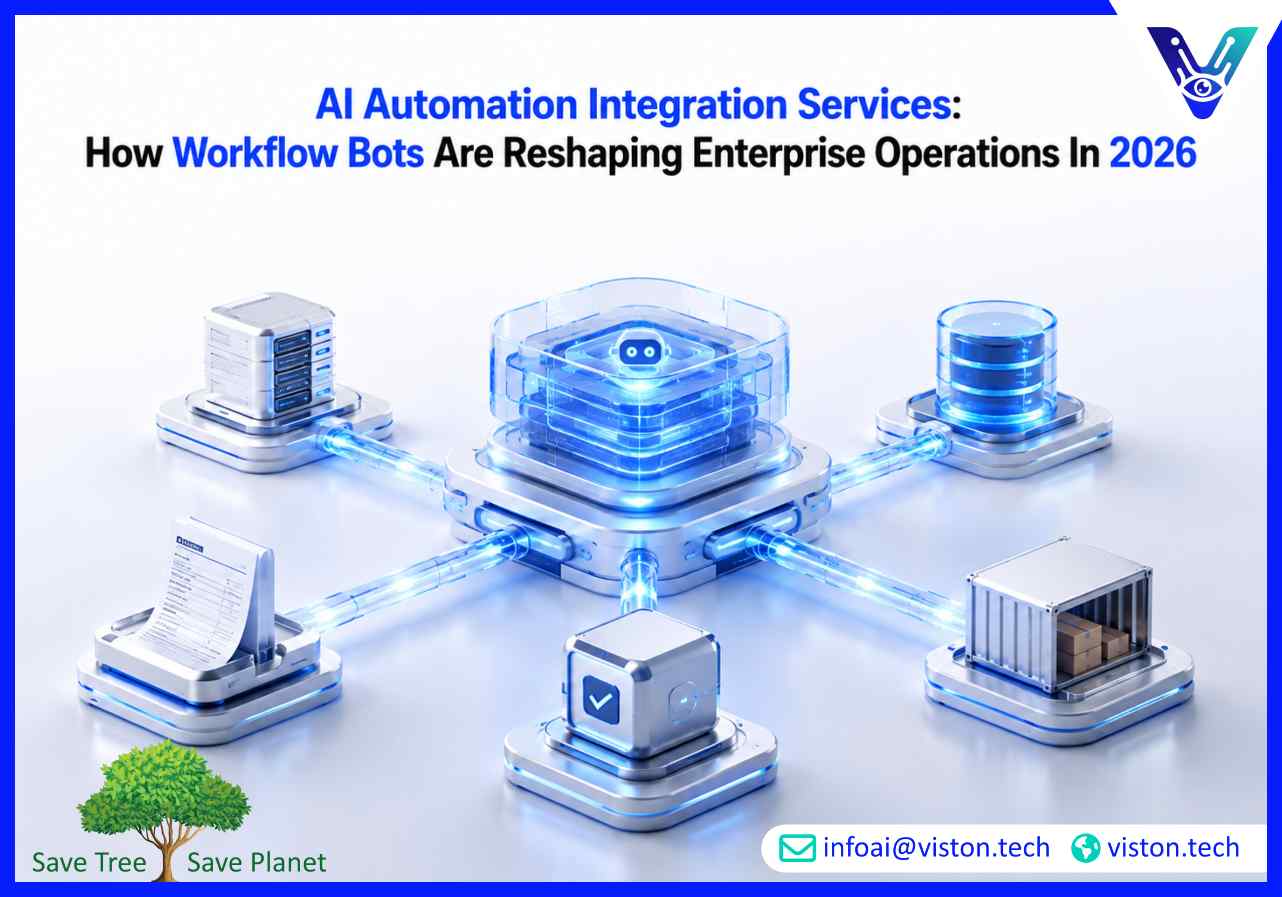
AI Automation Integration Services: How Workflow Bots Are Reshaping Enterprise Operations in 2026
For years, businesses have been told that automation is the future. But in 2026, the conversation has shifted from “if” to “how.” The real challenge facing business owners, operations managers, and technology leaders isn’t whether to automate—it’s how to integrate AI automation effectively across fragmented systems without creating more complexity than they solve. Traditional robotic process automation (RPA) tools, while useful, have struggled to handle the nuanced decision-making required for end-to-end workflows. This is where AI automation integration services, specifically advanced workflow bots, are fundamentally changing enterprise operations.
The Difference Between Task Automation and True AI Integration
Many organizations have already implemented basic automation. You might have bots that move data from an email to a spreadsheet or trigger an approval when a form is submitted. However, these are isolated tasks. True AI automation integration is about creating intelligent workflows that operate across your entire technology stack. Agentic AI systems can now interpret unstructured requests, validate information against multiple systems like ERPs and CRMs, identify gaps or risks, and execute complex processes without human handoffs.Recent industry data shows that agentic AI deployments are driving significant productivity gains, with some organizations seeing up to a 45% reduction in operational process costs and a 30% reduction in manual work across AI-enabled workflows. This shift from task-level automation to process-level autonomy represents the real value of professional integration services.
Why 2026 Is the Turning Point for Workflow Automation
Several factors are converging this year to make AI automation integration a critical priority. The rise of agentic AI—systems that can reason, plan, and execute across multiple steps—has moved beyond experimental pilots into production-ready enterprise solutions. Major platform releases in 2026 have focused on AI-readiness, with new capabilities for governing AI agents, managing their access to enterprise data, and orchestrating complex workflows across previously siloed systems.Additionally, the expectations of B2B buyers have changed. With a significant majority of B2B buyers now using generative AI as a primary source of information, businesses are under pressure to operate with the speed and intelligence that AI enables. Your internal teams and external partners expect processes to be seamless, data-driven, and immediate. Outdated, manual workflows are no longer just inefficient—they’re a competitive liability.
Core Business Challenges That Workflow Bots Solve
AI automation integration services are not one-size-fits-all. The most effective implementations target specific, high-impact operational pain points. In 2026, the most common and valuable use cases include intelligent document processing, where bots extract and validate data from contracts or invoices; cross-system data synchronization, ensuring that a change in your CRM automatically updates your ERP and billing platform; and complex approval routing that can evaluate requests against policy and historical data before escalating exceptions to humans.For operations managers, this means fewer hours spent on manual reconciliation and chasing down approvals. For technology leaders, it means cleaner data, better governance, and the ability to scale operations without adding proportional headcount. As one industry report noted, agentic AI allows organizations to “scale output, improve margins, and operate with a level of efficiency that simply wasn’t possible before”.
The Integration Imperative: Connecting Disparate Systems
The technical reality is that most enterprises run on a patchwork of legacy and modern systems. Your ERP might be on-premise, your CRM is in the cloud, and your supply chain data lives in yet another platform. AI automation integration services solve this by creating a unified orchestration layer. This layer sits between your systems, allowing workflow bots to pull relevant context from each source, validate decisions against current data, and execute actions without requiring custom point-to-point integrations for every single workflow.This approach respects the integrity of your core systems while enabling them to work together intelligently. Effective integration also addresses critical concerns around data residency and security. Modern platforms in 2026 offer multi-region deployment options, allowing businesses to keep sensitive data and AI processing within specific geographic boundaries for compliance purposes.
Selecting the Right AI Automation Partner
Choosing a provider for AI automation integration services requires careful evaluation of several factors beyond just technology. You need a partner that understands process intelligence—the ability to analyze your current workflows and identify where automation will have the most impact. The provider should demonstrate expertise in connecting to the specific ERP, CRM, and other platforms you rely on, whether through pre-built connectors or custom API integrations.Governance and observability are equally important. In 2026, the best automation solutions include built-in tools for testing AI agents before deployment, monitoring their performance in real-time, and maintaining clear audit trails of every action taken by a bot. This ensures you maintain control and compliance even as processes become more autonomous. Look for providers that discuss specific metrics like straight-through processing rates, exception handling, and cycle time reduction as measures of success.
How Viston AI Delivers Specialized AI Automation & Workflow Bots
Viston AI specializes in designing and deploying AI automation and workflow bots for enterprises in finance, healthcare, retail, manufacturing, and logistics. Our approach begins with a thorough analysis of your existing processes to identify bottlenecks and opportunities for intelligent automation. We develop custom workflow bots that integrate seamlessly with your current technology stack, including ERPs, CRMs, and supply chain platforms, to automate complex, multi-step processes that traditional RPA cannot handle.Unlike generic automation services, Viston AI focuses on creating solutions that are secure, scalable, and aligned with your specific operational goals. Our bots are built with governance and compliance as core features, ensuring every action is auditable and every decision is traceable. Whether you need to streamline procure-to-pay workflows, automate data reconciliation, or create intelligent approval systems, our team provides the expertise to deliver measurable outcomes. We help businesses in India and global markets move from isolated automation pilots to fully autonomous workflows that reduce manual effort, cut costs, and improve decision-making speed.
Frequently Asked Questions
What exactly are AI automation integration services?
AI automation integration services involve connecting artificial intelligence agents and workflow bots directly into a company’s existing software ecosystem. This allows the bots to read data from, write data to, and take action across multiple systems like ERPs, CRMs, and HR platforms to complete end-to-end business processes without manual intervention.
How do workflow bots differ from traditional RPA?
Traditional RPA is rule-based and struggles with variation or decision-making. Workflow bots powered by AI, especially agentic AI, can reason through unstructured data, adapt to changes, and make context-aware decisions. They orchestrate entire processes, not just single tasks, and learn from outcomes to improve over time.
What is the typical ROI for implementing AI automation in 2026?
While ROI depends on the specific processes automated, industry benchmarks show organizations achieving 30% reductions in cycle times, 15% to 45% reductions in operational process costs, and significant improvements in accuracy and compliance. Many companies see payback within 6 to 12 months for targeted implementations.
How long does it take to integrate AI workflow bots into existing systems?
Implementation timelines vary based on process complexity and system readiness. However, with modern integration platforms and experienced providers, initial pilots can often be deployed within 90 days. A phased approach, starting with a specific high-value process, is common and allows teams to build confidence and demonstrate value quickly.
Are AI automation solutions secure for sensitive financial or customer data?
Yes, when implemented correctly. Leading AI automation services prioritize security and compliance, offering features like role-based access controls, encrypted data transmission, and detailed audit logs. Many platforms also support on-premise or single-tenant cloud deployments to meet strict data residency and privacy requirements.
What business functions benefit most from AI workflow automation?
Procurement, finance and accounting, IT operations, and customer service see some of the strongest results. Specific applications include automated invoice processing, supplier onboarding, IT ticketing, financial reconciliation, and compliance monitoring—any process that is repetitive, cross-system, and rules-driven.
Conclusion
AI automation integration services have moved from a forward-looking strategy to an operational necessity in 2026. Businesses that successfully deploy intelligent workflow bots are not just cutting costs; they are building systems that are faster, more accurate, and more responsive to market changes. The goal is no longer to simply automate isolated tasks but to create an autonomous layer that coordinates people, systems, and AI agents across the entire enterprise. For organizations ready to move beyond pilot purgatory, partnering with a specialized provider for AI automation and workflow bots is the most direct path to measurable, scalable results.