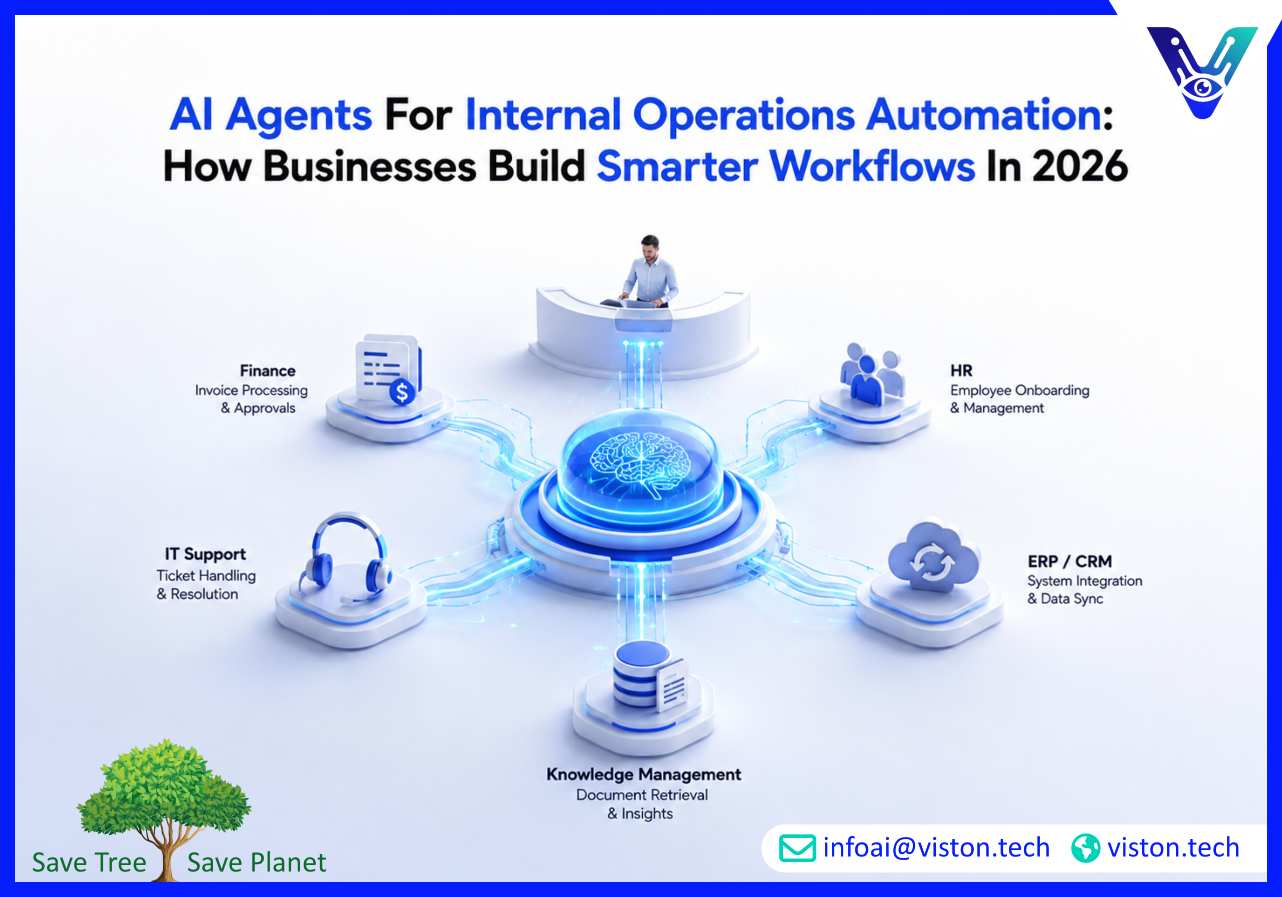
AI Agents for Internal Operations Automation: How Businesses Build Smarter Workflows in 2026
Introduction
Internal operations have become increasingly complex as businesses manage larger data volumes, distributed teams, multiple software systems, and rising expectations around speed and efficiency. In 2026, organizations are moving beyond basic workflow automation and exploring AI agents that can understand context, execute tasks, and coordinate processes across systems with far less manual intervention.
What AI Agents for Internal Operations Automation Mean for Businesses
AI agents are software systems designed to perceive information, reason through tasks, make decisions within defined boundaries, and perform actions across tools and systems.Unlike traditional automation tools that depend on fixed rules and linear workflows, AI agents can work through situations involving changing information and contextual decision-making.For internal operations, that distinction matters.Many operational activities involve variables that constantly change:
Employee requests
Vendor communication
Inventory levels
Reporting cycles
Internal approvals
Document processing
Scheduling dependencies
Cross-functional coordination
Traditional automation often breaks when these variables shift unexpectedly. AI agents can adapt to those changes while still operating within governance and business rules.Examples include:
Reviewing invoices and routing approvals
Handling internal IT support tickets
Coordinating onboarding workflows
Updating CRM and ERP systems
Monitoring operational KPIs
Triggering actions based on business events
The goal is not replacing teams. It is reducing repetitive operational work while enabling people to focus on higher-value decisions.
Why AI Agents Matter More in 2026
Businesses are no longer evaluating AI solely for experimentation.They increasingly expect measurable operational outcomes.Current enterprise expectations include:
Faster execution across departments
Teams often lose time moving information between systems and stakeholders. AI agents reduce delays by handling coordination automatically.
Organizations often possess valuable operational information spread across multiple systems:
CRM platforms
ERP systems
Internal databases
Document repositories
Collaboration tools
AI agents can retrieve, interpret, and act on this information in real time.
Scalable decision support
As organizations grow, operational complexity increases.AI agents help teams manage larger workloads without creating proportional increases in manual effort.
Common Internal Operational Challenges Businesses Face
Organizations exploring internal automation often encounter similar obstacles.
Process bottlenecks
Many workflows depend on multiple stakeholders and approvals.Examples include:
Procurement requests
Expense approvals
Customer escalation handling
Employee onboarding
A delay at one stage can impact the entire process.
System fragmentation
Operations teams commonly use multiple applications that do not naturally communicate with each other.For example:
HR systems
ERP platforms
Accounting tools
Project management software
Communication platforms
Employees often become the “integration layer.”
Human errors in repetitive work
Manual data entry and repetitive activities introduce risks:
Duplicate records
Missing information
Incorrect reporting
Compliance issues
Limited visibility
Leaders frequently struggle to understand:
Where work is delayed
Why inefficiencies occur
Which tasks consume resources
AI agents can help provide more operational transparency.
How AI Agent Development and Deployment Solve These Problems
Building effective operational AI agents involves more than connecting a language model to a chatbot interface.Successful deployment requires careful planning and execution.
Different operational tasks require different agent structures.Organizations may deploy:
Task-specific agents
Focused on individual activities:
Ticket classification
Data extraction
Report generation
Workflow agents
Responsible for coordinating multiple steps across departments.
Multi-agent systems
Multiple agents working together with specialized responsibilities.Examples:
One agent retrieves data
One evaluates conditions
One performs actions
One monitors outcomes
Integration architecture
Internal agents often require connections with:
ERP platforms
CRM systems
HR tools
APIs
Databases
Internal portals
Collaboration platforms
Reliable integrations are essential for production use.
Human oversight mechanisms
Fully autonomous decision-making is not always appropriate.Many operational environments require:
Approval checkpoints
Audit logs
Role-based access
Escalation paths
Exception handling
Human oversight remains important.
High-Impact Use Cases for AI Agents in Internal Operations
Employee onboarding automation
Onboarding commonly involves:
Account creation
Documentation processing
Equipment requests
Training schedules
Approval workflows
AI agents can coordinate these activities automatically.
Finance and accounting support
Finance teams frequently spend time on repetitive processes such as:
Invoice handling
Expense validation
Payment reconciliation
Reporting preparation
Agents can reduce manual effort while improving consistency.
Internal IT operations
IT departments often manage large ticket volumes.AI agents can:
Categorize requests
Suggest resolutions
Retrieve documentation
Escalate complex cases
Track status updates
Supply chain and procurement operations
Operational agents can:
Monitor inventory
Trigger purchase requests
Identify vendor delays
Update systems automatically
Knowledge management
Employees often struggle to locate information spread across multiple systems.AI agents can act as intelligent internal assistants that retrieve relevant information quickly.
Implementation Considerations Before Deployment
Organizations frequently underestimate the planning required for operational AI systems.Several factors influence long-term success.
Data quality
AI agents depend heavily on reliable data.Poor data can lead to:
Incorrect decisions
Workflow failures
Reduced trust
Businesses should evaluate:
Data consistency
Accessibility
Accuracy
Ownership
Security and access control
Internal operational data often includes sensitive information.Security measures may include:
Identity management
Access permissions
Encryption
Audit trails
Role-based controls
Compliance requirements
Depending on industry requirements, businesses may need:
Data handling controls
Retention policies
Regional data requirements
Governance frameworks
Performance monitoring
Deployment should include ongoing measurement.Key indicators often include:
Task completion rates
Processing times
Error reduction
Human intervention frequency
Operational cost impact
What Businesses Should Look for in an AI Agent Development Partner
Selecting technology alone rarely determines success.Businesses should evaluate implementation capabilities as carefully as software features.Consider the following:
Process understanding
A strong implementation team should understand operational workflows rather than simply building AI interfaces.
Integration expertise
Internal agents often succeed or fail based on how well they connect with business systems.
Governance approach
Organizations increasingly expect:
Security frameworks
Human oversight
Monitoring mechanisms
Responsible deployment practices
Scalability planning
Initial pilots frequently expand into larger automation programs.Deployment approaches should support future growth.
Ongoing optimization support
Operational environments change continuously.Agents often require:
Performance tuning
Prompt optimization
Workflow adjustments
Model improvements
The Future of Internal Operations Is Becoming Agentic
Businesses are moving toward environments where AI systems do more than answer questions.They increasingly perform actions.Emerging operational capabilities include:
Dynamic workflow orchestration
Persistent memory across processes
Cross-system decision-making
Event-driven automation
Multi-agent collaboration
Adaptive operational planning
The shift is gradual rather than immediate.Most organizations will adopt agentic automation in stages:
Individual task automation
Workflow automation
Multi-agent operational systems
Larger AI-enabled operational ecosystems
Organizations that approach implementation strategically are more likely to realize sustainable value.
Frequently Asked Questions
What is the difference between AI agents and traditional workflow automation?
Traditional automation relies on predefined rules and fixed process flows. AI agents can interpret context, reason through tasks, adapt to changing information, and make controlled decisions within defined parameters.
Which departments benefit most from AI agents for internal operations automation?
Common areas include finance, HR, IT operations, procurement, customer operations, and knowledge management. Any department with repetitive workflows and large information flows can benefit.
Are AI agents suitable for small and mid-sized businesses?
Yes. Smaller businesses often use AI agents to reduce operational overhead and improve efficiency without significantly increasing headcount.
Can AI agents work with existing systems?
Most operational AI implementations integrate with existing platforms through APIs, databases, and enterprise software connectors rather than requiring complete system replacement.
How long does AI agent deployment typically take?
Timeframes vary depending on complexity, integrations, and workflow requirements. Small operational use cases may take several weeks, while enterprise-scale implementations can involve phased deployment over several months.
Conclusion
AI agents for internal operations automation are becoming practical business infrastructure rather than experimental technology. Organizations are using them to reduce repetitive work, improve process visibility, accelerate execution, and create more efficient operational environments.Successful adoption depends on more than deploying AI models. It requires thoughtful AI agent development and deployment that aligns with business processes, security expectations, integrations, and long-term operational goals. Businesses that approach implementation strategically are likely to build stronger foundations for scalable, intelligent operations in 2026 and beyond.