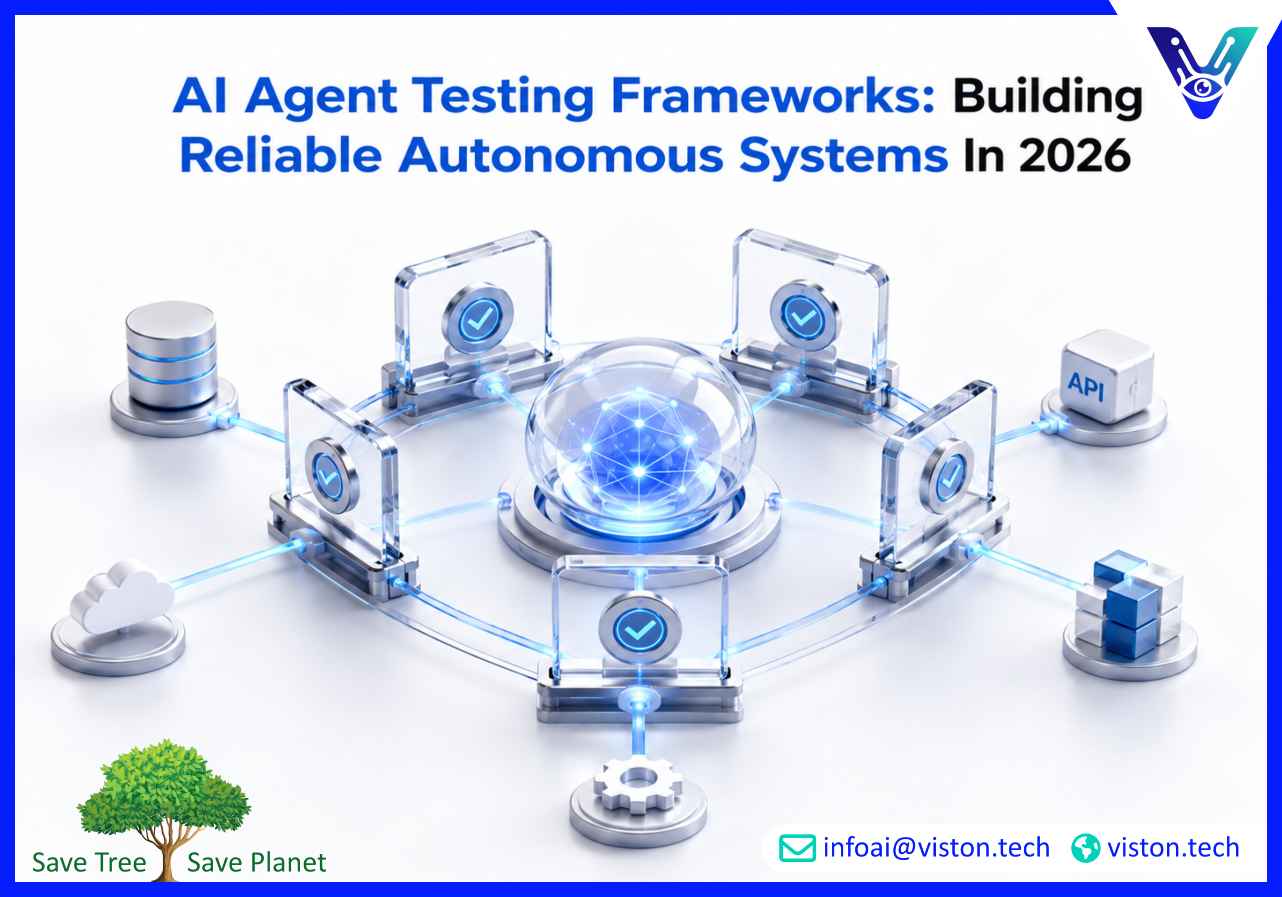
AI Agent Testing Frameworks: Building Reliable Autonomous Systems in 2026
Introduction
As AI agents become responsible for increasingly complex business processes, testing can no longer be treated as an afterthought. Organizations deploying autonomous systems need structured validation methods to ensure reliability, safety, performance, and compliance. AI agent testing frameworks provide the foundation for evaluating agent behavior before deployment and throughout the operational lifecycle.
What Are AI Agent Testing Frameworks?
AI agent testing frameworks are structured methodologies, tools, and processes used to evaluate the behavior, performance, security, and reliability of AI agents.Unlike traditional software testing, AI agent testing must account for dynamic decision-making, probabilistic outputs, tool usage, memory systems, multi-step reasoning, and interactions with external applications. An AI agent can behave differently depending on context, data quality, prompts, environmental conditions, and integrations.A comprehensive testing framework helps organizations answer critical questions:
Does the agent consistently achieve its intended objectives?
Can it handle unexpected inputs safely?
Does it follow business rules and compliance requirements?
How does performance change over time?
Are integrations functioning correctly?
Can the system scale under production workloads?
In 2026, organizations increasingly view AI agent testing as a core requirement for responsible AI deployment rather than an optional quality assurance activity.
Why AI Agent Testing Matters More Than Ever in 2026
The growing adoption of autonomous AI systems has increased both opportunities and risks.Modern agents can:
Execute workflows
Access enterprise systems
Analyze large datasets
Trigger business actions
Interact directly with customers
Coordinate with other agents
When these systems make incorrect decisions, the consequences can extend beyond software defects and affect operations, customer experience, revenue, compliance, and brand reputation.Common business risks include:
Hallucinated Decisions
An agent may generate incorrect conclusions or recommendations while appearing confident.
Workflow Failures
A single failed API call or integration issue can disrupt an entire automation sequence.
Security Vulnerabilities
Improper permissions or tool usage can expose sensitive information.
Performance Degradation
Agents often perform differently as workloads, prompts, and datasets evolve.
Unpredictable Multi-Agent Behavior
Complex systems involving multiple agents introduce additional testing challenges related to coordination, communication, and task orchestration.Testing frameworks help organizations identify these issues before they impact production environments.
Core Components of an Effective AI Agent Testing Framework
Successful testing frameworks combine multiple evaluation layers rather than relying on a single metric.
Functional Testing
Functional testing verifies that the AI agent performs assigned tasks correctly.Examples include:
Completing workflow steps
Retrieving accurate information
Following predefined instructions
Triggering appropriate actions
This testing ensures the agent can achieve expected business outcomes under normal operating conditions.
Behavioral Testing
Behavioral testing examines how agents respond to varying inputs, contexts, and edge cases.Organizations evaluate:
Decision consistency
Response quality
Goal completion rates
Error handling capabilities
Context retention
This type of testing helps identify unexpected behaviors before deployment.
Integration Testing
Most AI agents rely on external systems.Testing should validate integrations with:
CRM platforms
ERP systems
Databases
APIs
Knowledge bases
Communication tools
The objective is to ensure that every connection functions reliably under realistic workloads.
Security Testing
AI agents frequently access sensitive business information.Security testing focuses on:
Access controls
Authentication mechanisms
Authorization policies
Prompt injection resistance
Data leakage prevention
Tool permission boundaries
Security validation is becoming increasingly important as enterprise AI adoption expands.
Performance Testing
Performance testing measures how agents behave under different operating conditions.Organizations commonly evaluate:
Response times
Resource utilization
Concurrent user capacity
Workflow completion speed
Scalability thresholds
This ensures production environments remain stable as demand grows.
Regression Testing
AI systems evolve continuously through model updates, prompt modifications, workflow changes, and integration enhancements.Regression testing verifies that new updates do not negatively impact existing functionality.
Key Metrics Used in AI Agent Testing
A testing framework is only effective when supported by meaningful measurements.Common evaluation metrics include:
Task Success Rate
Measures the percentage of tasks completed correctly.
Goal Completion Accuracy
Evaluates whether the intended objective was achieved.
Tool Utilization Effectiveness
Determines whether external tools are being used appropriately.
Error Recovery Rate
Measures the agent’s ability to recover from failures.
Hallucination Frequency
Tracks incorrect outputs generated by the system.
Response Quality Scores
Assesses relevance, usefulness, and accuracy.
Latency Measurements
Evaluates operational speed under real-world conditions.Organizations increasingly combine automated metrics with human evaluations to obtain a more complete view of performance.
Challenges of Testing AI Agents
Traditional testing methods often fall short when applied to autonomous systems.
Non-Deterministic Outputs
The same input may produce slightly different outputs across executions.Testing frameworks must account for acceptable response ranges rather than expecting identical results every time.
Dynamic Environments
Agents frequently interact with changing external systems and data sources.This creates testing complexity because outputs depend on real-time conditions.
Multi-Step Reasoning
Many agents perform planning, tool execution, verification, and decision-making before producing results.Testing must evaluate the entire reasoning chain rather than focusing solely on final outputs.
Memory Dependencies
Agents that retain context across sessions require specialized testing approaches to validate long-term memory behavior.
Continuous Learning and Updates
Frequent model improvements and workflow modifications require ongoing validation processes to maintain reliability.
Best Practices for AI Agent Testing in Enterprise Environments
Organizations achieving successful AI deployments typically follow several testing best practices.
Build Testing Into Development From Day One
Testing should begin during design and development rather than after implementation.Early testing reduces deployment risks and accelerates production readiness.
Create Realistic Evaluation Scenarios
Synthetic test cases are useful but insufficient.Organizations should test agents using realistic workflows, business data, customer interactions, and operational situations.
Use Automated Testing Pipelines
Manual testing alone cannot keep pace with modern AI deployment cycles.Automated testing pipelines enable continuous validation throughout development and production.
Monitor Production Performance
Testing should continue after deployment.Continuous monitoring helps identify:
Behavioral drift
Integration failures
Performance degradation
Emerging risks
Combine Human and Automated Evaluation
While automated metrics provide scalability, human reviewers remain essential for assessing reasoning quality, business alignment, and user experience.
How Agent Integration Services Support AI Agent Testing
Many organizations struggle not because they lack AI models but because they lack the infrastructure needed to integrate, monitor, and test agents effectively.Agent Integration Services play a critical role in creating reliable testing environments by connecting AI agents with enterprise systems, workflows, data sources, and monitoring platforms.These services typically support:
Workflow orchestration
API integrations
Data connectivity
Evaluation pipelines
Monitoring systems
Security controls
Governance frameworks
Deployment automation
A well-designed integration architecture allows testing frameworks to operate consistently across development, staging, and production environments.Without proper integration, testing results often fail to reflect real-world operating conditions.
Building Reliable AI Agent Deployments with Viston AI’s Agent Integration Services
As businesses move from experimental AI projects to production-grade automation, the quality of integration becomes just as important as the quality of the underlying models. This is where Viston AI’s Agent Integration Services align closely with AI agent testing frameworks.Effective testing requires agents to interact with enterprise systems in realistic environments. That means integrating workflows, APIs, databases, business applications, monitoring tools, and governance controls into a cohesive ecosystem. Poorly connected systems often create blind spots that make testing incomplete or unreliable.Viston AI focuses on helping organizations establish robust agent integration architectures that support deployment, monitoring, validation, and ongoing optimization. By connecting AI agents with operational systems and business processes, organizations can evaluate real-world performance, identify workflow bottlenecks, and improve reliability before large-scale rollout.For companies implementing autonomous workflows, integration services also support important testing objectives such as error tracking, performance measurement, security validation, tool orchestration, and operational observability.As AI ecosystems become increasingly complex in 2026, businesses need integration strategies that allow testing frameworks to function across the entire agent lifecycle. Strong integration practices help ensure that AI agents remain reliable, scalable, and aligned with business objectives long after initial deployment.
Selecting the Right AI Agent Testing Framework
Not every organization requires the same testing approach.When evaluating testing frameworks, decision-makers should consider:
Business Objectives
Testing requirements differ between customer service agents, operational assistants, research agents, and workflow automation systems.
Integration Complexity
The number of connected systems directly influences testing scope.
Compliance Requirements
Industries with strict regulatory obligations require more comprehensive validation processes.
Scalability Needs
Testing frameworks should support future growth without becoming operational bottlenecks.
Monitoring and Reporting Capabilities
Organizations benefit from visibility into performance trends, failures, and optimization opportunities.The most effective framework is one that aligns with business goals while supporting continuous improvement throughout the AI lifecycle.
Frequently Asked Questions
What is an AI agent testing framework?
An AI agent testing framework is a structured system of tools, methodologies, and evaluation processes used to assess the reliability, accuracy, security, and performance of AI agents before and after deployment.
Why are AI agent testing frameworks important?
They help organizations identify failures, hallucinations, security risks, integration issues, and performance problems before those issues impact business operations.
What metrics are commonly used to evaluate AI agents?
Common metrics include task success rate, goal completion accuracy, latency, response quality, error recovery rate, hallucination frequency, and tool utilization effectiveness.
How often should AI agents be tested?
Testing should occur throughout development, before deployment, after updates, and continuously during production through monitoring and automated evaluation processes.
Can AI agent testing be automated?
Yes. Many organizations use automated testing pipelines that evaluate workflows, integrations, outputs, performance, and regression risks on an ongoing basis.
How can Viston AI help organizations deploying AI agents?
Viston AI provides Agent Integration Services that help businesses connect AI agents with operational systems, workflows, monitoring platforms, and governance frameworks, creating a stronger foundation for testing, deployment, and long-term reliability.
Conclusion
AI agent testing frameworks have become an essential component of successful AI deployment strategies in 2026. As autonomous systems take on more business-critical responsibilities, organizations must validate performance, security, reliability, and operational readiness through structured testing processes. Combining comprehensive evaluation methodologies with strong Agent Integration Services enables businesses to reduce deployment risks and improve long-term outcomes. For organizations building scalable AI ecosystems, Viston AI supports this effort by helping create integrated environments where AI agents can be tested, monitored, and optimized with greater confidence and operational control.