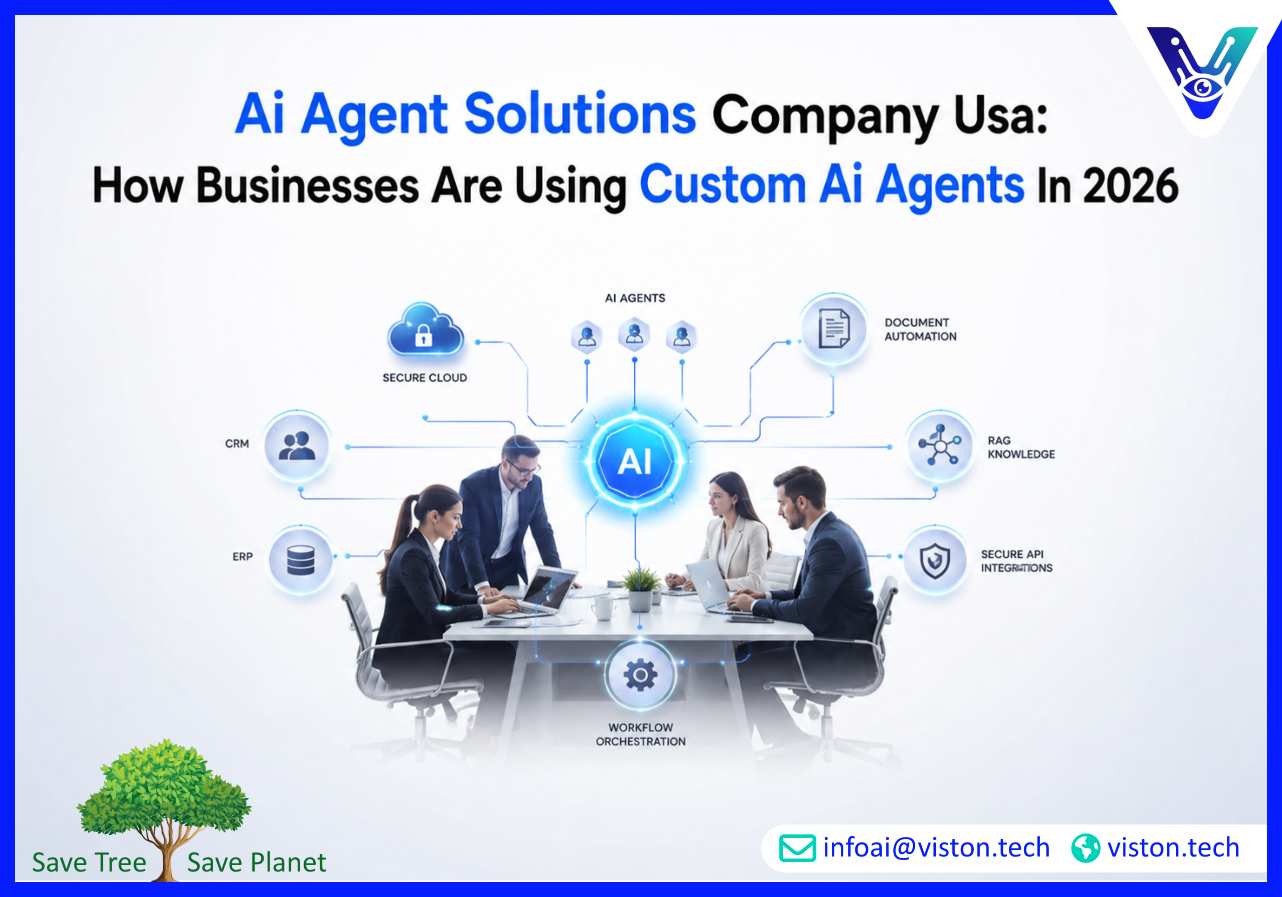
AI Agent Solutions Company USA: How Businesses Are Using Custom AI Agents in 2026
Introduction
Businesses across the USA are moving beyond basic automation and adopting AI agents to streamline operations, improve decision-making, and reduce manual workloads. From customer support to enterprise workflows, custom AI agents are becoming a practical business tool in 2026 for organizations seeking scalable, intelligent automation aligned with real operational goals.
What Is an AI Agent Solutions Company?
An AI agent solutions company helps businesses design, build, deploy, and manage AI-powered systems that can autonomously perform tasks, make decisions, interact with users, and integrate with business platforms.Unlike traditional automation tools that follow fixed rules, AI agents can understand context, process natural language, retrieve information, and adapt workflows dynamically. These systems often combine technologies such as:
Large language models (LLMs)
Retrieval-augmented generation (RAG)
Workflow orchestration
API integrations
Vector databases
Machine learning models
Enterprise automation platforms
Multi-agent coordination systems
In the USA, demand for custom AI agent solutions has increased significantly as companies look for ways to improve operational efficiency without replacing existing business systems.
Why Businesses in the USA Are Investing in AI Agents in 2026
Organizations are under increasing pressure to improve productivity, reduce repetitive workloads, and provide faster customer experiences. AI agents are helping companies achieve these goals while maintaining scalability.Several factors are driving adoption in 2026:
Rising Operational Complexity
Businesses now manage large volumes of data across CRMs, ERPs, communication platforms, analytics systems, and cloud applications. AI agents help connect these systems and automate cross-functional processes.
Demand for Faster Decision-Making
Modern businesses need real-time insights and quicker execution. AI agents can retrieve data, summarize information, generate responses, and trigger workflows faster than manual processes.
Shortage of Skilled Operational Resources
Many organizations struggle with repetitive administrative work that consumes valuable employee time. AI agents reduce dependency on manual handling for tasks such as:
Ticket management
Data processing
Report generation
Internal knowledge retrieval
Customer query handling
Lead qualification
Improved AI Infrastructure
Cloud AI platforms, enterprise APIs, and orchestration frameworks have matured significantly. This makes custom AI agent implementation more practical, secure, and scalable for businesses in the USA.
Common Business Use Cases for Custom AI Agents
AI agents are no longer limited to chatbot functionality. Businesses are deploying them across departments to improve operational workflows and customer interactions.
Customer Support Automation
AI agents can handle:
Tier-1 support requests
Knowledge base retrieval
Ticket categorization
Multilingual customer interactions
Automated escalation workflows
This reduces response times while allowing support teams to focus on complex cases.
Sales and Lead Qualification
Sales-focused AI agents can:
Analyze inbound leads
Qualify prospects
Schedule meetings
Generate outreach responses
Summarize CRM interactions
For businesses with large sales pipelines, this improves response efficiency and lead management consistency.
Internal Knowledge Management
Enterprise teams often struggle to access scattered information. AI agents can connect with internal systems and provide contextual answers from:
SOP documents
Internal databases
HR policies
Technical documentation
Project records
This reduces time spent searching for information across multiple systems.
Workflow Automation
AI agents are increasingly integrated into business operations to automate tasks such as:
Invoice processing
Approval routing
Reporting workflows
Inventory coordination
Procurement support
Compliance documentation
These automations reduce delays and minimize manual errors.
AI Research and Data Analysis
Organizations handling large data volumes use AI agents to:
Analyze structured and unstructured data
Summarize reports
Monitor trends
Generate business insights
Automate research tasks
This is particularly useful for operations, finance, marketing, and product teams.
Key Features Businesses Expect from AI Agent Solutions in 2026
Companies evaluating AI agent providers are now prioritizing reliability, scalability, security, and integration capability over experimental features.
Secure Enterprise Integration
Businesses expect AI agents to integrate securely with:
CRM systems
ERP platforms
Cloud infrastructure
Internal databases
Communication tools
Analytics systems
Security and access control are critical, especially for organizations handling sensitive business data.
Retrieval-Augmented Generation (RAG)
RAG systems allow AI agents to retrieve verified information from company data sources before generating responses. This helps reduce hallucinations and improves response accuracy.
Workflow Orchestration
Modern AI agents often operate as part of larger workflow systems rather than standalone tools. Orchestration enables agents to:
Trigger tasks automatically
Coordinate with APIs
Manage multi-step workflows
Escalate exceptions
Synchronize data across systems
Human-in-the-Loop Controls
Businesses increasingly require approval checkpoints for sensitive workflows. Human oversight remains essential for:
Financial decisions
Compliance reviews
Legal documentation
Customer escalations
Critical operational changes
Scalability and Monitoring
Organizations expect AI systems to support:
Usage monitoring
Logging and audit trails
Performance analytics
Workflow optimization
Multi-user scaling
Governance policies
Challenges Businesses Face When Implementing AI Agents
Although AI agents offer significant advantages, implementation can become difficult without proper planning and technical expertise.
Poor Integration Strategy
Many businesses adopt AI tools without considering how they will integrate with existing infrastructure. This often creates disconnected workflows and inconsistent outputs.
Inaccurate or Unreliable Responses
Without strong data retrieval systems and validation logic, AI agents may generate incorrect or misleading information.
Compliance and Security Risks
Businesses operating in regulated sectors must carefully manage:
Data privacy
User permissions
Auditability
Data residency
Access governance
Over-Automation
Not every workflow should be fully autonomous. Businesses that attempt to automate sensitive processes without oversight often face operational issues.
Lack of Long-Term Optimization
AI agents require ongoing monitoring, testing, and refinement. Companies that treat deployment as a one-time project often experience declining performance over time.
How Custom AI Agent Solutions Deliver Better Results
Custom AI agents are designed around actual business workflows, operational requirements, and internal systems rather than generic templates.This allows organizations to build AI solutions that align with their specific objectives.
Tailored Workflow Design
Custom AI agents can be configured for:
Department-specific tasks
Industry workflows
Internal terminology
Business logic
Approval structures
Custom reporting requirements
Better System Compatibility
Custom development enables smoother integration with existing enterprise infrastructure and APIs.
Greater Control and Governance
Organizations can define:
Access permissions
Escalation rules
Validation processes
Compliance controls
Data handling policies
Improved Accuracy
Custom retrieval pipelines, knowledge bases, and workflow logic help improve reliability compared to generic AI systems.
Why Businesses Work with Viston AI for Custom AI Agent Solutions
As businesses across the USA continue investing in AI-driven automation, many require more than basic chatbot deployment. They need structured AI agent systems that integrate with existing workflows, business platforms, and operational goals.Viston AI specializes in Custom AI Agent Solutions designed for practical business use cases rather than isolated AI experiments. The company focuses on helping organizations implement scalable AI agents that support workflow automation, enterprise integrations, intelligent task execution, and operational efficiency improvements.Its capabilities align with growing business requirements in areas such as:
AI workflow automation
Enterprise AI integrations
Multi-agent systems
AI orchestration
Retrieval-augmented AI systems
CRM and ERP connectivity
AI-powered business process automation
For organizations in the USA, implementation reliability, scalability, and integration flexibility are often critical selection factors. Viston AI’s approach emphasizes business-aligned deployment strategies that support operational workflows instead of forcing companies to redesign their infrastructure around AI tools.This is particularly relevant for businesses looking to adopt AI agents while maintaining governance, security, reporting visibility, and workflow control across departments.
How to Choose the Right AI Agent Solutions Company
Businesses evaluating AI agent providers should focus on operational capability rather than marketing claims.
Evaluate Integration Experience
The provider should understand enterprise integrations and workflow orchestration, not just prompt engineering.
Assess Scalability
AI systems should support long-term operational growth without major rework.
Review Security Practices
Look for clear approaches to:
Access management
Data security
Governance controls
Compliance support
Audit logging
Understand Deployment Methodology
A reliable provider should define:
Discovery processes
Workflow mapping
Testing procedures
Optimization strategies
Ongoing support models
Focus on Business Outcomes
The best AI implementations solve operational problems, improve efficiency, and support measurable business goals.
The Future of AI Agent Solutions in the USA
The AI agent market in the USA is expected to continue expanding rapidly as organizations move toward more autonomous and intelligent operations.Key trends shaping the future include:
Multi-agent enterprise systems
AI-powered workflow orchestration
Industry-specific AI agents
Autonomous research and reporting systems
Real-time business intelligence agents
Secure enterprise AI governance frameworks
Businesses are increasingly viewing AI agents as operational infrastructure rather than standalone tools.Organizations that invest strategically in scalable, well-integrated AI systems are likely to gain significant advantages in productivity, responsiveness, and operational efficiency over the next several years.
Frequently Asked Questions
What does an AI agent solutions company do?
An AI agent solutions company designs and deploys AI-powered systems that automate tasks, manage workflows, integrate with enterprise platforms, and support business operations using intelligent automation.
Are custom AI agents better than generic AI tools?
Custom AI agents are often more effective because they are designed around specific business workflows, integrations, data sources, and operational requirements.
Which industries benefit most from AI agent solutions?
Industries such as healthcare, logistics, finance, SaaS, retail, manufacturing, and enterprise services commonly benefit from AI agent automation and workflow optimization.
How do AI agents integrate with existing business systems?
AI agents typically integrate through APIs, cloud platforms, databases, CRMs, ERPs, and workflow automation systems to support seamless operational processes.
Why do businesses in the USA invest in AI agents?
Businesses invest in AI agents to improve efficiency, reduce repetitive work, accelerate decision-making, enhance customer support, and scale operations more effectively.
How does Viston AI support custom AI agent implementation?
Viston AI provides Custom AI Agent Solutions focused on workflow automation, enterprise integration, scalable AI deployment, and operational optimization for modern businesses.
Conclusion
The demand for AI agent solutions in the USA continues to grow as businesses seek smarter ways to automate operations, improve efficiency, and scale decision-making. Custom AI Agent Solutions allow organizations to build AI systems that align with real workflows, integrations, security requirements, and operational goals.In 2026, businesses are prioritizing reliable, scalable, and business-focused AI implementations over experimental deployments. Companies such as Viston AI are helping organizations adopt AI agents in ways that support practical automation, enterprise integration, and long-term operational value through structured and customized AI solutions.