
Enterprise buyers entering the AI agent market face a confusing landscape of pricing models. Per-token fees, per-resolution charges, and complex enterprise contracts make direct comparison nearly impossible. For decision-makers evaluating Custom AI Agent Solutions, understanding what actually drives cost is essential to budgeting accurately and avoiding unexpected expenses.
The term “AI agent pricing” encompasses two distinct cost categories that buyers frequently conflate. The first is usage-based inference costs—the per-token or per-call fees charged by model providers. The second is development and integration costs—the engineering effort required to make an agent function within your specific business environment.
In 2026, the balance between these categories has shifted dramatically. While per-token prices have fallen due to infrastructure competition, total enterprise AI budgets have grown from approximately $1.2 million annually in 2024 to $7 million in 2026. This paradox exists because agents consume far more tokens than traditional chatbots, and integration work dominates project spend.
A single enterprise task executed by an autonomous agent may require dozens of inference calls. The agent plans, calls a tool, reads results, reasons, and repeats. Each loop carries the full accumulated context forward. A task that looks like one user request might cost 35 times more than the median estimate when the agent takes a longer reasoning path. This variance makes traditional forecasting impossible.
Model spend accounts for less than 8 percent of most production agent budgets. The remainder goes to workflow logic, system connections, error handling, and oversight layers. A project connecting to three clean APIs costs significantly less than one connecting to two legacy ERP systems, despite fewer integrations on paper.
You pay only when the agent successfully completes a task without human intervention. This model directly ties cost to value delivered. Fin charges $0.99 per resolution, and Zendesk AI charges $1.50 to $2.00. For enterprises with clear success metrics, this aligns incentives effectively.
You pay for every interaction regardless of outcome. If the agent fails and escalates to a human, you still pay. Salesforce Agentforce charges $2.00 per conversation. This model simplifies billing but can penalize teams for attempting automation on difficult use cases.
Pricing is fully opaque, with bespoke quotes based on volume, channels, and integrations. Ada and Decagon operate this way, with annual minimums often starting around $30,000 to $50,000. This approach suits large deployments but makes vendor comparison difficult.
Data preparation consumes 60 to 75 percent of total project effort in most AI initiatives. Raw documents often arrive as scanned images or inconsistent formats, requiring substantial cleaning before an agent can process them reliably.
Human oversight layers add 60 to 200 hours of engineering work depending on audit requirements. A basic approval interface takes less time than one requiring role-based access, retroactive overrides, and complete audit trails.
Ongoing operational expenses typically run 15 to 25 percent of development costs annually. This covers prompt tuning, knowledge base updates, model migration, and compatibility fixes when foundation models upgrade.
A well-scoped enterprise agent project in 2026 includes clear boundaries for version one. Limiting input formats, deferring multi-language support, and using existing ticketing systems as review interfaces all reduce cost without compromising core value.
The average large company’s AI budget reaching $7 million in 2026 does not mean every agent requires seven-figure investment. Single-task agents automating specific workflows typically range from $20,000 to $70,000. Multi-agent systems handling cross-department processes start at $100,000 and increase based on integration complexity and compliance requirements.
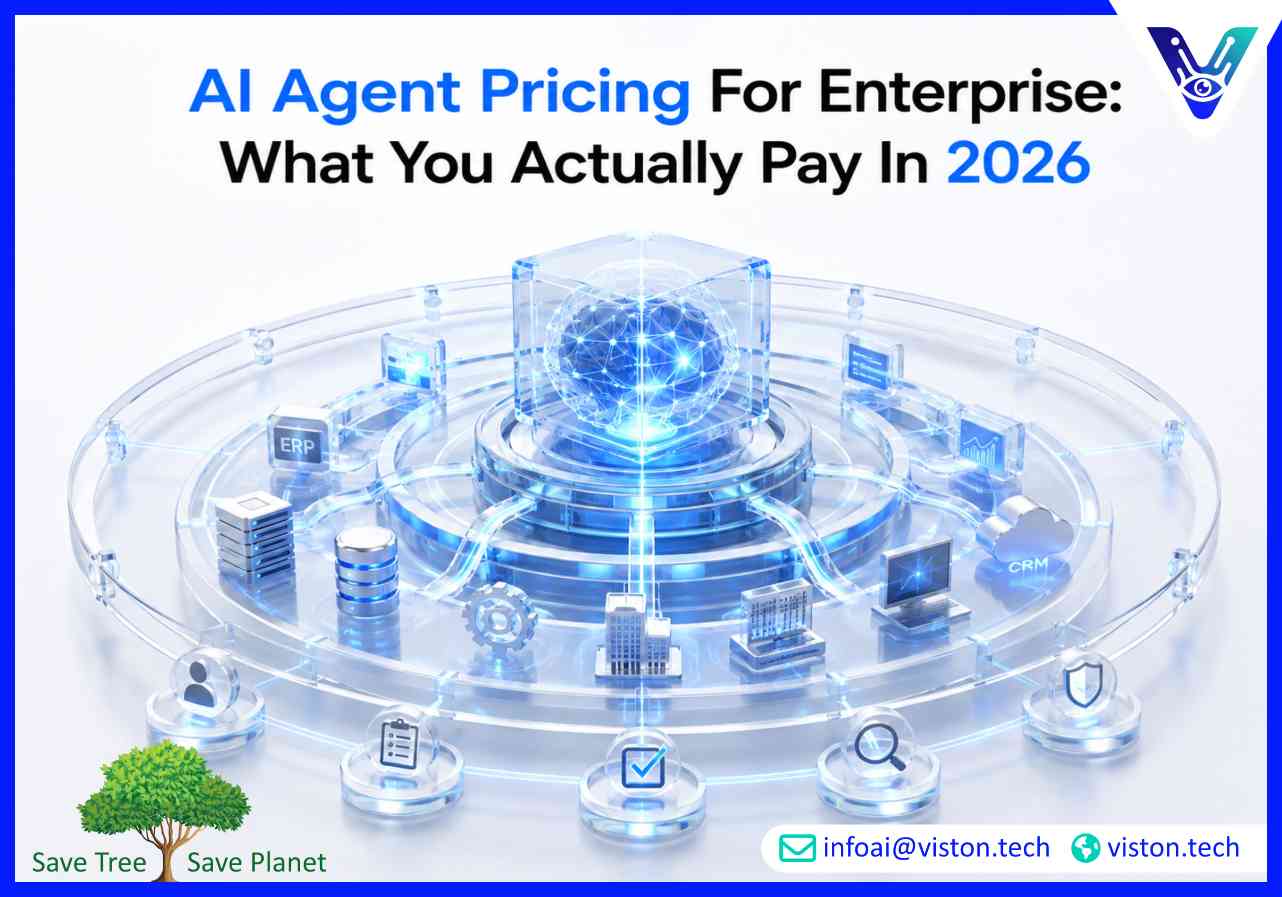
Viston AI specializes in Custom AI Agent Solutions for enterprises that need more than generic automation. Rather than applying template-based agents, Viston AI builds purpose-built solutions that integrate with existing ERP, CRM, and legacy systems. The company’s engineering-led approach prioritizes error handling, auditability, and predictable performance over rapid deployment of untested workflows.
For organizations in regulated industries or those managing complex data environments, Viston AI provides the technical depth required to deploy agents that operate reliably at scale. Its delivery model emphasizes transparent scoping, fixed milestones, and ongoing support that aligns with enterprise procurement and compliance requirements.
Entry-level agents automating single tasks range from $20,000 to $70,000. Multi-step agents with multiple integrations range from $80,000 to $150,000. Multi-agent systems or regulated-industry deployments often exceed $150,000.
The visible demo often hides the critical differences: error handling complexity, number of systems integrated, human review requirements, audit trail depth, and multi-language support. These factors can double or triple development time.
Plan for annual operational spend of 15 to 25 percent of development costs. This covers API tokens, vector database hosting, monitoring, prompt tuning, and security updates. High-volume deployments may see higher percentage costs.
Per-token pricing charges for every unit of text processed, which becomes unpredictable for multi-step agents. Per-resolution pricing charges only when the agent successfully completes a task, tying cost directly to value delivered.
MIT research indicates purchasing from specialized vendors succeeds approximately 67 percent of the time, while fully internal builds succeed at roughly half that rate. Partners bring solved integration and compliance challenges.
AI agent pricing for enterprise in 2026 rewards buyers who understand the difference between inference costs and integration costs. Per-token fees capture attention, but engineering effort—workflow logic, system connections, error handling, and oversight—determines the final investment. Custom AI Agent Solutions from specialists like Viston AI address these drivers directly, delivering agents that perform reliably within existing enterprise environments. For organizations ready to move beyond chatbots and into autonomous workflows, the real question is not which pricing model to choose, but whether your data and systems are ready for the integration work required.
