
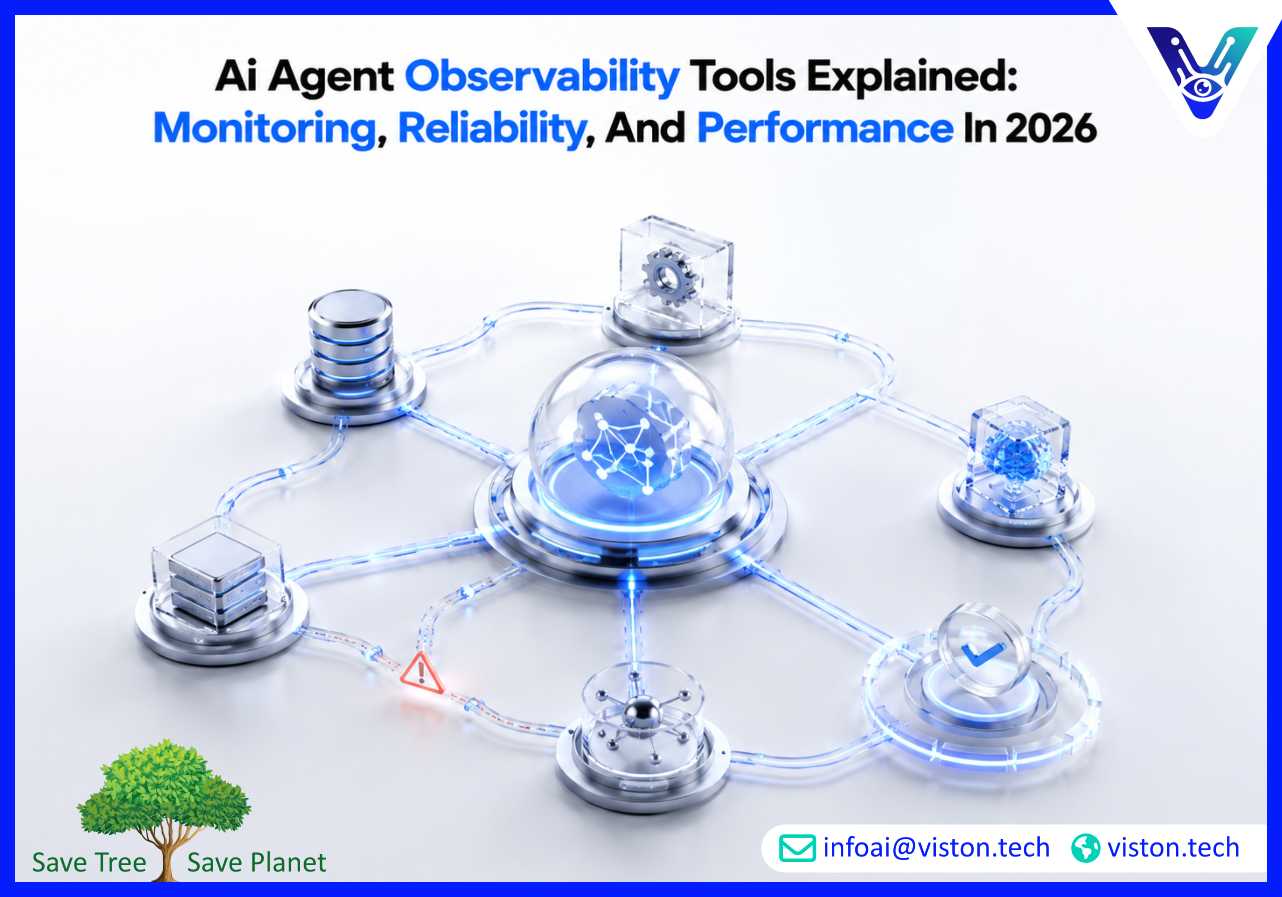
As AI agents move from experimentation to production environments, businesses face a new challenge: understanding what their AI systems are doing, why they make decisions, and how to ensure reliable outcomes. AI agent observability tools have become essential for monitoring performance, identifying failures, improving transparency, and maintaining operational confidence in increasingly complex AI-driven workflows.
AI agent observability tools help organizations monitor, analyze, and understand the behavior of AI agents operating in real-world environments.
Unlike traditional application monitoring, AI observability focuses on tracking agent reasoning, decision paths, tool usage, memory interactions, prompt execution, model responses, and workflow outcomes. These capabilities help teams identify issues before they impact business operations.
As AI agents become responsible for customer support, workflow automation, research tasks, software development assistance, and decision support, visibility into their behavior becomes critical.
Modern observability platforms provide insights into:
Without observability, organizations often struggle to understand why an agent produced a particular outcome or why performance degraded over time.
AI systems are becoming increasingly autonomous. Many organizations now deploy agents that can:
While these capabilities create significant efficiency gains, they also introduce operational risks.
Key challenges include:
AI agents may execute dozens of reasoning steps before producing an answer. Without observability, teams cannot inspect what happened during execution.
Large language models can generate incorrect information despite appearing confident. Observability tools help detect and analyze these situations.
Latency issues may originate from prompts, APIs, external tools, retrieval systems, or orchestration layers. Observability enables teams to identify root causes quickly.
Organizations operating in regulated environments increasingly require audit trails showing how AI systems arrived at specific decisions.
AI workloads can become expensive when token usage, model calls, or workflow complexity are not monitored effectively.
Effective observability requires more than basic logging. Modern solutions typically include several monitoring layers.
Tracing records every step an AI agent performs during execution.
This may include:
Traces allow engineers to inspect complete workflows and understand decision-making processes.
Prompt quality directly affects AI performance.
Observability platforms track:
This helps teams optimize prompts while maintaining consistency.
Many AI agents rely on external systems such as:
Observability tools track whether these integrations perform correctly and identify failures when they occur.
Retrieval-Augmented Generation (RAG) architectures have become common in enterprise AI systems.
Observability platforms evaluate:
These metrics help improve response reliability.
Organizations often use multiple language models for different tasks.
Observability solutions help compare:
This enables data-driven optimization.
Businesses deploying AI agents should monitor several important metrics.
Measures how often agents provide correct and useful outputs.
Tracks whether agents successfully complete assigned objectives.
Measures response times across workflows and integrations.
Identifies how often agents generate unsupported information.
Evaluates reliability of connected systems and APIs.
Captures feedback regarding usefulness and quality.
Tracks token usage, model costs, and infrastructure utilization.
Measures how often agents require human intervention.
These metrics help organizations balance performance, cost, and reliability.
Different organizations use observability platforms to address specific operational challenges.
Businesses deploying AI-powered support agents use observability to:
Companies often deploy agents that assist employees with research, documentation, and knowledge retrieval.
Observability helps ensure:
Organizations automating business processes require visibility into:
As enterprises adopt multi-agent architectures, observability becomes even more important.
Teams need visibility into:
Without observability, troubleshooting multi-agent environments becomes extremely difficult.
Not all observability platforms offer the same capabilities.
When evaluating solutions, organizations should consider the following features.
Comprehensive workflow tracing provides visibility across the entire execution chain.
Immediate insights help teams detect issues before they impact users.
The ability to identify exactly where failures occur accelerates troubleshooting.
Built-in evaluation tools help measure accuracy, reliability, and performance.
Automated alerts notify teams about anomalies, performance degradation, or failures.
Monitoring access patterns, sensitive data interactions, and policy violations supports governance initiatives.
Observability platforms should support increasing workloads as AI deployments grow.
Compatibility with popular AI frameworks, orchestration systems, cloud environments, and enterprise tools is essential.
Many businesses initially focus on AI functionality while underestimating monitoring requirements.
This often creates significant operational risks.
Agent quality may gradually decline due to changing data, prompts, or model updates.
Without monitoring, inefficient workflows can consume unnecessary compute resources.
Employees and customers lose confidence when AI systems behave unpredictably.
Insufficient auditability can create governance concerns, particularly in regulated environments.
Teams may spend substantial time investigating failures without sufficient visibility into agent behavior.
Observability helps address these challenges before they affect business outcomes.
Observability should not be treated as an afterthought.
Successful AI agent initiatives incorporate monitoring and evaluation throughout the development lifecycle.
Key stages include:
Organizations that integrate observability from the beginning often achieve faster deployment cycles and more reliable outcomes.
Organizations investing in AI agents need more than model integration. They require production-ready systems that are observable, scalable, secure, and measurable.
As a specialist in AI Agent Development & Deployment, Viston AI helps businesses design, implement, and operationalize AI agents that can perform reliably in real-world environments. This includes building agent architectures that incorporate monitoring, performance evaluation, workflow visibility, and operational controls from the start rather than treating observability as a later enhancement.
Modern AI deployments frequently involve multiple models, external tools, enterprise applications, knowledge bases, and automated workflows. Managing these moving parts requires structured deployment practices and strong visibility into agent behavior. Viston AI focuses on helping organizations create AI solutions that support traceability, performance optimization, and ongoing improvement throughout the agent lifecycle.
Whether businesses are deploying customer-facing assistants, workflow automation agents, internal productivity systems, or multi-agent environments, incorporating observability principles can improve reliability, governance, and user trust. By aligning AI implementation with operational requirements, organizations can reduce deployment risks while improving long-term performance and scalability.
As AI adoption continues to accelerate in 2026, businesses increasingly recognize that successful agent deployment depends not only on intelligence but also on transparency, monitoring, and continuous optimization.
AI observability is rapidly evolving alongside advances in agent capabilities.
Several trends are shaping the future:
As AI systems become more integrated into business operations, observability will become a foundational requirement rather than an optional enhancement.
AI agent observability is the practice of monitoring, tracing, analyzing, and evaluating AI agent behavior to improve reliability, transparency, performance, and operational oversight.
They help organizations understand agent decision-making, identify failures, monitor performance, reduce hallucinations, improve governance, and optimize operational efficiency.
Important metrics include response accuracy, latency, task completion rates, hallucination frequency, tool success rates, token consumption, user satisfaction, and escalation rates.
Observability tools cannot eliminate hallucinations entirely, but they help identify patterns, analyze root causes, evaluate outputs, and improve overall response quality.
Yes. Multi-agent environments involve complex interactions between agents, tools, and workflows. Observability provides critical visibility into coordination, execution, and performance.
Viston AI focuses on AI Agent Development & Deployment with an emphasis on building scalable, production-ready solutions that support monitoring, optimization, governance, and long-term operational reliability.
Understanding AI agent observability tools is becoming increasingly important as organizations deploy more sophisticated AI systems in production environments. Effective observability provides the visibility needed to monitor performance, improve reliability, reduce risks, and maintain trust in AI-driven operations. For businesses investing in AI Agent Development & Deployment, observability should be considered a core component of successful implementation rather than an optional add-on. By combining intelligent automation with strong monitoring practices, organizations can achieve more dependable, scalable, and measurable AI outcomes. Viston AI supports this approach by helping businesses build AI agent solutions designed for long-term operational success.
