
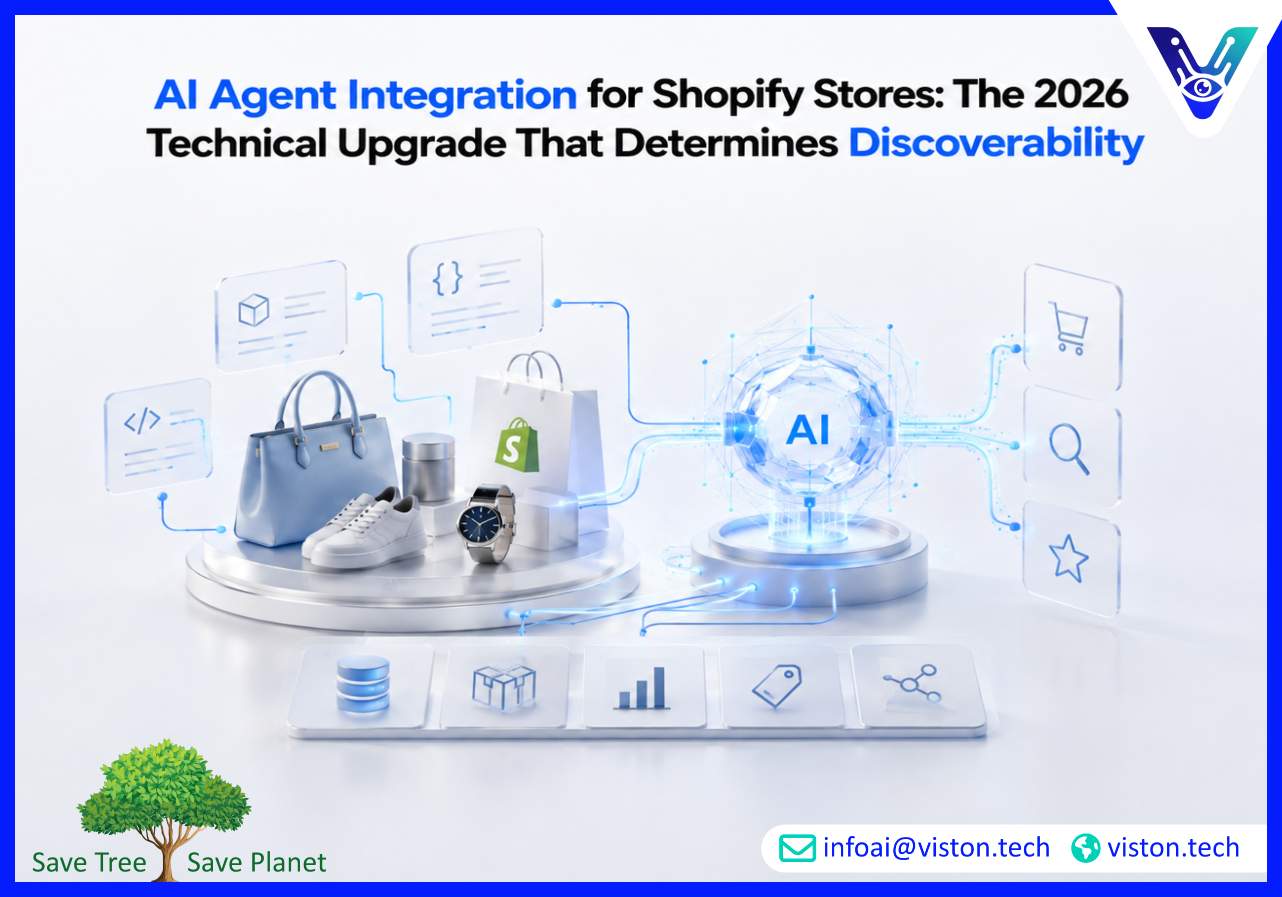
In early 2026, Shopify activated Agentic Storefronts for every merchant. This single update transformed how AI agents interact with your store—but activation alone delivers no competitive advantage. AI agent integration is the missing layer that turns passive API access into measurable revenue.
AI agent integration is distinct from simply enabling Shopify’s native agentic features. While Agentic Storefronts open API access for AI systems like ChatGPT, Microsoft Copilot, and Google AI Mode, integration refers to the deliberate technical work of preparing your store’s data infrastructure for autonomous agent decision-making.
An AI agent doesn’t “see” your store the way a human does. It parses structured data fields, metafields, JSON-LD markup, and API responses. If key product information lives only in marketing copy or Liquid templates, agents cannot access it. Agent integration solves this by restructuring how your store communicates with machine buyers.
Shopify already reported a 15x increase in AI-originated orders since early 2025 . The infrastructure is live. The question is whether your store is optimized to win agent-driven transactions or invisible to them.
Three major developments in 2026 have raised the stakes for Shopify merchants.
The protocol landscape has matured. Google’s Universal Commerce Protocol (UCP) now powers shopping in AI Mode and Gemini, with broad industry support from Stripe, Mastercard, and Visa. Shopify merchants benefit from automatic UCP integration, but Google bases recommendations on your Merchant Center feed quality—not your store design. OpenAI shifted ChatGPT shopping to a referral model in March 2026, meaning agents now link to your store rather than completing checkout inside the chat. Anthropic’s Model Context Protocol (MCP) is gaining traction as an open standard . Merchants who optimize their data once serve all three protocols simultaneously.
Microsoft launched Copilot Checkout and Brand Agents. Copilot Checkout allows customers to complete purchases directly inside Microsoft’s Copilot interface without leaving the conversation. Shopify merchants are enrolled automatically after an opt-out period. Microsoft also introduced Brand Agents trained on company product catalogs and brand content, capable of answering detailed product questions and guiding purchase decisions conversationally . These agents require complete, structured product data to function effectively.
Shopify’s AI Toolkit changed how automation works. Released in 2026, the AI Toolkit allows merchants to connect external AI tools directly to their store backend via the Model Context Protocol. These agents can perform SEO audits, batch product updates, pricing adjustments, and inventory management based on natural language commands . This creates new integration requirements—and new risks if not properly managed.
Without deliberate AI agent integration, Shopify merchants face three distinct operational gaps.
Most Shopify stores provide only 5 to 8 structured product attributes to AI systems. Agents making purchase recommendations need 30 or more data points to confidently select your products over competitors. Missing attributes like material composition, care instructions, compatibility details, or certifications mean agents cannot answer buyer questions. When an agent lacks information, it recommends a competitor whose data is complete .
AI agents execute multi-step tasks: discovering products, checking real-time inventory, applying discounts, and initiating checkout. If any step fails due to missing API configuration, stale inventory data, or incorrect pricing, the transaction aborts. Worse, repeated failures cause agents to deprioritize your store entirely for future queries.
Many merchants still rely on rigid automation tools like Zapier with trigger-action logic that breaks when business conditions change. AI agents can handle contextual decision-making—evaluating supplier alternatives, adjusting prices based on competitor signals, and routing orders based on real-time conditions—but only when properly integrated into your operational stack .
Specialized integration services focus on the technical work that most internal teams lack the bandwidth or expertise to execute.
Data structure audit and enrichment. Integration begins with a comprehensive audit of your product data architecture. This includes cataloging existing structured attributes, identifying gaps in metafield definitions, and mapping custom fields to Shopify Catalog standards. The goal is achieving 30+ structured attributes per product—the threshold for confident AI recommendation.
JSON-LD schema implementation. While Shopify provides basic Product schema by default, professional integration implements expanded JSON-LD with additionalProperty fields for every attribute AI agents might query. This includes aggregateRating, offers with complete availability data, and brand schema with rich metadata.
Agentic Storefronts configuration. Beyond the simple toggle in settings, proper configuration involves selecting which AI platforms to syndicate to, configuring brand voice and presentation settings, setting up attribution tracking for AI-originated orders, and establishing market-specific pricing rules for multi-currency transactions.
Real-time data pipeline maintenance. AI agents require real-time inventory and pricing data. Integration services audit your sync frequency between Shopify and any third-party fulfillment systems, ERP platforms, or warehouse management tools. Stale data is the most common failure point in agentic commerce.
AI Toolkit workflow governance. For merchants using Shopify’s AI Toolkit for operational automation, integration services establish governance protocols. This includes backup procedures before batch operations, validation steps for AI-generated content, and rollback capabilities when automated changes produce errors.
Viston AI specializes in the technical integration work that makes Shopify stores discoverable and functional for AI agents. Rather than generic consulting, our team focuses on the data architecture, API configuration, and workflow automation that directly impacts AI-driven revenue.
Our integration process begins with a comprehensive audit of your existing product data infrastructure—identifying gaps in structured attributes, metafield definitions, and schema markup that prevent agents from surfacing your products. We then implement expanded JSON-LD across your catalog, configure Shopify Catalog data mapping for optimal AI visibility, and establish real-time inventory pipelines that ensure agents always see accurate availability.
For merchants ready to leverage Shopify’s AI Toolkit, Viston AI designs governance frameworks that prevent the common pitfalls of agent-driven automation: batch operation rollback procedures, validation steps for AI-generated content, and monitoring protocols that catch errors before they affect live storefronts. Our focus is on practical, measurable outcomes—specifically, ensuring your products win when AI agents shop on behalf of buyers.
Yes. Agentic Storefronts provide the API access layer—the pipe through which agents connect to your store. Integration is the work of preparing what agents see when they connect. Activation without data optimization delivers minimal visibility.
For a standard Shopify store with 500-2,000 products, a complete integration—including data audit, metafield enrichment, JSON-LD implementation, and Agentic Storefronts configuration—typically requires 4 to 6 weeks. Larger catalogs or stores with complex ERP integrations may take 8 to 10 weeks.
Proper integration complements SEO rather than conflicting with it. The structured data improvements that help AI agents also enhance traditional search engine visibility. However, poorly executed changes to titles or descriptions can harm rankings—which is why professional integration with governance protocols matters.
Merchants typically see measurable results within 60 to 90 days post-integration, reflected in AI-attributed orders through Shopify’s referral tracking. Early adopters in competitive categories report 20-35% increases in AI-driven traffic within the first quarter. For specialized agent integration services, contact Viston AI directly for capability-specific inquiries.
Yes. Microsoft has positioned Copilot Checkout for B2B applications, particularly for repeat and contract-based purchases. B2B stores benefit from integration features like role-based pricing, customer-specific catalogs, and quote management—all of which require structured data that agents can parse.
AI agent integration for Shopify stores has moved from experimental to essential. The infrastructure is built, the protocols are standardized, and consumer behavior is shifting—hundreds of millions of users now shop through ChatGPT, Copilot, and AI Mode. Merchants who invest in proper integration now capture agent-driven revenue while most competitors remain invisible.
The work is technical but not speculative: audit your product data, enrich your structured attributes, implement complete schema markup, and configure your Agentic Storefronts for real-time accuracy. For merchants seeking specialized support, Viston AI provides the technical expertise required to execute this work at scale, ensuring your products surface when AI agents go shopping.
