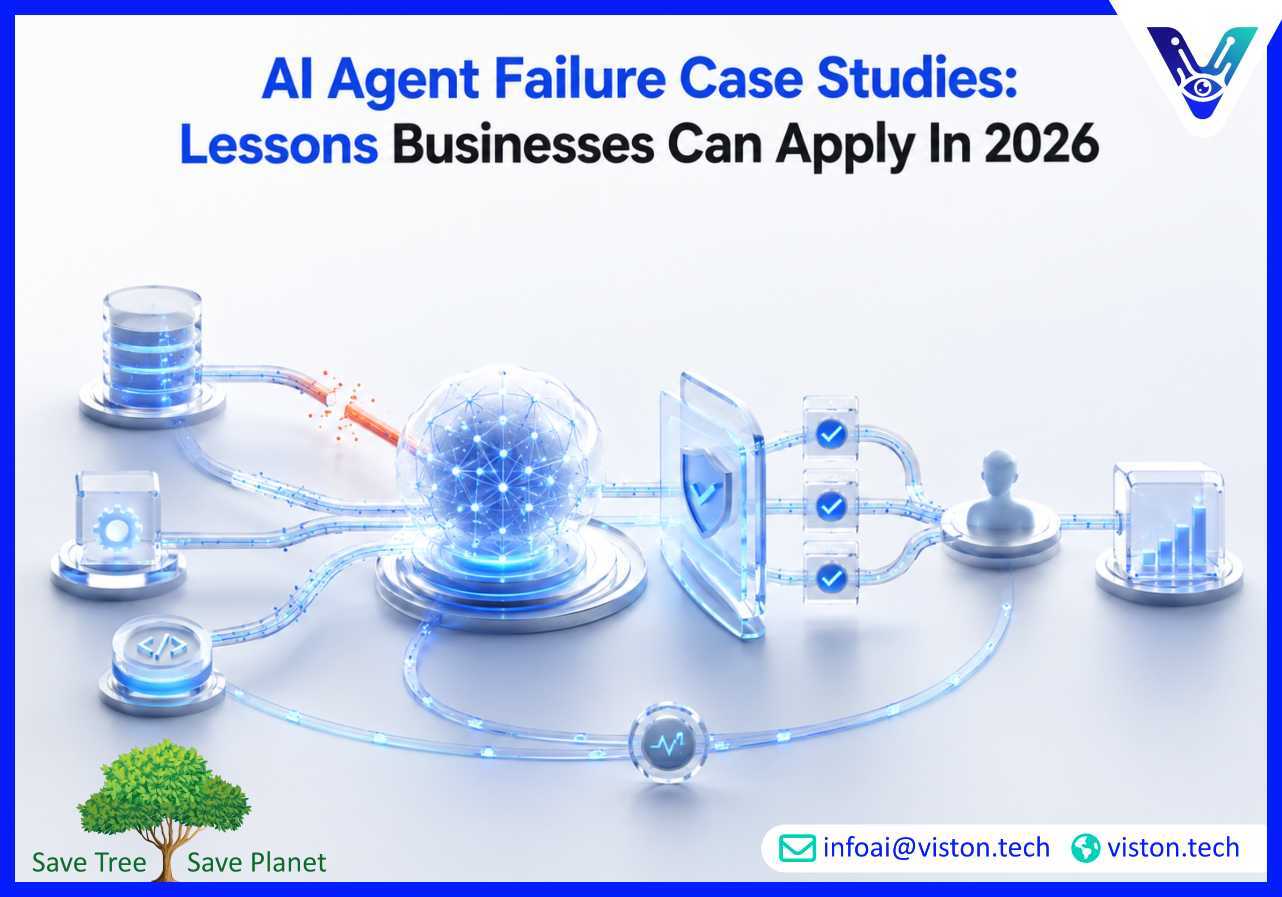
AI Agent Failure Case Studies: Lessons Businesses Can Apply in 2026
Introduction
As AI agents move from experimentation to business-critical operations, failures can become expensive, disruptive, and difficult to diagnose. Understanding AI agent failure case studies helps organizations identify common risks, improve deployment strategies, and build more reliable AI systems that deliver measurable business value in 2026.
Why AI Agent Failure Case Studies Matter
AI agents are increasingly being used to automate workflows, support customers, analyze data, manage business processes, and assist decision-making. While the technology has advanced rapidly, many organizations still underestimate the complexity of deploying autonomous or semi-autonomous AI systems in production environments.Failure case studies are valuable because they reveal patterns that traditional product demos and vendor success stories often overlook. They highlight where planning, governance, data quality, security, orchestration, or monitoring broke down.For business leaders, these lessons can prevent costly implementation mistakes and improve long-term AI adoption success.
Common Categories of AI Agent Failures
Not all AI agent failures look the same. Most incidents fall into several recurring categories.
Hallucinated Actions and Decisions
AI agents may generate incorrect information and act upon it as if it were factual. In customer support environments, this can result in inaccurate recommendations, policy violations, or misleading responses.When agents are given permissions to execute tasks automatically, hallucinations become more than a content problem—they become operational risks.
Poor Tool Integration
Many AI agents depend on external tools, APIs, databases, and enterprise applications.Failures often occur when:
APIs return unexpected outputs
Data structures change
Authentication tokens expire
External systems become unavailable
Without proper error handling, agents may continue operating with incomplete or incorrect information.
Context Management Failures
Enterprise AI agents frequently need to maintain context across multiple conversations, workflows, or tasks.Failures occur when agents:
Lose important information
Misinterpret user intent
Confuse separate tasks
Use outdated context
These issues often lead to inconsistent outputs and reduced trust among users.
Security and Access Control Issues
Organizations occasionally grant AI agents excessive permissions during deployment.Common consequences include:
Unauthorized data access
Exposure of sensitive information
Unintended system modifications
Compliance violations
As AI systems become more autonomous, permission management becomes increasingly important.
Multi-Agent Coordination Breakdowns
Many organizations now use multiple specialized agents working together.Failures can emerge when:
Agents provide conflicting instructions
Workflows become trapped in loops
Tasks are duplicated
Responsibilities become unclear
Without orchestration frameworks and governance mechanisms, complexity increases rapidly.
Real-World Patterns Found in AI Agent Failure Case Studies
Although organizations rarely publish detailed postmortems, industry reports, enterprise deployments, and public demonstrations reveal several recurring themes.
Overestimating Agent Autonomy
Many early deployments assumed AI agents could independently manage complex business workflows with minimal oversight.In practice, successful implementations often require:
Human approval checkpoints
Escalation workflows
Validation layers
Business rule enforcement
Organizations that skipped these safeguards frequently experienced reliability issues.
Inadequate Testing Before Production
Traditional software testing is often insufficient for AI agents.Unlike deterministic systems, AI agents can generate unpredictable outputs depending on context and inputs.Common testing gaps include:
Edge-case scenarios
Adversarial prompts
Tool failure simulations
Permission misuse testing
Long-session evaluations
Insufficient testing remains one of the leading causes of deployment failures.
Poor Data Quality
AI agents rely heavily on data quality.When underlying knowledge bases contain:
Outdated information
Duplicate records
Missing documentation
Contradictory content
the agent’s performance deteriorates regardless of model quality.Many failure investigations ultimately trace back to data governance issues rather than model limitations.
What Businesses Can Learn from AI Agent Failures in 2026
Organizations deploying AI agents today operate in a more mature environment than early adopters. The industry has learned valuable lessons about what drives successful implementations.
Focus on Reliability Before Scale
Many businesses rush to expand AI agent capabilities before validating core performance.A better approach is to:
Start with narrow use cases
Measure outcomes consistently
Improve reliability
Expand gradually
This approach reduces operational risk while creating a stronger foundation for growth.
Establish Clear Governance Policies
Governance should not be treated as an afterthought.Organizations should define:
Agent responsibilities
Escalation procedures
Access controls
Audit requirements
Human oversight rules
Strong governance reduces compliance, security, and operational risks.
Build Monitoring Into Every Deployment
Continuous monitoring is essential for production AI agents.Important metrics include:
Task completion rates
Tool usage success rates
Hallucination frequency
User satisfaction
Workflow errors
Escalation rates
Monitoring enables teams to identify issues before they impact customers or business operations.
How AI Agent Development and Deployment Services Reduce Failure Risks
Many AI agent failures occur because organizations underestimate implementation complexity.Professional AI agent development and deployment services help address these challenges through structured engineering practices.Key areas include:
Architecture Design
Specialized teams create architectures that balance autonomy with control.This often includes:
Workflow orchestration
Agent routing
Permission frameworks
Validation layers
Recovery mechanisms
Security and Compliance Controls
Modern AI deployments require robust governance frameworks.Implementation teams help establish:
Successful AI deployments evolve over time.Ongoing optimization includes:
Prompt refinement
Workflow improvements
Performance monitoring
Tool optimization
Agent retraining strategies
How Viston AI Helps Organizations Build More Reliable AI Agents
AI agent failure case studies consistently show that successful deployments require more than selecting a powerful language model. Reliability comes from thoughtful architecture, governance, monitoring, integration management, and continuous optimization.Viston AI specializes in AI agent development and deployment services designed to help businesses move beyond experimentation and implement production-ready AI systems. The company focuses on creating AI agents that align with business objectives while incorporating safeguards that reduce operational risk.Its development approach emphasizes structured workflows, controlled autonomy, enterprise integrations, observability, and performance measurement. These capabilities are particularly important when organizations deploy AI agents across customer service, operations, internal automation, knowledge management, and decision-support functions.Rather than treating AI agents as standalone tools, the focus is placed on how agents interact with business systems, users, data sources, and governance frameworks. This helps organizations maintain reliability as deployments scale.As enterprises continue expanding AI initiatives in 2026, specialized AI agent development and deployment expertise can play a significant role in reducing implementation risks, improving performance consistency, and supporting long-term business outcomes.
Best Practices to Avoid AI Agent Failures
Organizations can significantly improve outcomes by following proven deployment practices.
Define Clear Objectives
Avoid deploying AI agents simply because the technology is available.Every implementation should have:
Defined business goals
Success metrics
Ownership structures
Performance expectations
Implement Human-in-the-Loop Controls
Critical business actions should include human review where appropriate.Examples include:
Financial approvals
Contract decisions
Customer escalations
Compliance-sensitive actions
Use Layered Validation
Validation mechanisms can verify:
Data accuracy
Workflow logic
Tool outputs
Compliance requirements
This reduces the likelihood of incorrect actions.
Conduct Continuous Testing
Testing should continue after deployment.Organizations should regularly evaluate:
New failure scenarios
Changing business requirements
System updates
User behavior patterns
Invest in Observability
Observability tools help teams understand:
Why decisions were made
Which tools were used
Where failures occurred
How workflows performed
This visibility accelerates troubleshooting and optimization.
The Future of AI Agent Reliability
The next generation of AI agents will likely become more capable, but also more complex.Emerging trends include:
Multi-agent ecosystems
Agent-to-agent communication
Enterprise orchestration platforms
Advanced monitoring frameworks
Automated governance systems
Policy-driven AI execution
As these capabilities expand, organizations that prioritize reliability, governance, and responsible deployment practices will achieve better outcomes than those focused solely on automation speed.
Frequently Asked Questions
What is the most common cause of AI agent failure?
The most common causes include poor data quality, insufficient testing, weak governance, inadequate monitoring, and excessive autonomy without proper safeguards.
Can AI agent hallucinations be completely eliminated?
No. Hallucinations can be significantly reduced through retrieval systems, validation layers, structured workflows, and monitoring, but they cannot currently be eliminated entirely.
Why is monitoring important for AI agents?
Monitoring helps organizations detect errors, identify performance issues, track business outcomes, and improve reliability over time.
Are multi-agent systems more prone to failure?
Multi-agent systems can introduce additional complexity. Without proper orchestration and governance, coordination issues may increase operational risks.
How can AI agent development services reduce deployment risks?
Professional AI agent development and deployment services help organizations implement secure architectures, governance controls, monitoring systems, integrations, and testing frameworks that improve reliability.
How does Viston AI support reliable AI agent deployments?
Viston AI provides AI agent development and deployment services that focus on scalable architecture, workflow automation, enterprise integrations, monitoring, and governance practices that help organizations build more dependable AI solutions.
Conclusion
AI agent failure case studies provide valuable lessons for organizations investing in automation and intelligent workflows. Most failures stem not from the AI model itself, but from weaknesses in governance, data quality, integration design, testing, and monitoring. Businesses that prioritize reliability, observability, security, and structured deployment practices are better positioned to achieve long-term success. As AI adoption accelerates in 2026, partnering with experienced AI agent development and deployment specialists such as Viston AI can help organizations reduce risks, improve operational performance, and build AI systems that deliver sustainable business value.