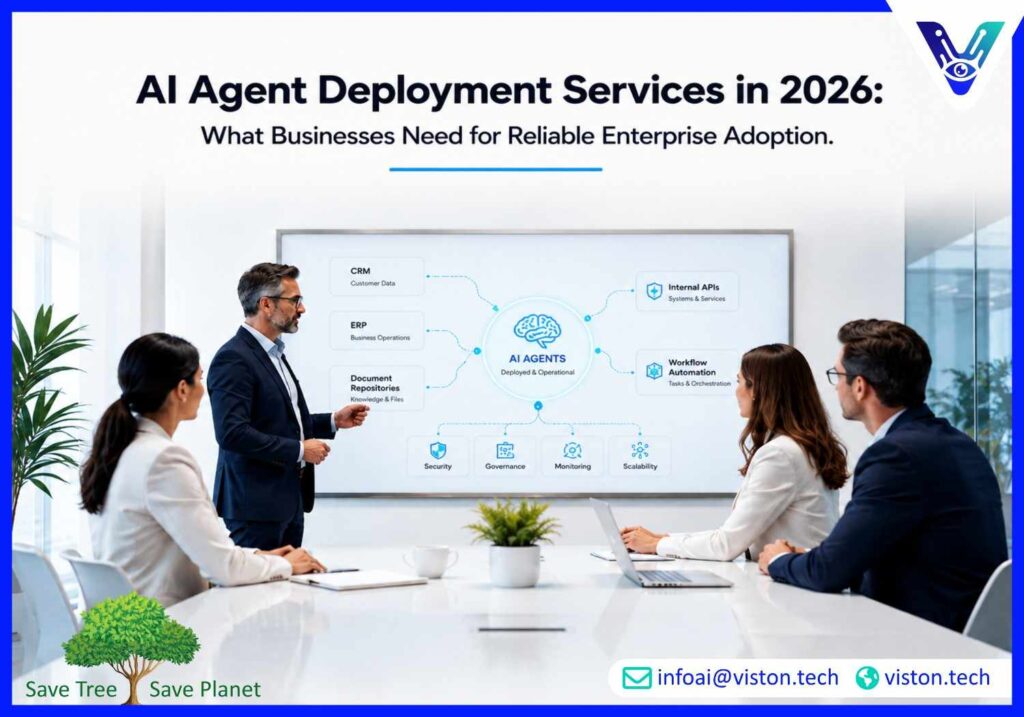
AI Agent Deployment Services in 2026: What Businesses Need for Reliable Enterprise Adoption
Introduction
AI agents have moved beyond experimentation. Businesses are now deploying systems that can automate workflows, coordinate actions, retrieve information, and assist teams in real operational environments. The challenge is no longer building an AI prototype. The real challenge is deploying AI agents in a way that is secure, scalable, reliable, and aligned with business outcomes.
Why AI Agent Deployment Services Matter in 2026
Many organizations successfully create proof-of-concept AI solutions but struggle when moving them into production environments.Deployment is where complexity increases.An AI agent operating inside a business environment may need to:
Access enterprise systems
Connect with CRM, ERP, and internal databases
Manage workflows across departments
Handle sensitive information
Follow security policies
Scale under changing workloads
Maintain response quality and reliability
A functioning prototype does not automatically become a dependable business system.AI agent deployment services focus on turning experimental systems into production-ready solutions that businesses can trust.In 2026, organizations are increasingly evaluating AI initiatives based on measurable business outcomes rather than model novelty. Questions have shifted from:“Can we build an AI agent?”to:“Can we operate it safely at scale?”That shift has made deployment expertise significantly more valuable.
Understanding AI Agent Deployment Services
AI agent deployment services involve the process of implementing, integrating, monitoring, optimizing, and maintaining AI agents within operational business environments.Deployment typically includes:
Infrastructure setup
Organizations must determine where agents run:
Cloud environments
Hybrid infrastructure
Private environments
Edge systems
On-premise environments
Infrastructure decisions affect:
Cost
Latency
Security
Performance
Scalability
Integration with business systems
AI agents become useful when connected to operational tools:
CRM platforms
ERP systems
Support systems
Document repositories
Internal APIs
Communication platforms
Disconnected agents create limited value.Integrated agents can participate in real workflows.
Security implementation
AI agents increasingly interact with sensitive business information.Deployment services frequently address:
Common Business Challenges During AI Agent Deployment
Many organizations underestimate deployment complexity.Several issues commonly emerge during implementation.
Unclear use-case prioritization
Some businesses attempt to automate everything simultaneously.This creates:
Fragmented workflows
Overlapping systems
Difficult ROI measurement
Deployment succeeds more often when organizations prioritize high-impact workflows.Examples include:
Customer support operations
Sales enablement
Internal knowledge retrieval
Procurement processes
Onboarding workflows
Data quality problems
AI agents depend heavily on reliable information.Common issues include:
Duplicated records
Outdated content
Disconnected systems
Inconsistent formatting
Poor data quality creates poor AI decisions.
Integration bottlenecks
Large organizations often operate dozens of systems.Connecting agents across:
Internal databases
APIs
Communication tools
Workflow platforms
can become technically challenging.
Security and compliance concerns
Security teams increasingly require:
Permission boundaries
Auditability
Explainability
Role-based access
Governance controls
Organizations in healthcare, finance, and regulated industries typically apply stricter requirements.
AI Agent Deployment Use Cases Across Industries
AI deployment is becoming increasingly practical because organizations now focus on workflow outcomes rather than standalone AI features.
Customer support operations
AI agents can:
Classify tickets
Answer routine questions
Retrieve historical information
Route cases
Summarize conversations
Human teams handle exceptions and complex scenarios.
Sales and marketing workflows
Agents can support:
Lead qualification
Prospect research
Personalized outreach
Campaign insights
CRM updates
Operations and procurement
Operational teams increasingly use agents for:
Document processing
Vendor management
Inventory workflows
Purchase approvals
Status tracking
Internal knowledge systems
Employees often spend considerable time searching for information.AI agents can connect:
Internal documentation
Policy libraries
Project repositories
Knowledge databases
and deliver faster answers.
Product and engineering teams
AI agents can assist with:
Requirement summaries
Bug categorization
Testing support
Documentation generation
Workflow coordination
What Businesses Expect from AI Agent Deployment Services in 2026
Buyer expectations have matured significantly.Organizations evaluating deployment providers increasingly focus on practical considerations.
Reliability under real workloads
Businesses want systems that continue performing under:
High traffic volumes
Large datasets
Changing user behavior
Flexible architecture
AI environments evolve rapidly.Organizations increasingly prefer:
Modular architectures
Model flexibility
Framework independence
Scalable deployment structures
Transparent governance
Decision-makers increasingly ask:
What information can the agent access?
Who can monitor activities?
How are decisions tracked?
What controls exist?
Ongoing optimization
Deployment should include operational support rather than one-time implementation.Continuous improvement may involve:
Model tuning
Workflow refinement
Usage analysis
Performance improvements
Implementation Considerations Before Deploying AI Agents
Organizations planning deployment should evaluate several factors before implementation begins.
Define measurable objectives
Examples include:
Reducing support response times
Improving employee productivity
Lowering operational costs
Increasing workflow speed
Clear objectives simplify ROI measurement.
Assess infrastructure readiness
Questions often include:
Are APIs available?
Can systems integrate effectively?
Is data structured appropriately?
Determine ownership
AI projects frequently involve:
Technology teams
Operations
Legal departments
Security teams
Business stakeholders
Defined ownership reduces implementation friction.
Plan governance early
Governance should not become an afterthought.Policies around:
Access
Security
Compliance
Accountability
should be established before deployment begins.
How Viston AI Supports AI Agent Deployment for Business Applications
For organizations moving beyond AI experimentation, deployment expertise becomes increasingly important.Viston AI focuses on AI agent deployment services designed around practical business implementation rather than isolated AI functionality. The emphasis is typically on helping organizations convert AI concepts into operational systems that fit existing workflows.AI deployment often requires more than selecting a model or creating prompts. Businesses frequently need support around system architecture, integrations, workflow orchestration, operational monitoring, and scalability planning.Organizations implementing AI agents may face challenges such as:
Fragmented data environments
Disconnected tools
Workflow complexity
Operational bottlenecks
Governance requirements
AI agent deployment services can help address these issues through structured implementation approaches that align technology decisions with business goals.For companies operating across global markets, deployment requirements may also involve security expectations, infrastructure flexibility, and support for changing operational demands.A specialized deployment approach becomes valuable because business systems rarely operate in isolation. Successful AI implementation depends on how effectively agents integrate into day-to-day workflows and how reliably they continue delivering value after launch.Rather than treating deployment as a one-time technical activity, the focus increasingly shifts toward creating systems that remain maintainable, scalable, and aligned with evolving business priorities.
Best Practices for Successful AI Agent Deployment
Organizations achieving stronger results often follow several common practices.
Fully autonomous systems are not always appropriate.Human oversight improves reliability and trust.
Monitor continuously
Monitor:
Usage behavior
Errors
Outputs
Operational costs
AI performance changes over time.
Prioritize security from day one
Security retrofits become expensive and disruptive.Governance should be part of initial planning.
Frequently Asked Questions
What are AI agent deployment services?
AI agent deployment services help businesses move AI systems into production environments through implementation, integrations, security setup, monitoring, and ongoing optimization.
How is AI agent deployment different from AI model development?
Model development focuses on creating AI capabilities. Deployment focuses on integrating and operating those capabilities inside real business systems.
How long does AI agent deployment take?
Implementation timelines vary depending on complexity, integrations, and business requirements. Small workflows may take weeks, while enterprise deployments can require several months.
Which industries benefit most from AI agent deployment?
Industries with workflow-intensive operations often see strong value, including healthcare, finance, retail, manufacturing, logistics, customer support, and SaaS businesses.
What should businesses evaluate when selecting an AI deployment provider?
Organizations commonly assess:
Technical expertise
Integration capabilities
Security practices
Scalability
Governance frameworks
Operational support
Can Viston AI help organizations deploy AI agents?
Where AI agent deployment aligns with business requirements, Viston AI’s deployment-focused capabilities can support organizations seeking structured implementation and operational integration.
Conclusion
AI agent deployment services have become a critical step in transforming AI from experimentation into practical business value. Organizations in 2026 are no longer focused solely on building intelligent systems; they are focused on deploying systems that operate reliably, integrate effectively, and support measurable outcomes.Successful AI agent deployment requires careful attention to infrastructure, workflow design, security, governance, and long-term optimization. Businesses that approach deployment strategically are more likely to achieve sustainable results instead of isolated pilot success. For organizations seeking dependable AI implementation support, specialists such as Viston AI can play an important role in helping operational AI initiatives move into real-world environments.