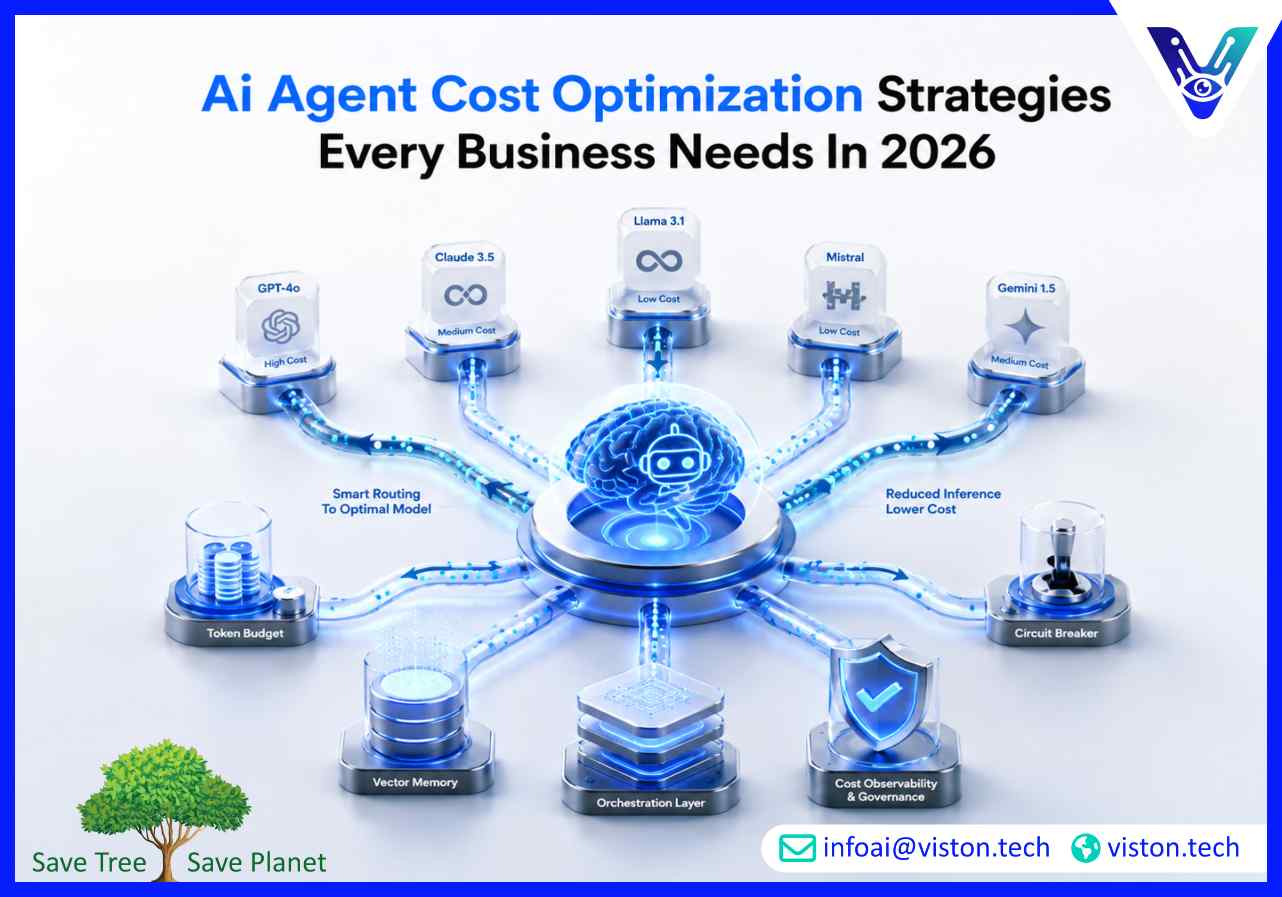
AI Agent Cost Optimization Strategies Every Business Needs in 2026
Deploying AI agents at scale is no longer purely a technical challenge — it has become a financial one. As organizations move from pilots to production, inference costs, compute overhead, and token consumption are quietly eroding the ROI that justified the investment in the first place. Getting cost optimization right is now as important as getting the technology right.
Why AI Agent Costs Are Harder to Control Than Expected
Traditional software costs scale predictably. You add users, you add capacity, and the relationship is relatively linear. AI agent workloads behave differently. Costs are probabilistic, context-dependent, and often invisible until the infrastructure invoice lands.Agentic workflows routinely trigger 10 to 20 LLM inference calls per user task. RAG architectures can inflate context windows by three to five times their baseline size. Always-on monitoring agents consume compute continuously, even when nothing meaningful is happening. The cumulative effect is that improperly optimized AI deployments can exceed projected operational budgets by two to four times within six to nine months of scaling.In 2026, LLM API spend has become one of the top three cloud cost categories for AI-intensive organizations, alongside compute and storage. The businesses winning on economics are those that built cost controls before they needed them, not after they received a painful invoice.
Understanding Where AI Agent Costs Actually Come From
Before you can optimize, you need to understand the cost structure. AI agent operating costs typically break down across four layers.Inference costs account for the largest share, often 70 to 85 percent of total agent operating expense. These are the token-based charges from LLM API calls, and they scale with prompt length, context window size, model tier, and call frequency.Orchestration overhead covers the compute consumed by agent reasoning loops, tool calls, memory retrieval, and task chaining. A poorly architected agent that loops unnecessarily burns through inference calls on tasks that should resolve in one or two steps.Storage and retrieval costs arise from vector databases, embedding generation, retrieval queries, and knowledge base operations. These grow quietly as agent memory and context libraries expand.Operational and engineering costs include monitoring, governance logging, security compliance layers, and the engineering time required to maintain production systems. These are frequently underestimated in early budgeting.Understanding the full cost picture is the starting point. Optimizing only inference while ignoring orchestration and storage rarely produces the unit economics improvements organizations are looking for.
Core Strategies for Reducing AI Agent Costs Without Sacrificing Quality
Implement Multi-Model Routing
One of the highest-impact changes an organization can make is to stop using a single frontier model for every task. Not every agent interaction requires the most capable or most expensive model available.Routing simpler, well-defined tasks to smaller, cost-efficient models while reserving premium models for complex reasoning or high-stakes decisions can reduce LLM costs substantially. The cost differential between frontier and efficient models in 2026 is significant — some efficient models are priced at a fraction of their premium counterparts, with minimal quality impact for appropriate task types. Teams that implement intelligent model routing typically report meaningful reductions in inference spend with minimal regression in output quality.The key is building routing logic that matches task complexity to model capability, rather than defaulting to the same model for everything.
Control Context Bloat
Context bloat is one of the quietest and most damaging cost drivers in agentic systems. In naive implementations, every piece of memory or historical context is injected into every inference call, regardless of whether it is relevant. As agent memory grows, this scales linearly and eventually becomes a serious cost problem.Switching from full-context injection to retrieval-based memory — where only relevant context is pulled for each inference call — significantly reduces token consumption per call. Retrieval-augmented approaches ensure that agents work with what they need rather than dragging the entire history of a conversation or workflow into every prompt.Organizations should also audit prompt designs regularly. Verbose, repetitive, or poorly structured prompts waste tokens at scale. Tighter prompt engineering across high-volume agents can produce immediate cost reductions without any architectural change.
Use Prompt Caching for Repetitive Workloads
For agents that use stable system prompts or repeatedly reference the same documents, prompt caching eliminates redundant compute. When the same input sequences are processed repeatedly, caching allows the model to skip reprocessing those tokens on every call.For cache-eligible workloads, the cost reduction can be substantial. This strategy is particularly effective for customer-facing agents, internal knowledge assistants, and any deployment where the system prompt or reference content remains consistent across a high volume of interactions.
Set Token Budgets and Circuit Breakers
Agent loops that run longer than they should are a real and costly problem in production environments. Without hard boundaries, a reasoning loop can chain through dozens of inference calls on a task that should resolve in two or three.Implementing per-task inference budgets and circuit breakers — automatic stops triggered when a defined threshold is reached — protects unit economics and prevents individual tasks from generating disproportionate cost. This is especially important in autonomous agent architectures where human oversight between steps is limited.Token budgets should be defined at the task level, not just at the system level. Granular budget enforcement gives organizations far more precision in managing costs across different agent types and use cases.
Build Cost Attribution and Observability From the Start
Finance teams cannot optimize what they cannot see. Tagging every inference request with metadata — by team, application, model, environment, and use case — creates the visibility needed to identify which agents or workflows are driving disproportionate spend.Without cost attribution at this level of granularity, organizations often end up with the equivalent of a large unexplained line item on their AI bill, with no clear path to resolution. Real-time cost monitoring, spend dashboards, and per-team budget policies are becoming standard features of mature enterprise AI programs in 2026, borrowing directly from the FinOps frameworks that enterprises applied to cloud cost management in previous years.
Architectural Decisions That Affect Long-Term Cost Efficiency
The cost structure of an AI agent deployment is largely determined at the architecture stage. Decisions made during development — about orchestration frameworks, memory design, model selection, and integration patterns — have compounding effects in production.Agents built on modular, task-specific architectures are easier to optimize than monolithic designs where a single model handles everything. Multi-agent orchestration, where specialized agents handle discrete functions and a coordinator manages workflow logic, allows each component to be optimized and scaled independently.Provider portability is another architectural consideration with real cost implications. Locking into a single LLM provider without the ability to route to alternatives limits an organization’s ability to benefit from competitive pricing and model improvements as the market evolves. Designing for provider flexibility from the beginning preserves commercial leverage.
How Viston AI Supports Cost-Efficient AI Agent Development and Deployment
Viston AI specializes in AI agent development and deployment, with a delivery approach built around measurable business outcomes rather than technical complexity for its own sake. Cost-efficiency is embedded into the design process from the start, not treated as an afterthought once infrastructure bills arrive.Their work spans custom AI agent solutions, multi-agent orchestration, agentic workflows, and enterprise agent integration — covering the full scope of what most businesses need to move from proof of concept to scalable production. This breadth matters for cost optimization because the architectural decisions made during development directly determine what an organization pays to operate at scale.Viston AI’s approach includes architecture planning that accounts for LLM selection, orchestration design, and infrastructure scalability — the precise factors that determine long-term cost efficiency. Their MLOps and model monitoring capabilities support the observability and budget governance that production agent deployments require.For organizations that have already deployed agents and are discovering cost problems they did not anticipate, Viston AI’s strategic AI consulting services, including ROI analysis and AI readiness assessments, offer a structured path to identifying and resolving the underlying architectural or operational issues driving unnecessary spend.Their stated delivery timeline of eight to twelve weeks for full implementations, with proof of concept results visible within two to four weeks, reflects a practical focus on time-to-value that aligns naturally with the cost control priorities of business decision-makers.
Frequently Asked Questions
What is the biggest driver of AI agent costs in production?
Inference costs — the token-based charges from LLM API calls — typically account for 70 to 85 percent of total agent operating costs. The scale of these costs is driven by factors including context window size, call frequency, model tier, and agent loop complexity.
How does multi-model routing reduce AI agent costs?
Multi-model routing directs different types of tasks to models matched to the complexity and requirements of each task. Simpler tasks go to smaller, less expensive models, while complex reasoning tasks use premium models when genuinely needed. This avoids the significant overpayment that occurs when a single frontier model handles all workloads by default.
Can I reduce inference costs without degrading agent performance?
Yes. Many cost optimization strategies — including prompt caching, retrieval-based memory, prompt compression, and model routing — reduce costs primarily by eliminating waste rather than reducing quality. Most organizations find significant room to cut spend on redundant token processing before any quality tradeoff becomes relevant.
What is prompt caching and when is it most useful?
Prompt caching stores processed versions of stable input sequences so the model does not recompute them on every call. It is most effective for agents with consistent system prompts or those that repeatedly reference the same documents, and can reduce costs substantially for high-volume, cache-eligible workloads.
How do circuit breakers help control AI agent spend?
Circuit breakers are automatic stops that halt an agent loop when a defined token or call threshold is reached. They prevent runaway reasoning loops from generating disproportionate inference costs on individual tasks, which is particularly important in autonomous agent architectures.
How can Viston AI help with AI agent cost optimization?
Viston AI builds AI agent systems with cost-efficient architecture built into the design from the start, covering model selection, orchestration planning, and MLOps. For existing deployments, their AI consulting and ROI analysis services can identify where cost inefficiencies are occurring and recommend concrete improvements.
Conclusion
AI agent cost optimization is not a secondary concern — it is a core discipline for any organization running agents in production in 2026. The strategies that matter most involve thoughtful architecture, intelligent model routing, precise token management, and operational observability. Organizations that build these controls into their agent deployments from the start operate with significantly better economics than those discovering the problem after the fact. For businesses looking to develop or scale AI agent systems with commercial efficiency built in from day one, working with a specialist in AI agent development and deployment is the most direct path to sustainable outcomes. Viston AI’s end-to-end capabilities across agent design, orchestration, and MLOps make it a practical partner for organizations serious about getting both the technology and the economics right.