
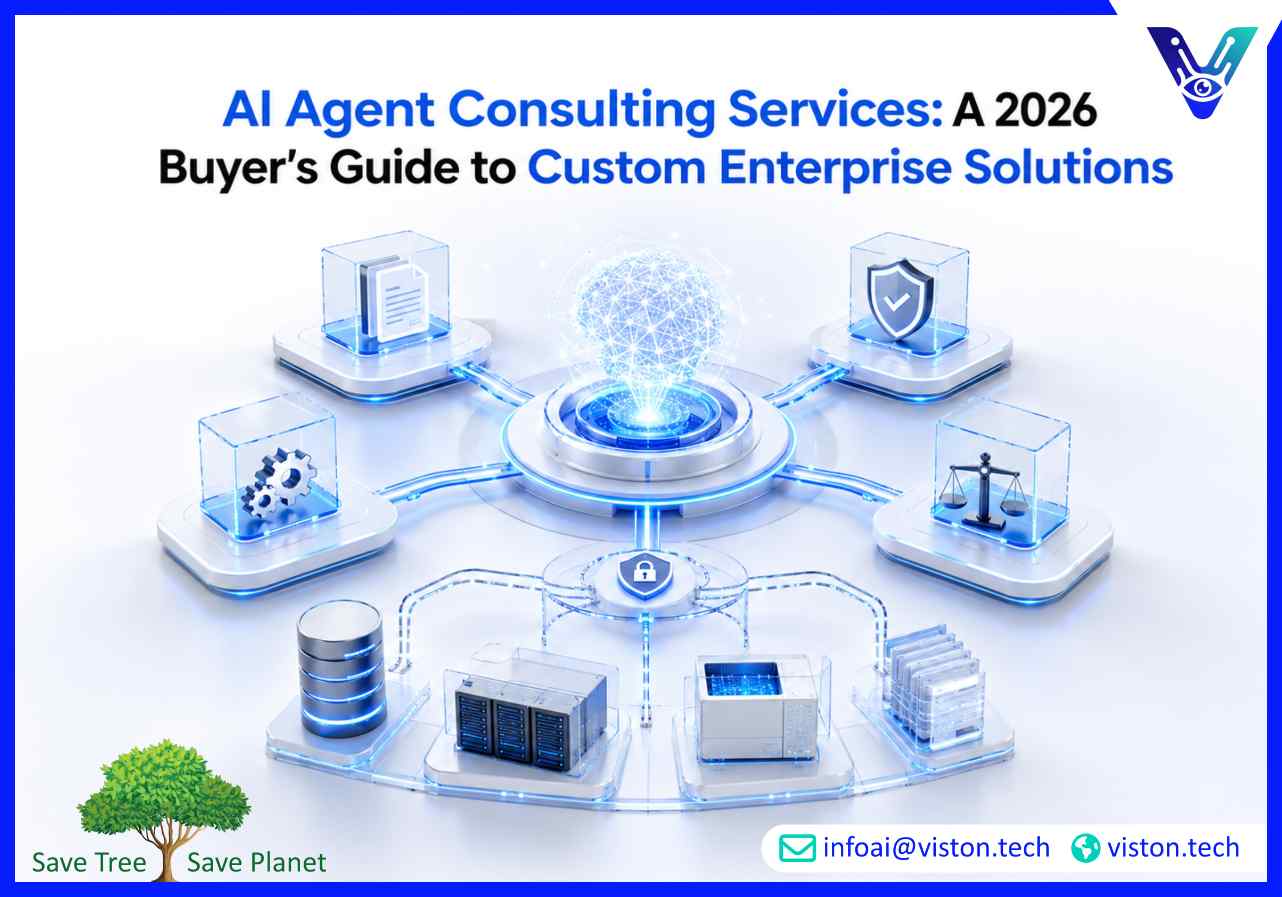
The shift from generative AI to autonomous AI agents represents the most significant operational shift for enterprises since cloud computing. But buying AI agent consulting services is different from traditional IT consulting. Success demands specialized expertise in orchestration, governance, and multi-agent architectures. Here is what decision-makers need to know before investing.
AI agent consulting services help organizations design, build, deploy, and govern autonomous AI systems that pursue goals independently. Unlike traditional automation or chatbot implementations, agentic AI can observe context, make decisions across multiple steps, and take action within defined boundaries.
For business buyers, the distinction matters. A chatbot follows scripted paths. An AI agent reasons through complexity, negotiates between sub-options, and coordinates across systems without constant human prompting. This capability transforms how work gets done—but only when implemented correctly.
In 2026, the market has matured past the pilot phase. Enterprise leaders expect measurable outcomes. According to recent industry analysis, while AI agent solutions generated over $10 billion in revenue in 2024, only a minority of companies currently extract consistent bottom-line value from their implementations. The gap is not technological. It is about integration, governance, and execution expertise.
Many organizations attempt to build AI agent capabilities internally. The obstacles that emerge are rarely technical.
Data fragmentation is the first barrier. AI agents require clean, accessible data across systems. Most enterprises operate with siloed databases, inconsistent taxonomies, and undocumented APIs. An agent that cannot reliably pull from CRM, ERP, and support platforms cannot function.
Governance gaps follow closely. Autonomous systems need clear decision boundaries. Who approves what? What happens when an agent encounters an edge case? What audit trails exist? Organizations without established frameworks often find their pilots stalled by legal, compliance, or security reviews.
Orchestration complexity catches many teams off guard. A single workflow might require multiple specialized agents working together: one for document parsing, another for policy checking, a third for exception handling. Coordinating these subagents requires architecture expertise that most internal teams lack.
This explains the rising demand for AI agent consulting services. External specialists bring battle-tested patterns, governance frameworks, and multi-agent orchestration experience that would take years to develop internally.
Custom AI agent solutions differ fundamentally from off-the-shelf products. A pre-built agent might handle basic customer support queries. A custom solution integrates with proprietary systems, follows unique business rules, and adapts to specific regulatory requirements.
The practical outcomes include:
For finance, IT operations, customer support, and supply chain management, custom AI agent solutions are moving from experimental to essential.
Selecting a consulting partner requires scrutiny beyond standard IT vendor evaluation. Here are the specific capabilities to assess.
Ask prospective partners how they design multi-agent systems. Do they use established frameworks for agent-to-agent communication? How do they handle conflicts between agents? What patterns do they employ for fault tolerance? Vague answers signal shallow experience.
Governance cannot be an afterthought. The right consulting service builds audit trails, approval workflows, and rollback capabilities into the architecture from day one. Every agent decision should be logged, explainable, and reversible. Ask for examples of governance frameworks they have deployed in regulated industries.
Custom AI agent solutions are only as valuable as the systems they connect to. Confirm that the consulting partner has proven experience with your specific technology stack—whether that includes Salesforce, SAP, Microsoft Dynamics, custom APIs, or legacy on-premise systems.
In 2026, regulatory attention on autonomous systems is intensifying. Your consulting partner should demonstrate familiarity with emerging standards, data residency requirements, and industry-specific compliance needs. For organizations in healthcare, financial services, or government, this is non-negotiable.
Beware of consulting engagements that cannot define success metrics in advance. Experienced AI agent consultants establish baseline performance, define acceptable accuracy thresholds, and build monitoring dashboards that track real business impact.
For organizations seeking enterprise-grade AI agent capabilities, Viston AI provides custom AI agent solutions built for measurable business outcomes. Based in Ahmedabad, India, and serving global clients since 2021, Viston AI combines technical depth with practical implementation experience across finance, healthcare, retail, manufacturing, and logistics.
Their approach addresses the three barriers that derail most agentic AI initiatives. First, data integration: Viston AI architects connections across fragmented systems, ensuring agents have reliable access to the information they need. Second, governance: security, compliance, and auditability are embedded into every solution, not added as an afterthought. Third, orchestration: their team designs modular multi-agent architectures that scale without becoming brittle.
What distinguishes Viston AI is its focus on ROI and deployment speed. The firm provides AI strategy and consulting alongside technical implementation, helping clients identify high-value use cases before writing a single line of code. For organizations frustrated by stalled pilots or disappointing vendor results, Viston AI offers a practical path to production-ready AI agents that actually deliver on the promise of autonomous operations.
Traditional automation follows predefined rules. AI agents observe context, make decisions across multiple steps, adapt to unexpected situations, and learn from feedback. They can orchestrate tasks across multiple systems rather than being confined to one tool.
Costs vary significantly based on complexity, integration requirements, and governance needs. Entry-level implementations for well-defined workflows typically start around $50,000 to $100,000. Enterprise-scale multi-agent systems often exceed $250,000. Most consulting providers structure engagements in phases, beginning with discovery and a pilot implementation.
Finance operations, including invoice processing and expense auditing, IT support, including ticket triage and incident response, customer service, including intelligent routing and resolution automation, and compliance monitoring are current high-ROI use cases. Internal operational workflows generally succeed before customer-facing applications.
A pilot implementation typically requires 8 to 12 weeks, including discovery, design, sandbox testing, and supervised deployment. Full enterprise rollout with multiple agents and integrations often takes 4 to 6 months. The sandbox phase—where agents operate in parallel without touching production—is essential for calibration.
Audit logging of every agent decision, human-in-the-loop approval workflows for high-risk actions, kill switches and manual overrides, explainability tools showing why an agent made a specific choice, and automated rollback capabilities when accuracy falls below threshold.
AI agent consulting services have evolved from experimental to essential for enterprises serious about operational efficiency. The organizations capturing real value are not those with the most advanced models—they are those with the most disciplined approach to integration, governance, and multi-agent orchestration. Custom AI agent solutions offer the specificity that off-the-shelf products cannot match, but only when implemented by partners who understand enterprise realities. For business leaders evaluating this space, prioritize demonstrated architecture expertise, embedded governance capabilities, and measurable outcome track records. The technology is ready. The question is whether your implementation approach is.
