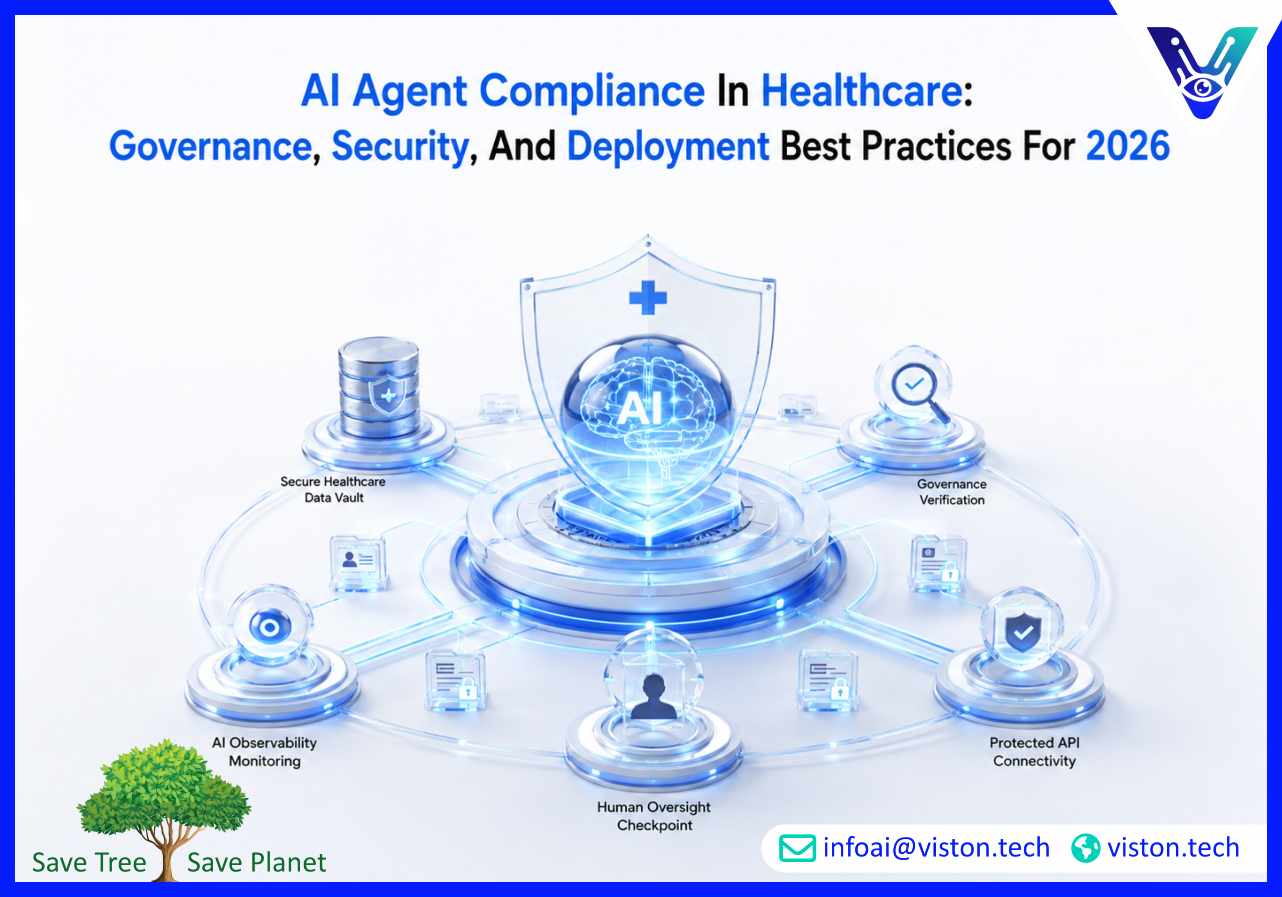
AI Agent Compliance in Healthcare: Governance, Security, and Deployment Best Practices for 2026
Introduction
AI agents are rapidly becoming part of healthcare operations, from clinical documentation and patient engagement to workflow automation and diagnostics support. As adoption grows, healthcare organizations face increasing pressure to ensure these systems remain compliant, secure, explainable, and operationally reliable in highly regulated environments.
Understanding AI Agent Compliance in Healthcare
AI agent compliance in healthcare refers to the frameworks, controls, governance models, and operational safeguards used to ensure AI systems operate within legal, ethical, clinical, and cybersecurity standards.Unlike traditional automation tools, AI agents can make decisions, trigger workflows, access sensitive patient data, interact with clinical systems, and continuously adapt based on inputs. This creates additional compliance responsibilities for healthcare providers, healthtech companies, insurers, and enterprise healthcare networks.In 2026, compliance is no longer limited to data privacy alone. Healthcare organizations must now address:
Patient data protection
AI explainability and auditability
Model governance
Human oversight requirements
Security monitoring
Bias mitigation
Clinical workflow accountability
Third-party AI vendor risks
AI infrastructure governance
Regulatory reporting readiness
As enterprise AI deployments become more autonomous, healthcare compliance teams are increasingly collaborating with engineering, legal, cybersecurity, and operations departments to establish organization-wide AI governance programs.
Why AI Agent Compliance Matters More in 2026
Healthcare remains one of the most regulated industries globally, and AI adoption has accelerated faster than many governance frameworks initially anticipated.Several factors are driving stricter compliance expectations in 2026:
Expansion of Autonomous AI Workflows
AI agents are now handling tasks such as:
Prior authorization processing
Clinical summarization
Patient triage assistance
Medical coding support
Care coordination workflows
Claims validation
Revenue cycle automation
Internal healthcare operations
As these systems gain operational authority, organizations must ensure accountability mechanisms are clearly defined.
Increased Regulatory Scrutiny
Healthcare regulators globally are introducing clearer expectations around:
AI transparency
Clinical decision traceability
Data residency
Cross-border healthcare data usage
Explainable AI systems
Risk classification for AI-enabled healthcare tools
Organizations deploying healthcare AI without structured governance face growing legal, operational, and reputational exposure.
Rising Cybersecurity Risks
Healthcare remains a primary target for ransomware and identity-based attacks. AI agents connected to electronic health records (EHRs), internal APIs, billing systems, and patient databases increase the potential attack surface.Compliance programs now require AI-specific security controls, including:
Identity and access governance
Runtime monitoring
Prompt injection protection
Secure model orchestration
API security management
Encrypted agent communications
Infrastructure segmentation
Key Compliance Areas for Healthcare AI Agents
Healthcare organizations evaluating AI agent deployment must assess compliance across multiple operational layers.
Data Privacy and Patient Information Protection
Healthcare AI systems frequently process protected health information (PHI), making privacy governance foundational.Organizations must ensure:
Data minimization practices
Role-based access controls
Secure data storage
Encryption at rest and in transit
Consent management
Retention policy alignment
Controlled third-party integrations
Secure training data pipelines
AI agents should only access the minimum data necessary to complete specific workflows.Healthcare enterprises are increasingly implementing zero-trust architectures for AI environments to reduce internal exposure risks.
Auditability and Decision Traceability
Healthcare organizations need clear visibility into:
What an AI agent did
Why it acted
Which data influenced outcomes
What systems were accessed
Whether human intervention occurred
Audit logs are becoming essential for operational governance, legal reviews, incident response, and compliance investigations.Modern healthcare AI systems now require:
Immutable logging
Workflow replay capabilities
Version-controlled prompts
Model lineage tracking
Agent activity monitoring
Automated compliance reporting
Without these controls, healthcare organizations may struggle to demonstrate accountability during audits or regulatory reviews.
Human Oversight and Escalation Controls
AI agents should not operate without clear supervision boundaries in healthcare environments.Organizations increasingly deploy layered escalation frameworks where:
Human-in-the-loop governance helps reduce operational risk while supporting regulatory defensibility.This is particularly important for AI systems involved in:
Clinical recommendations
Medication workflows
Diagnostic support
Patient communication
Insurance decisions
Emergency triage systems
Bias, Fairness, and Ethical AI Governance
Healthcare AI systems can unintentionally amplify disparities if training data or workflows contain hidden bias.Compliance strategies increasingly include:
Bias testing protocols
Representative dataset validation
Model drift monitoring
Fairness evaluation reporting
Demographic outcome analysis
Ethical AI review committees
Healthcare organizations are expected to demonstrate proactive bias management rather than reacting after incidents occur.
AI Security and Infrastructure Governance
AI agent security has become a major enterprise priority in 2026.Healthcare AI deployments often involve:
Multiple LLM providers
Internal orchestration layers
API-based integrations
Cloud infrastructure
Sensitive operational data
Real-time workflows
Compliance-ready infrastructure typically includes:
Secure Model Access Controls
Organizations should restrict:
Prompt access
Administrative permissions
Deployment privileges
Integration authorizations
Data retrieval pathways
Runtime Monitoring
Healthcare AI systems increasingly require continuous monitoring for:
Unusual behavior
Unauthorized data access
Hallucination risks
Prompt manipulation
Output anomalies
Performance degradation
Infrastructure Segmentation
Leading healthcare organizations separate AI environments from core clinical systems where possible to reduce operational exposure.This often includes:
Dedicated AI workloads
Controlled API gateways
Segmented cloud environments
Independent logging systems
Network isolation policies
Compliance Challenges During AI Agent Deployment
Many healthcare organizations underestimate the complexity of production AI deployment.Common compliance-related deployment challenges include:
Legacy System Integration
Healthcare environments frequently rely on older infrastructure, including EHR platforms, imaging systems, and fragmented operational databases.AI agents must integrate without compromising compliance or introducing security gaps.
Vendor Governance
Healthcare organizations increasingly use multiple AI vendors simultaneously.This creates challenges around:
Data ownership
Infrastructure visibility
Third-party risk management
Cross-platform auditability
Service-level accountability
Vendor due diligence has become a critical procurement requirement.
Operational Drift
AI systems evolve over time.Without governance frameworks, organizations risk:
Untracked workflow changes
Degraded outputs
Policy misalignment
Regulatory exposure
Security vulnerabilities
Continuous AI governance is now considered an operational necessity rather than a one-time implementation exercise.
Best Practices for Compliant AI Agent Deployment in Healthcare
Healthcare enterprises adopting AI agents successfully in 2026 typically follow several operational best practices.
Establish AI Governance Early
Compliance cannot be added after deployment.Organizations should define:
AI usage policies
Approval workflows
Security standards
Risk classifications
Escalation rules
Monitoring procedures
Vendor evaluation criteria
before implementation begins.
Prioritize Explainable Architectures
Healthcare stakeholders increasingly favor AI systems that provide transparent reasoning and traceable outputs.This is especially important for:
Clinical operations
Patient-facing interactions
Regulatory reporting
Internal audits
Explainability improves trust across legal, technical, operational, and clinical teams.
Build Compliance Into Deployment Pipelines
Modern AI deployment pipelines increasingly include:
Automated policy checks
Security validation
Prompt testing
Access verification
Logging enforcement
Risk scoring
Governance approvals
Compliance automation helps reduce operational overhead while improving consistency.
Use Continuous Monitoring and Observability
AI observability has become essential for healthcare environments.Organizations should monitor:
Agent performance
Workflow outcomes
Security anomalies
Prompt activity
API usage
Model reliability
Compliance deviations
Real-time visibility improves incident response and governance maturity.
How Viston AI Supports Healthcare AI Agent Deployment
Viston AI specializes in AI agent development and deployment for enterprise environments where governance, scalability, security, and operational reliability are critical.For healthcare organizations, compliant AI deployment requires more than building intelligent workflows. It involves designing secure architectures, integrating with existing systems, managing sensitive data responsibly, and ensuring AI agents operate within clearly governed boundaries.Viston AI supports businesses implementing AI-driven operational systems through capabilities such as:
Enterprise AI agent architecture design
Secure deployment pipelines
Multi-agent orchestration
Workflow automation
AI observability and monitoring
Infrastructure integration
Governance-focused deployment strategies
API and enterprise system connectivity
Scalable AI operations management
In healthcare settings, these capabilities are especially relevant where organizations must balance innovation with compliance, auditability, and patient data protection.As healthcare enterprises expand AI adoption across operations, administration, and support functions, implementation quality becomes a significant differentiator. Reliable deployment frameworks, monitoring systems, and governance controls are increasingly necessary for organizations seeking sustainable AI adoption rather than isolated experimentation.
What Healthcare Leaders Should Evaluate Before Choosing an AI Deployment Partner
Healthcare organizations evaluating AI implementation partners should assess more than model capabilities alone.Key evaluation areas include:
Security and Compliance Readiness
Providers should demonstrate experience with:
Secure infrastructure design
Access management
Healthcare data handling
Logging systems
Monitoring frameworks
Governance implementation
Integration Capability
Healthcare systems are highly interconnected.Deployment partners should support:
EHR integration
API orchestration
Cloud infrastructure compatibility
Enterprise workflow automation
Data pipeline management
Scalability and Operational Support
AI systems must remain stable as usage grows.Organizations should evaluate:
Deployment reliability
Observability tooling
Maintenance workflows
Incident response processes
Long-term support capability
Governance and Risk Awareness
Healthcare AI deployment requires operational maturity, not just technical execution.Experienced providers understand:
AI risk management
Human oversight requirements
Enterprise governance expectations
Compliance-driven architecture decisions
Frequently Asked Questions
What is AI agent compliance in healthcare?
AI agent compliance in healthcare refers to the governance, security, privacy, monitoring, and operational controls used to ensure AI systems operate safely and legally within healthcare environments.
Why is AI governance important for healthcare AI systems?
Healthcare AI systems often process sensitive patient information and influence operational or clinical workflows. Governance helps organizations manage risk, maintain accountability, and meet regulatory expectations.
What are the biggest compliance risks with healthcare AI agents?
Common risks include unauthorized data access, insufficient audit trails, biased outputs, insecure integrations, lack of human oversight, and poor monitoring of AI-driven workflows.
How can healthcare organizations deploy AI agents securely?
Secure deployment typically involves role-based access controls, encrypted infrastructure, runtime monitoring, audit logging, governance workflows, and continuous compliance monitoring.
What should healthcare companies look for in an AI deployment partner?
Organizations should evaluate security practices, healthcare integration expertise, governance capabilities, scalability, observability tooling, and operational support experience.
Does Viston AI support enterprise AI deployment for regulated industries?
Yes. Viston AI focuses on AI agent development and deployment for enterprise environments where governance, scalability, operational reliability, and secure implementation are important considerations.
Conclusion
AI agent compliance in healthcare has become a core operational requirement as organizations expand AI adoption across clinical, administrative, and enterprise workflows. In 2026, successful AI deployment depends not only on model performance but also on governance maturity, infrastructure security, auditability, and responsible operational oversight.Healthcare organizations investing in AI agent development and deployment must prioritize scalable compliance frameworks from the beginning. This helps reduce operational risk, improve trust, strengthen security posture, and support sustainable long-term AI adoption. For enterprises navigating these challenges, providers such as Viston AI can support the deployment of structured, enterprise-ready AI systems aligned with modern governance expectations.