
AI Agent Compliance Frameworks: What Enterprise Teams Need to Know Before Deploying Agentic Workflows in 2026
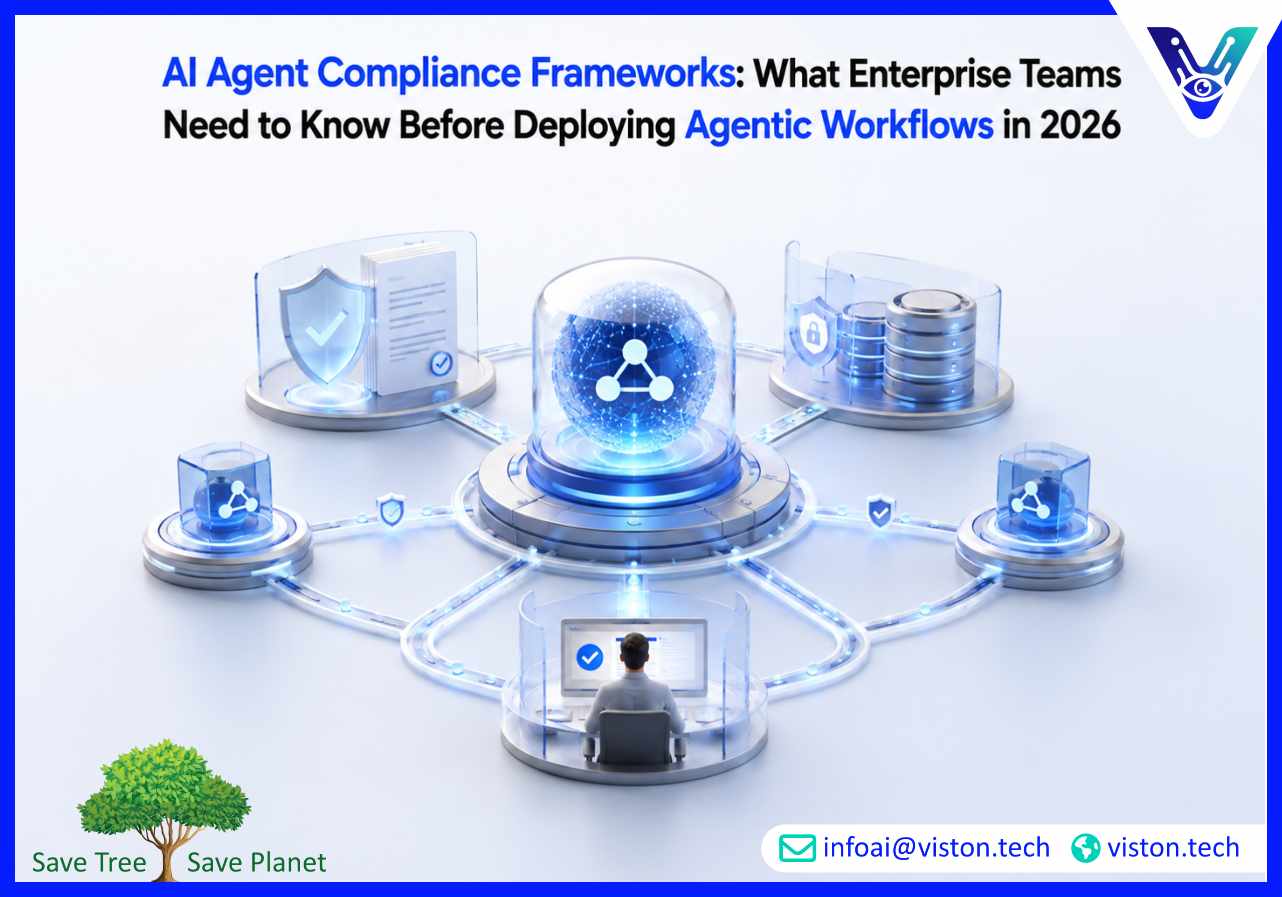
Autonomous AI agents are no longer experimental. Enterprises across finance, healthcare, logistics, and operations are running agentic workflows in production — systems that make decisions, execute tasks, and coordinate processes with minimal human intervention. That capability is powerful. It is also the reason AI agent compliance frameworks have moved from a governance afterthought to a board-level priority in 2026.
Why Compliance Is Now Inseparable From Agentic AI Deployment
For most of the past few years, AI governance existed primarily in policy documents. That period is effectively over
The EU AI Act reaches full enforcement on August 2, 2026. For organizations deploying AI agents that influence hiring, lending, healthcare decisions, legal services, or any designated high-risk category, this carries direct financial and operational consequences. Penalties under Article 99 reach up to €35 million or 7% of global annual turnover. These are not theoretical risks — they are enforcement-grade obligations with a fixed deadline.
Beyond the EU, NIST released AI RMF version 1.1 in March 2026, which has become the practical baseline for US federal procurement and enterprise vendor evaluation. ISO/IEC 42001 is increasingly requested alongside SOC 2 and ISO 27001 in procurement assessments. Singapore launched the world’s first dedicated governance framework specifically for agentic AI in January 2026.
The compliance landscape for AI agents is not abstract. It is specific, accelerating, and tied directly to how organizations architect, deploy, and monitor their agentic workflows.
What Makes Agentic Workflows a Distinct Compliance Challenge
Traditional software systems follow deterministic logic. You can audit them, trace them, and predict their behavior under known conditions. Agentic workflows are fundamentally different.
An AI agent observes context, reasons through goals, selects actions, and executes tasks dynamically. In multi-agent architectures, one orchestrating agent directs several sub-agents, each operating across different systems, data sources, and APIs. The decisions these agents make can be distributed, emergent, and difficult to attribute to any single instruction or design choice.
This creates compliance problems that static governance models are not built to address:
- Accountability gaps. When an agentic workflow produces a harmful or incorrect outcome, responsibility is often fragmented across the model, the orchestration layer, the integration design, and the business rules. Without explicit ownership assigned at each layer, liability spreads without clarity.
- Audit traceability. Compliance frameworks require that AI systems produce evidence — logs, decision trails, human oversight triggers, and intervention records. Many agentic systems are deployed without this infrastructure in place from day one, creating retroactive compliance debt.
- Data boundaries. AI agents frequently interact with sensitive internal data, customer records, and third-party APIs. Without enforced data residency controls, role-based access, and tenant isolation, even well-intentioned agentic deployments can expose organizations to GDPR, HIPAA, or sector-specific data obligations.
- Autonomy limits. Frameworks like the EU AI Act and NIST AI RMF require that high-stakes AI systems maintain meaningful human oversight. In agentic architectures, defining where autonomous execution is appropriate and where human-in-the-loop validation is required is both a design decision and a compliance requirement.
The Five Frameworks Shaping Enterprise AI Agent Governance
Most enterprise compliance programs in 2026 are built around a core set of overlapping frameworks. Understanding how they interact matters before deployment decisions are made.
- EU AI Act (Regulation 2024/1689) applies to any organization operating in or selling into the EU. Its risk-based approach classifies AI systems by potential impact, with the highest obligations reserved for systems that influence consequential decisions.
- NIST AI RMF 1.1 organizes enterprise governance around four functions — Govern, Map, Measure, and Manage — and has become the de facto reference architecture for US enterprise and federal contexts.
- ISO/IEC 42001 provides a structured AI Management System standard comparable to ISO 27001 for information security. Enterprise buyers are increasingly treating it as a vendor evaluation criterion.
- SOC 2 (AICPA TSP 100) remains relevant for agentic platforms that handle sensitive customer data, particularly in SaaS and B2B contexts.
- GDPR governs how AI agents process personal data across European markets, with direct relevance to any agentic workflow touching customer-facing processes.
The practical challenge for most organizations is that these frameworks overlap significantly but are not identical. Controls that satisfy one do not automatically satisfy another. Engineering teams making architecture decisions without awareness of specific article-level requirements often create compliance gaps that surface only when assessed against the full framework set.
What Compliance-Ready Agentic Architecture Looks Like in Practice
Deploying compliant agentic workflows is primarily an architecture and engineering challenge. Policy documents without underlying technical controls provide no actual protection.
The foundations of compliant agentic architecture include:
- Observability from day one. Every agent action, tool call, decision node, and handoff should be traceable. Deep tracing — using tools like LangSmith for LangGraph-based systems, for example — allows teams to identify exactly where a failure occurred, which agent made which decision, and when latency or unexpected behavior emerged.
- Defined autonomy boundaries. Explicitly define which tasks an agent can execute autonomously and which require human validation before proceeding. Human-in-the-loop checkpoints are not just good practice — in high-risk categories under the EU AI Act, they are a regulatory requirement.
- Role-based access and data isolation. Agents should operate on the principle of least privilege. They should have access only to the data and systems their specific function requires. Cryptographic tenant boundaries and dedicated environment controls prevent unintended data commingling.
- Governance-aligned orchestration. Orchestration layers should enforce business rules, compliance policies, and behavioral guardrails as part of the workflow design itself, not as external checks added afterward.
- Lifecycle ownership. Assign explicit ownership for every AI agent across its full lifecycle — development, deployment, monitoring, and retirement. Distributed ownership without accountability structure creates the exact liability gaps that regulators and enterprise buyers scrutinize.
How Viston AI Approaches Compliance Within Agentic Workflow Engineering
For enterprise teams evaluating agentic AI partners, the question is not simply whether a vendor can build multi-agent systems. The more important question is whether they build them with the controls, observability, and governance architecture that compliance frameworks require.
Viston AI brings over 15 years of data and ML engineering experience to agentic workflow design, with a delivery track record across clients in the USA, Europe, and Australia — regions where the EU AI Act, NIST AI RMF, GDPR, and APRA compliance requirements directly shape deployment expectations.
Viston’s engineering approach is built around deterministic control and observability. Their LangGraph development practice prioritizes explicit control flows, LangSmith-based tracing from day one, and state management that maintains context reliably across extended agent interactions. For organizations using Camunda, Viston designs BPMN workflows with full adherence to BPMN 2.0 and DMN 1.3 standards — architectures explicitly designed to meet GDPR, HIPAA, and APRA requirements.
Critically, Viston treats compliance considerations as engineering inputs, not post-deployment additions. Guardrails, access controls, legacy system integration with appropriate security boundaries, and cost-aware architectures that minimize unnecessary data exposure are built into the workflow design from the outset.
For enterprise leaders moving from agentic prototypes to production-grade systems — where compliance, accountability, and audit-readiness are non-negotiable — Viston’s combination of framework-specific expertise and real-world deployment experience makes them a technically credible partner.
Frequently Asked Questions
What is an AI agent compliance framework?
An AI agent compliance framework is a structured set of policies, technical controls, governance structures, and accountability mechanisms that govern how autonomous AI agents are designed, deployed, monitored, and audited. Key frameworks in 2026 include the EU AI Act, NIST AI RMF 1.1, ISO/IEC 42001, SOC 2, and GDPR.
Does the EU AI Act apply to agentic workflows?
Yes. If your agentic workflows influence decisions in high-risk categories — such as hiring, lending, healthcare, or critical infrastructure — EU AI Act obligations apply from August 2, 2026. This includes requirements for human oversight, transparency, risk management documentation, and audit logging.
What does human-in-the-loop mean in the context of agentic AI compliance?
Human-in-the-loop refers to defined checkpoints within an agentic workflow where a human must review, validate, or approve an agent’s proposed action before execution continues. Compliance frameworks require these checkpoints for high-stakes or high-risk decisions to ensure accountability and error correction.
What technical controls are required for compliant agentic AI deployment?
Core technical requirements include full observability and decision tracing, role-based access controls, data isolation and residency enforcement, defined autonomy limits, human oversight triggers, and lifecycle ownership documentation. These controls need to be built into the architecture, not applied retroactively.
How does ISO/IEC 42001 relate to agentic AI deployments?
ISO/IEC 42001 provides an AI Management System standard that structures how organizations govern AI across its lifecycle. Enterprise buyers and regulated-industry clients are increasingly requesting ISO 42001 certification or alignment as part of vendor assessment, particularly for agentic systems handling sensitive data or consequential decisions.
Can Viston AI help build governance-ready agentic workflows?
Yes. Viston’s engineering practice is built around deterministic control, observability, and compliance-aware architecture. Their experience with GDPR, HIPAA, and APRA-aligned deployments across USA, European, and Australian enterprise clients makes them a relevant partner for organizations that need agentic workflows built to meet current regulatory standards.
Conclusion
AI agent compliance frameworks are not a future consideration — they are a present-tense engineering and governance requirement. With the EU AI Act’s full enforcement window opening in August 2026, NIST AI RMF 1.1 shaping enterprise procurement, and ISO 42001 becoming a standard vendor evaluation criterion, organizations deploying agentic workflows without a structured compliance architecture are taking measurable regulatory and reputational risk.
The organizations that will deploy agentic AI confidently are those that treat compliance as a design input, not an afterthought. That means choosing the right frameworks, building the right technical controls, and working with partners who understand both the engineering requirements and the regulatory stakes. Viston AI’s approach to agentic workflow engineering reflects exactly that priority — governance-aware, observable, and built for production environments where compliance is not optional.
