
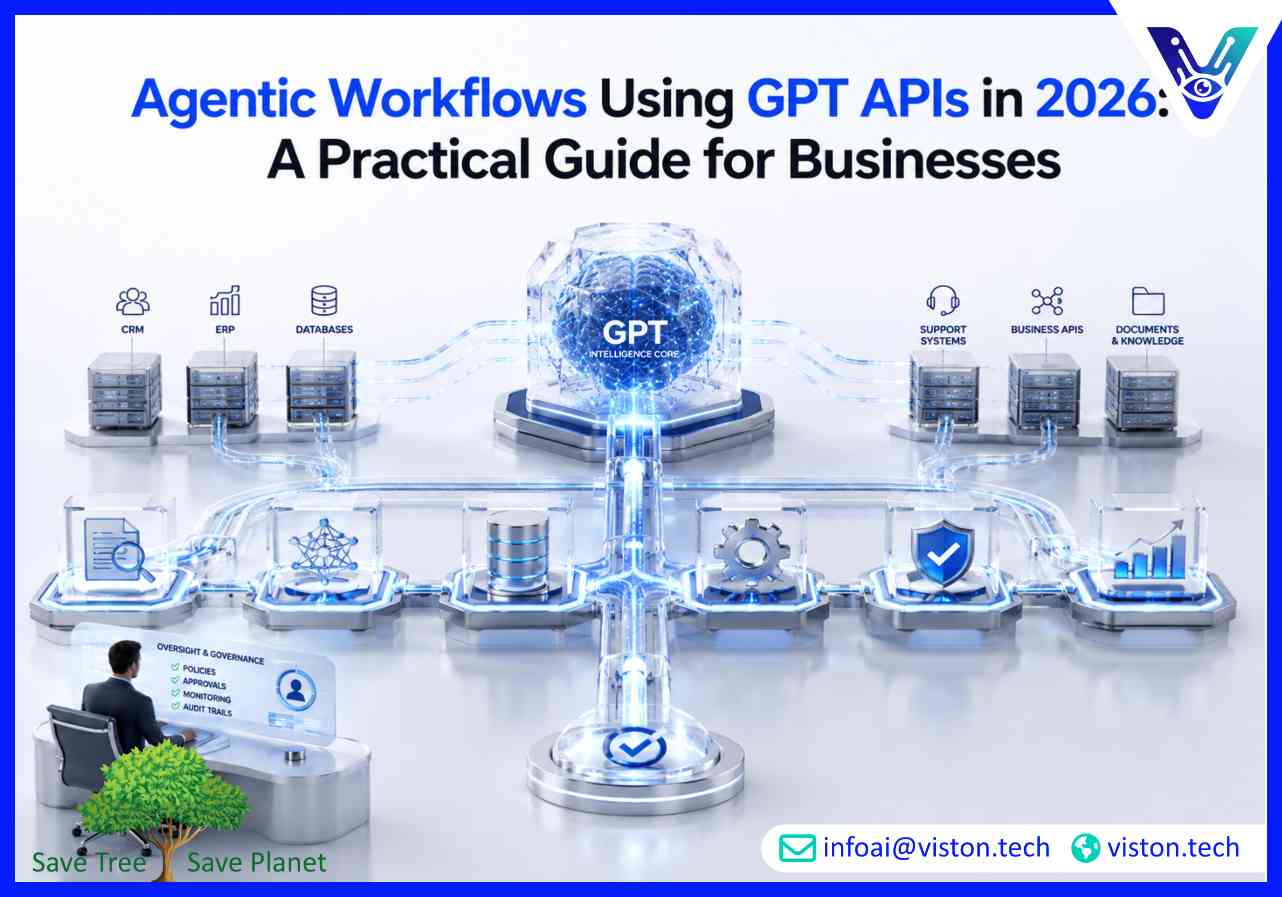
Businesses are increasingly moving beyond simple AI chatbots and experimenting with agentic workflows that can perform tasks, make decisions, interact with systems, and complete multi-step processes. GPT APIs have become a foundational technology for building these workflows, enabling organizations to automate operations while maintaining oversight, security, and business control
Agentic workflows are structured business processes where AI agents perform specific tasks autonomously within defined rules and objectives. Unlike traditional AI interactions that respond to a single prompt, agentic workflows use GPT APIs to manage sequences of actions, retrieve information, interact with tools, evaluate outcomes, and coordinate multiple workflow stages.
GPT APIs provide the intelligence layer that allows agents to understand context, reason through tasks, generate outputs, and interact with business systems. These APIs can be integrated with databases, CRMs, customer support platforms, enterprise software, internal documentation systems, and third-party applications.
A typical agentic workflow may involve:
The goal is not simply generating text but executing meaningful business processes with controlled autonomy.
Organizations are facing increasing pressure to improve efficiency, reduce operational bottlenecks, and scale processes without proportionally increasing headcount. Traditional automation solutions work well for repetitive rule-based activities but often struggle when workflows require contextual understanding, decision-making, or dynamic problem-solving.
GPT-powered agentic workflows address these limitations by introducing intelligence into operational processes.
GPT APIs enable agents to handle research, analysis, data interpretation, document processing, and communication tasks that previously required significant manual effort.
Agentic systems can perform multiple actions simultaneously, reducing delays caused by manual coordination between departments, applications, and stakeholders.
Organizations can automate increasingly complex workflows without creating extensive rule-based systems that become difficult to maintain.
GPT APIs can access internal documentation, knowledge bases, policies, procedures, and historical records to support accurate workflow execution.
Agentic workflows can improve response times, service consistency, issue resolution, and personalized customer interactions.
As AI adoption matures, businesses are focusing less on standalone AI assistants and more on workflow-driven AI systems that generate measurable operational value.
Successful implementations require more than connecting a GPT API to a business application. Reliable workflows depend on a structured architecture designed for scalability, governance, and business outcomes.
Each agent should have a clearly defined role. Examples include research agents, support agents, planning agents, document-processing agents, reporting agents, compliance-review agents, and workflow-monitoring agents.
Specialized agents typically deliver more predictable and maintainable outcomes than general-purpose agents attempting to handle every task.
Orchestration determines how tasks move through the workflow. It controls sequencing, approvals, routing logic, retries, escalation paths, and communication between agents.
Without orchestration, agents operate independently and may fail to produce reliable business results.
GPT APIs become significantly more valuable when connected to business tools and operational systems.
Common integrations include:
Agents must have access to relevant information throughout the workflow. Effective context management improves consistency, accuracy, and decision quality.
This may include customer data, workflow history, business policies, compliance requirements, operational procedures, and historical interactions.
Organizations must establish clear rules around permissions, access control, data handling, audit logging, monitoring, and approval requirements.
Strong governance is particularly important when agents interact with sensitive business systems or customer information.
Successful deployment starts with understanding the business process before selecting technology.
The best candidates are workflows that are repetitive, time-consuming, involve multiple systems, and require contextual decision-making.
Common examples include:
Organizations should document triggers, inputs, outputs, approvals, dependencies, exceptions, and business rules before developing agents.
This creates a clear understanding of where GPT APIs can add value and where human oversight remains necessary.
Breaking workflows into specialized responsibilities improves reliability. Each agent should have clearly defined objectives, permissions, and expected outputs.
Agents need secure access to the systems involved in workflow execution. Integration planning is often one of the most critical stages of implementation.
Output verification, confidence scoring, business rules, and approval checkpoints help maintain quality and reduce operational risk.
Organizations should measure workflow completion rates, accuracy, response times, cost efficiency, escalation frequency, and business outcomes.
Continuous optimization is essential as business requirements evolve.
Agentic workflows can support multiple departments and operational functions.
The most successful deployments focus on business outcomes rather than technology features alone.
As businesses explore agentic workflows using GPT APIs, implementation complexity often becomes a significant challenge. Building reliable workflows requires more than API access. Organizations need workflow design, orchestration planning, system integration, governance controls, monitoring frameworks, and ongoing optimization.
Viston AI specializes in Agentic AI Workflows that help organizations move from isolated AI experiments to structured business automation. Its approach focuses on connecting GPT-powered agents with operational processes, enterprise systems, business data, and workflow requirements.
For organizations seeking scalable AI automation, Viston AI supports workflow architecture design, agent orchestration, integration planning, automation deployment, and operational optimization. This enables businesses to implement practical agentic systems that improve efficiency while maintaining visibility, accountability, and control.
Rather than treating AI as a standalone tool, the focus is on building workflow-driven solutions that align with real operational objectives and measurable business outcomes.
Agentic workflows use GPT APIs to power AI agents that can perform tasks, interact with systems, make decisions within defined rules, and complete multi-step business processes.
Traditional automation follows predefined rules, while agentic workflows use AI reasoning and contextual understanding to handle more dynamic and complex business scenarios.
In many cases, yes. Organizations often include human approval stages for financial, legal, compliance-related, or high-impact decisions.
Sales, customer support, finance, HR, operations, knowledge management, and workflow automation initiatives commonly benefit from agentic AI implementations.
Yes. GPT APIs can be integrated with CRMs, ERPs, databases, support platforms, document systems, communication tools, and custom business applications.
Viston AI provides Agentic AI Workflow services that support workflow design, agent orchestration, integrations, deployment planning, and optimization for business-focused AI automation initiatives.
Agentic workflows using GPT APIs represent a significant evolution in business automation for 2026. By combining AI reasoning, workflow orchestration, system integrations, and governance controls, organizations can automate complex operational processes that extend beyond traditional automation capabilities. Success depends on thoughtful workflow design, secure integrations, performance monitoring, and clear business objectives. For companies exploring Agentic AI Workflows, Viston AI offers expertise that helps transform GPT-powered automation into structured, scalable, and outcome-driven business solutions.
