
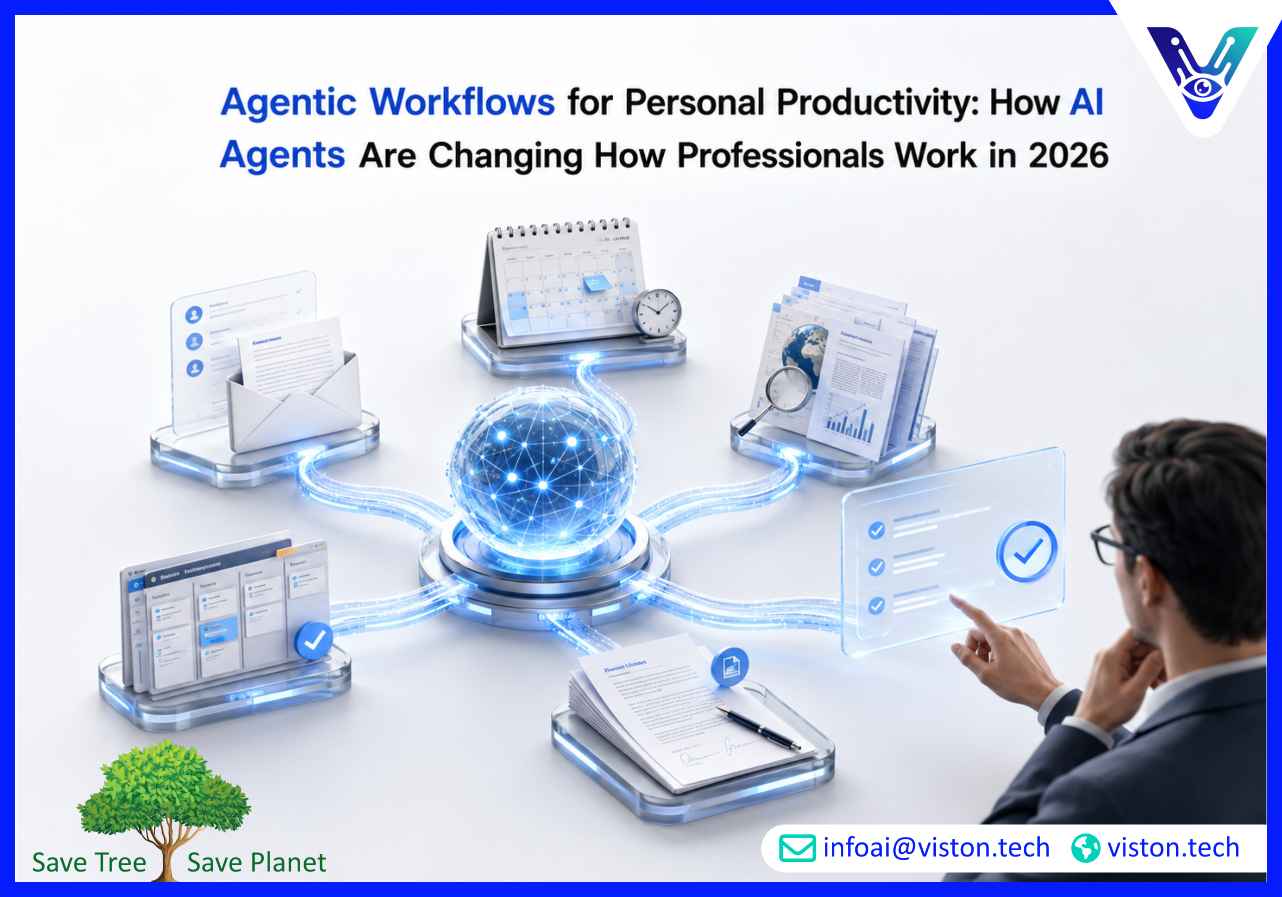
A practical guide for professionals and business leaders ready to move beyond basic AI assistance
Personal productivity has always been about working smarter — but in 2026, the tools available to professionals have moved well beyond calendars, task managers, and simple AI assistants. Agentic workflows for personal productivity represent a genuine shift in how individuals manage their time, decisions, and output, giving ambitious professionals a meaningful edge in an increasingly competitive environment.
Most people have experienced AI as a reactive tool. You ask a question; it answers. You paste a document; it summarises. This is useful, but it is fundamentally passive. Agentic AI workflows operate differently. An agentic system is given a goal, and it takes the initiative to plan, execute, monitor, and iterate — calling on the tools and information it needs without waiting for instructions at every step.
For personal productivity, this distinction is significant. Rather than asking an AI to draft an email and then manually sending it, an agentic workflow can monitor your inbox for relevant threads, draft prioritised responses based on context, schedule follow-ups, and flag items requiring your attention — all while you focus elsewhere. The work still reflects your judgment and your voice, but the execution is largely autonomous.
This is what separates agentic AI from the productivity tools most professionals are already using. It is not assistance. It is delegation — to a system capable of reasoning, adapting, and completing multi-step processes without needing you to hold its hand through each one.
The strongest candidates for agentic workflow automation are tasks that are cognitively demanding but structurally repetitive — work that requires thought, but follows recognisable patterns each time it occurs.
Professionals spend a significant portion of their working day finding, processing, and synthesising information. An agentic workflow can monitor sources relevant to your work — industry news, competitor activity, regulatory updates, client developments — and deliver a structured briefing based on your defined priorities. Rather than spending forty minutes pulling together a morning review, you arrive at a curated summary that reflects what actually matters to your decisions that day.
For deeper research tasks, agentic systems can gather information from multiple sources, cross-reference findings, identify gaps, and produce a structured output ready for your review. What previously took hours of manual effort can be reduced to a review and refinement task.
Email and calendar management remain two of the highest-friction areas of professional life. Agentic workflows can triage inbound communication by urgency and context, prepare draft responses aligned to your tone and established patterns, coordinate meeting scheduling across multiple parties, and send follow-up messages at the right moments — all without requiring your direct involvement at every step.
This is particularly valuable for founders, executives, and consultants managing high volumes of communication across multiple relationships simultaneously.
Keeping multiple projects moving requires constant attention to dependencies, deadlines, and blockers. An agentic workflow can track progress across connected systems, identify where tasks are stalling, send proactive nudges to relevant parties, and update project records automatically when actions are completed. The cognitive overhead of maintaining situational awareness across parallel workstreams — a persistent drain on professional focus — is substantially reduced.
For professionals whose output is primarily written — analysts, consultants, marketers, strategists — agentic workflows can handle first drafts, research summaries, data narratives, and document structuring. The professional’s role shifts toward direction, quality review, and refinement rather than production from scratch. Output volume increases without compromising the quality or judgement that distinguishes expert work.
The difference between an agentic workflow that genuinely improves personal productivity and one that creates more overhead than it saves is almost always in the design. Several principles apply consistently across effective personal workflow implementations.
Identify the tasks in your working day that consistently consume disproportionate time relative to the value they produce. These are your strongest candidates for agentic automation. Starting with high-volume, lower-stakes processes — inbox triage, meeting preparation, status update compilation — allows you to build confidence in the system before extending it to more consequential work.
Effective agentic workflows are goal-oriented. Rather than specifying each step an agent should take, define the outcome you need and give the system the context and tools to pursue it. A well-designed agentic workflow for research, for example, does not need to be told to check each source manually — it needs to know what question it is answering and what quality standard the output must meet.
Personal productivity workflows should include clear checkpoints for decisions that carry meaningful consequences. Agentic systems are highly effective at execution, but your judgment remains essential for anything where context, relationship nuance, or strategic alignment is at stake. The most effective personal implementations are those where the agent handles execution and the human handles direction and review.
An agentic workflow that operates in isolation from your existing stack adds friction rather than removing it. The most effective personal productivity implementations connect with the tools you already depend on — your email client, calendar, project management platform, note-taking system, and communication tools — and operate within those environments rather than requiring you to adopt an entirely parallel workflow.
Adopting agentic AI workflows for personal productivity is not simply a matter of choosing a tool and activating it. Several practical considerations should inform your approach.
Data access and permissions matter from the outset. An agent operating on your behalf needs access to the information and systems relevant to its tasks. This requires clarity on what data the system can access, how it is handled, and where it is stored — particularly for professionals working in regulated environments or handling sensitive client information.
Framework and architecture choice affects how the workflow behaves under real working conditions. Whether a workflow is built on LangGraph for stateful, structured execution or CrewAI for collaborative multi-agent processes depends on the complexity of what you are trying to automate. These decisions have downstream implications for how reliably the system performs, how easily it can be adjusted, and how its behaviour can be monitored over time.
Observability is also important at a personal level. Knowing what your agent did, when it did it, and why it made a particular decision is essential for building trust in the system and catching errors before they become problems. Tracing tools that log agent actions and decisions give you the visibility to refine and improve your workflows as your needs evolve.
Viston AI specialises in custom agentic AI workflow development, bringing over fifteen years of data and machine learning engineering experience to deployments that go well beyond off-the-shelf automation tools. Their work covers the full lifecycle of agentic system design — from initial process assessment through architecture selection, build, integration, and ongoing monitoring.
Where personal and professional productivity workflows are concerned, Viston’s capability in frameworks including LangGraph, AutoGen Studio, and CrewAI means the architecture chosen for any given workflow is matched to the actual complexity and requirements of the use case — not simply the framework most familiar to the team. Their API-first integration approach ensures that agents connect cleanly with the tools professionals already rely on, from email and calendar systems to internal databases and proprietary platforms.
Viston’s observability-first methodology — implementing deep tracing with tools such as LangSmith from day one — gives professionals and organisations full visibility into how their agents are performing and where refinements are needed. For individuals and teams operating in environments where accuracy, discretion, and accountability matter, this level of transparency is essential. Their track record across more than 2,860 client deployments in the USA, UK, Europe, and Australia reflects a consistent focus on delivering workflows that function reliably in real working conditions, not just in demonstrations.
An agentic workflow for personal productivity is an AI-driven system that can autonomously plan, execute, and adapt multi-step tasks on your behalf — such as managing communications, conducting research, coordinating schedules, or producing content — without requiring manual input at every stage. Unlike standard AI assistants, agentic systems act on goals rather than waiting for individual instructions.
Standard automation tools follow fixed, predefined rules. If the input matches the rule, the action executes. Agentic workflows are dynamic — they reason through context, make decisions based on available information, adapt when conditions change, and pursue outcomes across multiple steps. This makes them suitable for tasks involving judgment, unstructured information, or variable conditions that rule-based tools cannot handle.
The strongest candidates are tasks that are cognitively repetitive but contextually variable — inbox triage, meeting preparation, research briefings, project status monitoring, content first drafts, and follow-up coordination. Tasks requiring significant strategic judgment or sensitive relationship management are better handled with human oversight integrated into the workflow, rather than fully delegated to the agent.
Effective agentic workflow design requires a sound understanding of the underlying frameworks, integration architecture, and system behaviour under real working conditions. While some platforms offer low-code interfaces for basic implementations, workflows designed to operate reliably across complex personal or professional environments — particularly those involving multiple integrations or sensitive data — benefit significantly from specialist engineering expertise.
Viston AI begins with a comprehensive assessment of the processes to be automated, the tools involved, and the data access requirements. From there, they select the appropriate agentic framework — whether LangGraph, CrewAI, or AutoGen Studio — and build the workflow with an observability-first approach that ensures performance can be monitored, refined, and scaled over time. Their methodology is designed to deliver working implementations rapidly while maintaining the rigour required for production-grade deployments.
Security and data governance are foundational considerations in any agentic workflow deployment. Well-designed systems implement strict access controls that limit the agent’s reach to only what is necessary, encrypt sensitive data appropriately, and maintain audit logs of all agent actions. For professionals handling confidential information, working with a specialist who builds security and compliance requirements into the architecture from the outset is essential.
Agentic workflows for personal productivity represent one of the most practical applications of agentic AI available to professionals right now. The shift from passive AI assistance to autonomous, goal-oriented execution changes what is possible in a working day — freeing attention for the decisions, relationships, and strategic thinking that create genuine value. The professionals and organisations getting the most from this shift are those who approach it with clear process thinking, the right integration architecture, and appropriate oversight built in. Viston AI’s expertise in custom agentic workflow development provides the technical foundation and practical methodology to move from concept to reliable production implementation — designed for the way professionals actually work.
