
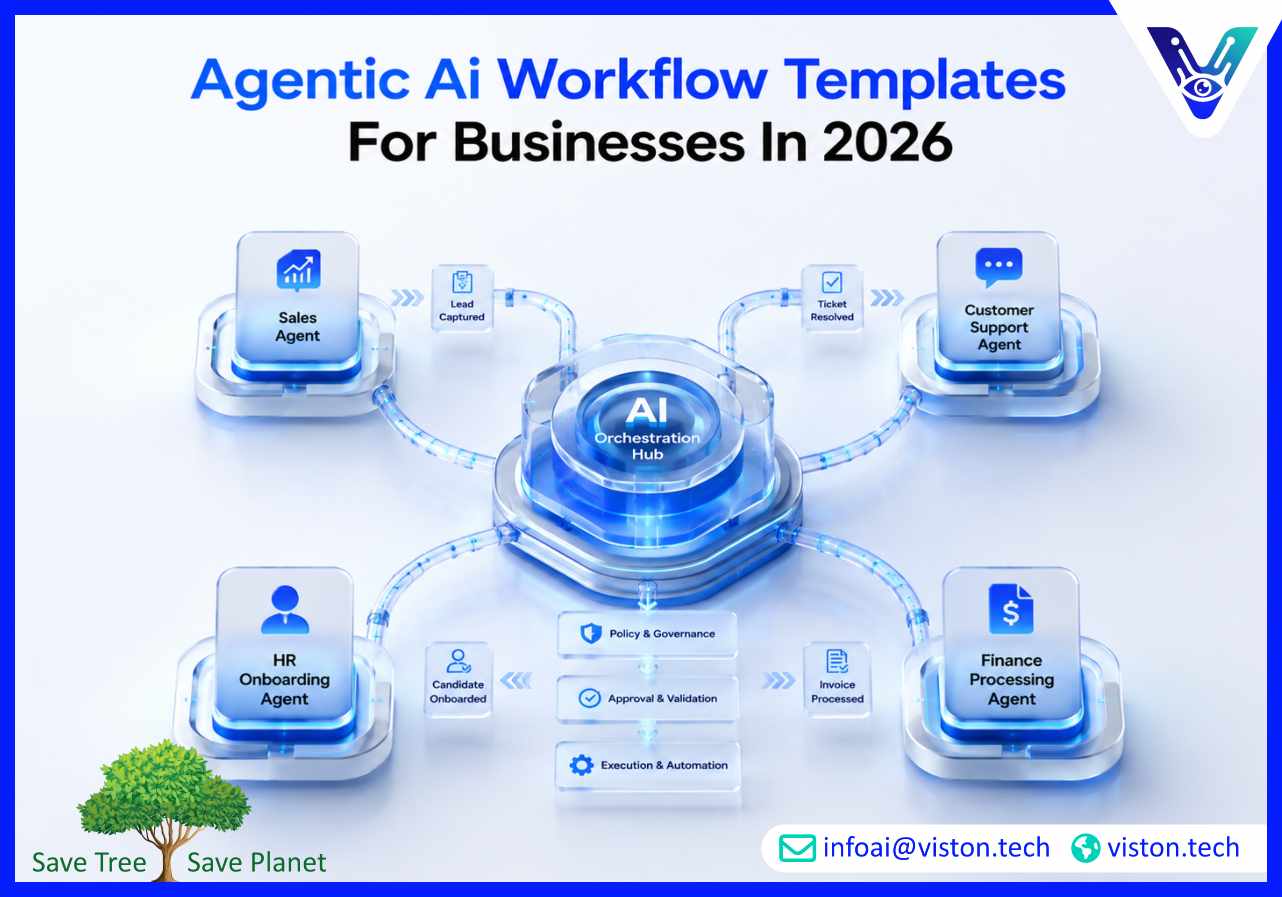
Businesses are rapidly moving beyond simple automation and exploring agentic AI workflows that can plan, execute, coordinate, and optimize tasks across multiple systems. The challenge is not deciding whether to use AI agents, but understanding how to structure them effectively. Agentic AI workflow templates provide a practical starting point for organizations looking to deploy scalable and reliable AI-driven operations in 2026.
Agentic AI workflow templates are predefined frameworks that outline how AI agents collaborate to complete business processes. Rather than building every workflow from scratch, businesses can use templates to define agent roles, decision paths, integrations, escalation rules, and operational outcomes.
An agentic workflow differs from traditional automation because agents can analyze context, make decisions within defined boundaries, access tools, retrieve information, and coordinate with other agents to achieve specific objectives.
These templates help organizations accelerate implementation while reducing design complexity and operational risk.
By standardizing these components, businesses can deploy workflows faster and maintain greater consistency across operations.
Organizations increasingly face pressure to improve efficiency, reduce manual effort, and deliver faster customer experiences. Agentic AI workflow templates help bridge the gap between AI experimentation and production-ready business processes.
Instead of designing complex agent ecosystems from the ground up, companies can leverage proven workflow structures aligned with common operational requirements.
Templates also provide a practical framework for testing agentic systems before expanding them across the organization.
The most effective templates focus on business processes that involve repetitive decision-making, multiple systems, and measurable outcomes.
This template helps sales teams automate prospect evaluation while maintaining quality and consistency.
Workflow Structure:
This workflow reduces manual research and enables sales teams to focus on qualified opportunities.
Customer support teams can use agentic workflows to improve response speed and service consistency.
Workflow Structure:
The result is faster ticket handling while maintaining service quality standards.
HR teams often manage onboarding activities across multiple departments and systems.
Workflow Structure:
This template improves employee experience and reduces administrative workload.
Finance departments can automate invoice and document-heavy operations while maintaining governance.
Workflow Structure:
Such workflows improve processing speed while supporting accountability and audit readiness.
Templates provide structure, but successful deployment requires thoughtful implementation. Organizations should focus on business outcomes rather than technology alone.
Select workflows that are repetitive, time-consuming, and operationally important. Early success creates momentum for broader adoption.
Each agent should have a specific role. Overlapping responsibilities often create confusion and reduce workflow reliability.
Critical decisions involving finance, legal matters, compliance, or customer commitments should include approval checkpoints.
Agentic workflows deliver the most value when connected to CRM platforms, ERP systems, helpdesks, databases, and internal knowledge repositories.
Track metrics such as processing time, completion rates, escalation frequency, accuracy, operational savings, and customer satisfaction.
The goal is not simply to automate tasks but to improve measurable business performance.
As organizations adopt agentic AI workflows, many discover that successful implementation requires more than access to AI models. Businesses need workflow architecture, orchestration design, system integrations, governance controls, and ongoing optimization.
Viston AI specializes in Agentic AI Workflows that help organizations design and deploy structured AI-driven operations. Its approach focuses on aligning AI agents with practical business objectives rather than creating isolated automation experiments.
By helping businesses define workflow requirements, establish agent roles, integrate enterprise systems, and implement governance frameworks, Viston AI supports organizations seeking scalable and reliable agentic automation.
Whether the objective is sales automation, customer service enhancement, operations optimization, or process transformation, a structured workflow approach can significantly improve implementation success. Viston AI helps organizations move from fragmented AI initiatives toward coordinated workflows that generate meaningful operational value.
An agentic AI workflow template is a predefined framework that outlines how AI agents collaborate, make decisions, access tools, and complete business processes in a structured manner.
Templates reduce implementation time, improve consistency, support governance, and provide a proven structure for deploying agentic AI systems.
Sales operations, customer support, employee onboarding, finance processing, compliance management, reporting, and operational workflows are common use cases.
Yes. Human-in-the-loop controls are recommended for high-risk decisions, approvals, compliance reviews, and customer-facing actions.
Traditional automation follows fixed rules, while agentic workflows allow AI agents to analyze context, make decisions, collaborate, and adapt within predefined operational boundaries.
Viston AI helps organizations design, integrate, deploy, and optimize Agentic AI Workflows that align with business objectives, operational requirements, and scalability goals.
Agentic AI workflow templates provide businesses with a practical foundation for deploying AI-driven operations in 2026. By defining agent roles, orchestration logic, integrations, and governance requirements upfront, organizations can accelerate implementation while reducing risk. Whether supporting sales, customer service, HR, finance, or operational workflows, well-designed templates help businesses achieve greater efficiency, consistency, and scalability. For organizations exploring Agentic AI Workflows, Viston AI offers the expertise required to transform workflow concepts into reliable and business-focused implementations.
