
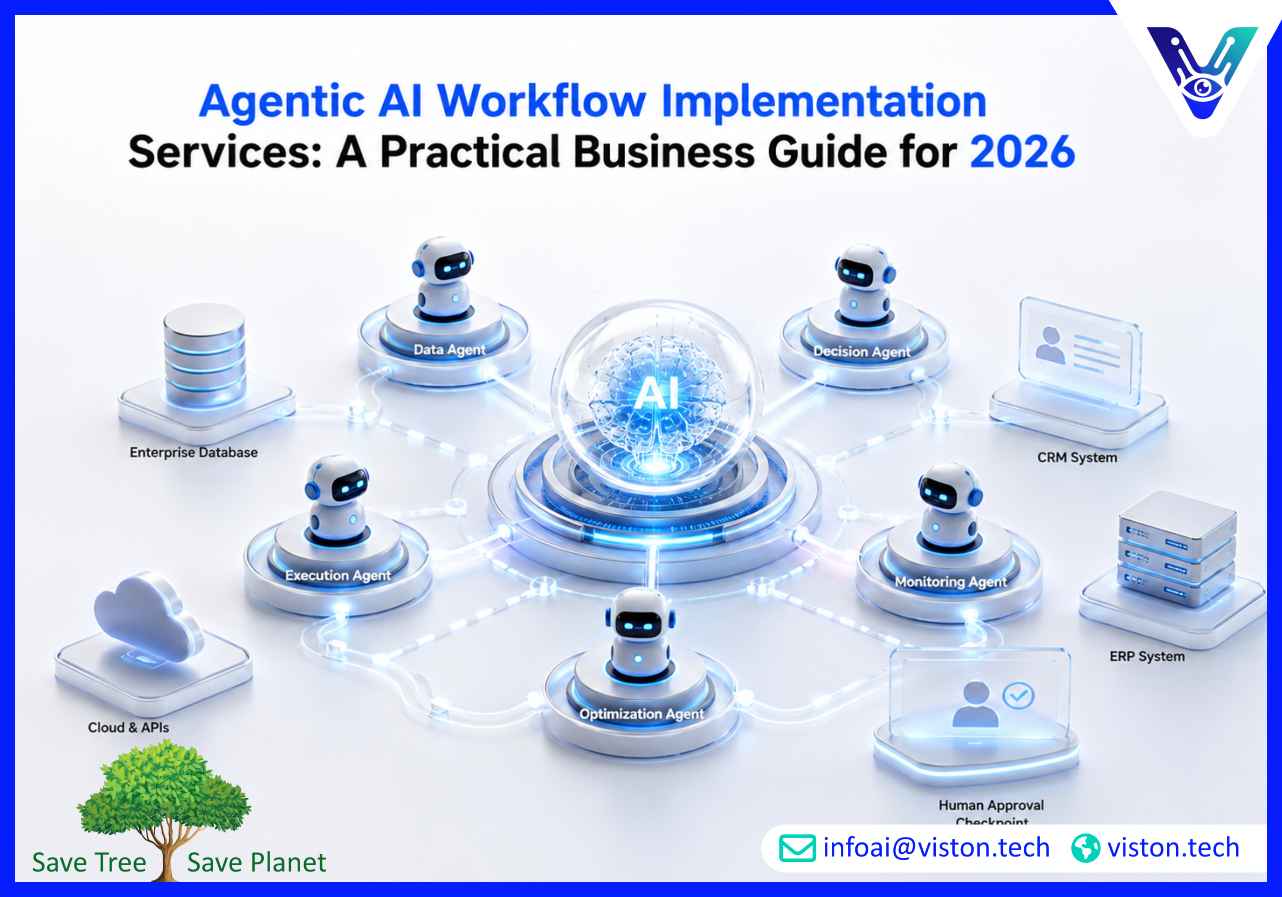
As organizations move beyond basic automation, agentic AI workflows are emerging as a powerful way to automate complex business processes. Companies seeking faster operations, better decision-making, and scalable automation increasingly rely on agentic AI workflow implementation services to connect AI agents, business systems, and workflows into coordinated operational ecosystems
Agentic AI workflow implementation services help organizations design, build, deploy, and manage AI-powered workflows that can perform tasks, make decisions, interact with systems, and collaborate with other agents while operating within predefined business rules.
Unlike traditional automation, which follows fixed instructions, agentic workflows enable AI agents to dynamically respond to changing conditions, retrieve information, execute actions, and coordinate tasks across multiple systems.
A properly implemented agentic workflow may involve:
The goal is not simply automation but creating intelligent operational workflows that improve efficiency, consistency, and scalability.
Businesses today face growing operational complexity. Teams often work across multiple software platforms, communication channels, databases, and business processes. Manual coordination between these systems creates delays, inefficiencies, and operational risk.
Agentic AI workflows help address these challenges by enabling AI agents to act as operational participants rather than passive assistants.
Organizations implementing agentic workflows can automate tasks that previously required extensive human coordination while maintaining governance and oversight.
Building an effective agentic workflow requires more than connecting an AI model to a business process. Successful implementation involves architecture, governance, integrations, monitoring, and workflow design.
The implementation process begins by identifying suitable workflows. High-value candidates typically involve repetitive tasks, multiple systems, decision-making requirements, and measurable business outcomes.
Process mapping helps organizations understand:
Each AI agent should have clearly defined responsibilities. Specialized agents often perform better than a single general-purpose agent.
Examples include:
Role clarity improves reliability, scalability, and governance.
Orchestration determines how agents communicate, share information, transfer tasks, and complete workflows.
Key orchestration capabilities include:
Without orchestration, individual agents may perform tasks successfully but fail to deliver consistent business outcomes.
Most enterprise workflows depend on multiple systems. Effective implementation requires secure integration with:
Integrations allow AI agents to operate within actual business environments rather than isolated testing environments.
Organizations that achieve successful outcomes typically focus on practical implementation strategies rather than attempting to automate everything at once.
Choose processes that generate measurable value and contain clear operational inefficiencies. This creates faster ROI and simplifies adoption.
Human-in-the-loop controls remain important for workflows involving financial decisions, compliance requirements, legal reviews, customer commitments, or sensitive communications.
Agent performance depends heavily on data accuracy and accessibility. Poor-quality data can significantly reduce workflow effectiveness.
Governance frameworks should define permissions, audit trails, approval rules, monitoring requirements, and security controls before deployment.
Success metrics should focus on business performance rather than technical activity.
Common metrics include:
Organizations that continuously measure outcomes can optimize workflows more effectively over time.
Agentic AI workflows can support numerous operational functions across industries.
These use cases demonstrate how agentic workflows can support business operations while maintaining visibility and governance.
For organizations evaluating agentic AI workflow implementation services, Viston AI focuses on helping businesses design, orchestrate, and deploy practical Agentic AI Workflows that align with operational goals and real-world business requirements.
Successful workflow implementation requires more than AI model selection. It involves workflow analysis, agent architecture design, system integrations, orchestration logic, governance frameworks, testing, monitoring, and ongoing optimization. Viston AI’s expertise in Agentic AI Workflows supports organizations looking to move from isolated AI tools toward coordinated workflow automation.
Businesses often require workflows that connect multiple systems, automate repetitive processes, improve operational efficiency, and support scalable growth. Through agent orchestration, workflow automation, API integrations, and business process alignment, Viston AI helps organizations create structured AI-driven workflows that can operate reliably within enterprise environments.
The focus remains on delivering workflows that solve practical business challenges, improve operational visibility, and support long-term scalability while maintaining security, governance, and business control.
These services help businesses design, deploy, integrate, and manage AI-powered workflows where autonomous agents perform tasks, coordinate actions, and support business processes.
Traditional automation follows predefined rules. Agentic workflows allow AI agents to make contextual decisions, interact with systems, coordinate activities, and adapt to changing workflow conditions.
Processes involving repetitive tasks, multiple systems, large amounts of data, decision-making requirements, and workflow coordination are often ideal candidates.
Yes. Many organizations use human-in-the-loop controls for sensitive decisions, compliance requirements, financial approvals, and customer-facing communications.
Implementation timelines vary based on workflow complexity, integration requirements, governance needs, and organizational readiness. Simple workflows may be deployed within weeks, while enterprise-wide implementations may take several months.
Yes. Viston AI specializes in Agentic AI Workflows and supports businesses with workflow design, agent orchestration, system integration, deployment, governance, and ongoing optimization.
Agentic AI workflow implementation services are becoming a foundational component of enterprise automation strategies in 2026. By combining intelligent agents, workflow orchestration, system integrations, and governance controls, businesses can automate complex processes that extend beyond traditional automation capabilities. Organizations that invest in well-designed Agentic AI Workflows can improve efficiency, reduce operational bottlenecks, and create scalable digital operations. For businesses seeking structured implementation and practical workflow automation, Viston AI provides expertise that aligns closely with the successful deployment of agentic AI workflows.
