
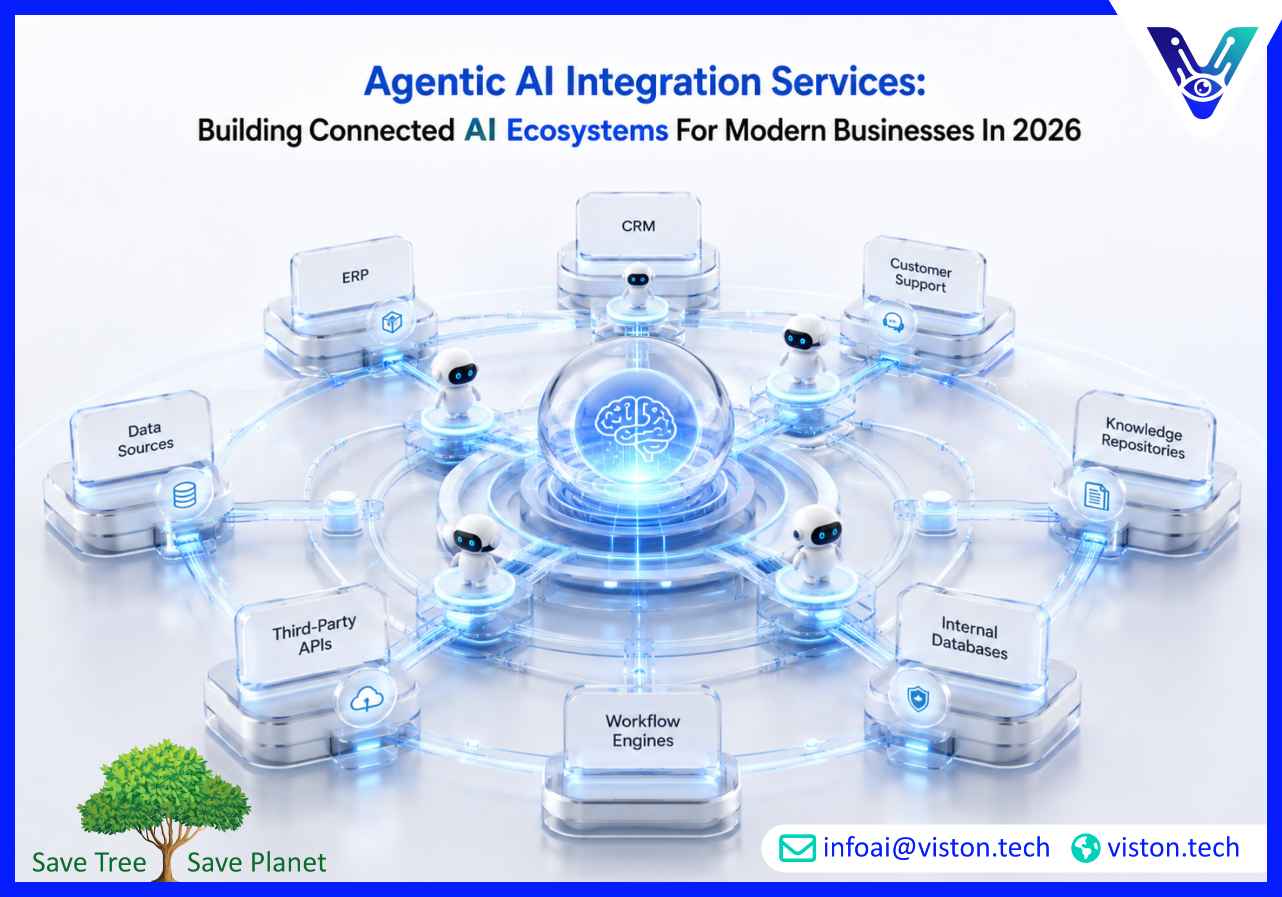
As organizations move beyond standalone AI tools, the demand for agentic AI integration services continues to grow. Businesses are no longer looking for isolated AI capabilities; they need intelligent systems that connect applications, automate workflows, coordinate decisions, and operate across existing business infrastructure. In 2026, successful AI adoption depends heavily on how effectively AI agents integrate with enterprise operations.
Agentic AI integration services focus on connecting AI agents with business systems, workflows, data sources, and operational processes. Unlike traditional software integrations that simply move data between applications, agentic integrations enable AI-powered systems to perform actions, make decisions, retrieve information, coordinate tasks, and execute workflows with varying levels of autonomy.
An AI agent can be designed to perform specific responsibilities such as customer support, lead qualification, document processing, workflow orchestration, data analysis, reporting, compliance monitoring, or operational coordination. However, these agents create business value only when they can access the systems and information required to perform their roles.
Agentic AI integration services bridge this gap by connecting AI agents to:
The result is a connected AI ecosystem capable of supporting real-world business operations rather than functioning as a standalone chatbot or isolated automation tool.
Businesses are increasingly adopting AI to improve efficiency, reduce operational friction, and support decision-making. However, AI systems that operate independently often struggle to deliver measurable business outcomes.
Agentic AI integration solves this challenge by enabling AI agents to interact directly with business processes and systems.
Many organizations operate with fragmented technology stacks. Sales teams use CRM platforms, finance departments rely on ERP systems, customer support uses ticketing tools, and operations teams manage workflows through separate applications.
Integrated AI agents can move across these environments, reducing information silos and enabling smoother workflow execution.
Modern workflows often involve multiple systems, approvals, stakeholders, and data sources. Agentic integrations allow AI agents to coordinate these activities automatically while maintaining visibility and governance.
AI agents with access to connected systems can retrieve information, analyze data, generate recommendations, and initiate actions much faster than traditional manual processes.
As organizations grow, manual coordination becomes increasingly difficult. Integrated AI agents help businesses scale operations without increasing administrative complexity at the same rate.
Successful agentic AI implementations require more than connecting APIs. Businesses need a structured integration strategy that supports security, reliability, scalability, and operational performance.
AI agents require secure access to business applications and data sources. Integration services establish reliable communication channels between agents and enterprise systems using APIs, middleware, connectors, and workflow orchestration platforms.
Agentic systems often involve multiple actions occurring across different platforms. Workflow orchestration determines how tasks are triggered, routed, validated, escalated, and completed.
Without orchestration, AI agents may perform isolated tasks but struggle to support end-to-end business processes.
AI agents need access to accurate context to make informed decisions. Integration services often include connecting agents to internal documentation, policies, product information, customer records, and operational data.
Effective context management improves accuracy, consistency, and business relevance.
Organizations must ensure AI agents access only authorized information and perform approved actions. Integration services typically include authentication controls, permissions management, audit logging, encryption, and governance mechanisms.
Not every decision should be automated. Many businesses implement human approval workflows for high-impact actions such as financial transactions, legal responses, compliance reviews, and customer-facing communications.
Agentic AI integration services help define when agents can act independently and when escalation is required.
Organizations across industries are adopting agentic AI integrations to improve operational efficiency and support business growth.
The most successful implementations focus on workflows where AI agents can reduce manual effort while maintaining operational control and visibility.
Organizations often achieve better results when they approach agentic AI integration as a business transformation initiative rather than a technology deployment project.
Select workflows that are repetitive, time-consuming, and operationally important. Early success helps build organizational confidence and creates measurable value.
Understanding current processes, dependencies, and system interactions is essential before designing AI-driven workflows.
Each AI agent should have a well-defined role with specific objectives, permissions, and operational boundaries.
Security, compliance, approval workflows, monitoring, and auditability should be incorporated from the beginning rather than added later.
Success metrics should focus on operational improvements such as response times, productivity gains, cost reduction, workflow completion rates, customer satisfaction, and process efficiency.
As organizations increasingly adopt AI-driven operations, effective integration becomes a critical factor in achieving long-term success. Viston AI specializes in Agent Integration Services that help businesses connect AI agents with existing systems, workflows, and operational processes.
Its approach focuses on creating practical, scalable integrations that align AI capabilities with real business objectives. This includes connecting AI agents to enterprise applications, designing workflow orchestration strategies, enabling secure system interactions, and supporting automation initiatives that improve operational performance.
Businesses exploring agentic AI often face challenges related to fragmented systems, workflow complexity, governance requirements, and implementation scalability. Viston AI helps address these challenges by focusing on structured integration strategies that support both automation and business control.
Whether organizations are implementing customer service agents, workflow automation systems, operational assistants, or multi-agent environments, effective integration remains essential for delivering measurable business outcomes. Viston AI’s expertise in Agent Integration Services helps organizations move beyond experimentation and create connected AI ecosystems that support sustainable growth.
Agentic AI integration services connect AI agents with business systems, applications, workflows, and data sources, enabling them to perform tasks and support business operations effectively.
Traditional integrations primarily exchange data between systems. Agentic integrations enable AI agents to retrieve information, make decisions, execute actions, coordinate workflows, and interact dynamically with business processes.
Organizations with complex workflows, multiple software platforms, high operational workloads, and growing automation requirements often gain significant value from agentic AI integrations.
Businesses should focus on access controls, authentication, audit logging, encryption, governance policies, compliance requirements, and human oversight mechanisms to ensure secure AI operations.
Yes. Many integration projects involve connecting AI agents to legacy applications through APIs, middleware platforms, custom connectors, and workflow automation technologies.
Viston AI provides Agent Integration Services that help organizations connect AI agents with business systems, automate workflows, establish governance frameworks, and build scalable AI-enabled operations.
Agentic AI integration services play a vital role in helping businesses unlock the full value of AI investments in 2026. While AI agents continue to become more capable, their effectiveness depends on how well they connect with business systems, workflows, and operational processes. Organizations that prioritize integration, governance, workflow orchestration, and scalability are better positioned to achieve measurable business outcomes. For companies exploring AI-driven transformation, Agent Integration Services provide the foundation needed to build connected, efficient, and future-ready operations. Viston AI supports this journey through practical integration expertise focused on sustainable business impact.
