
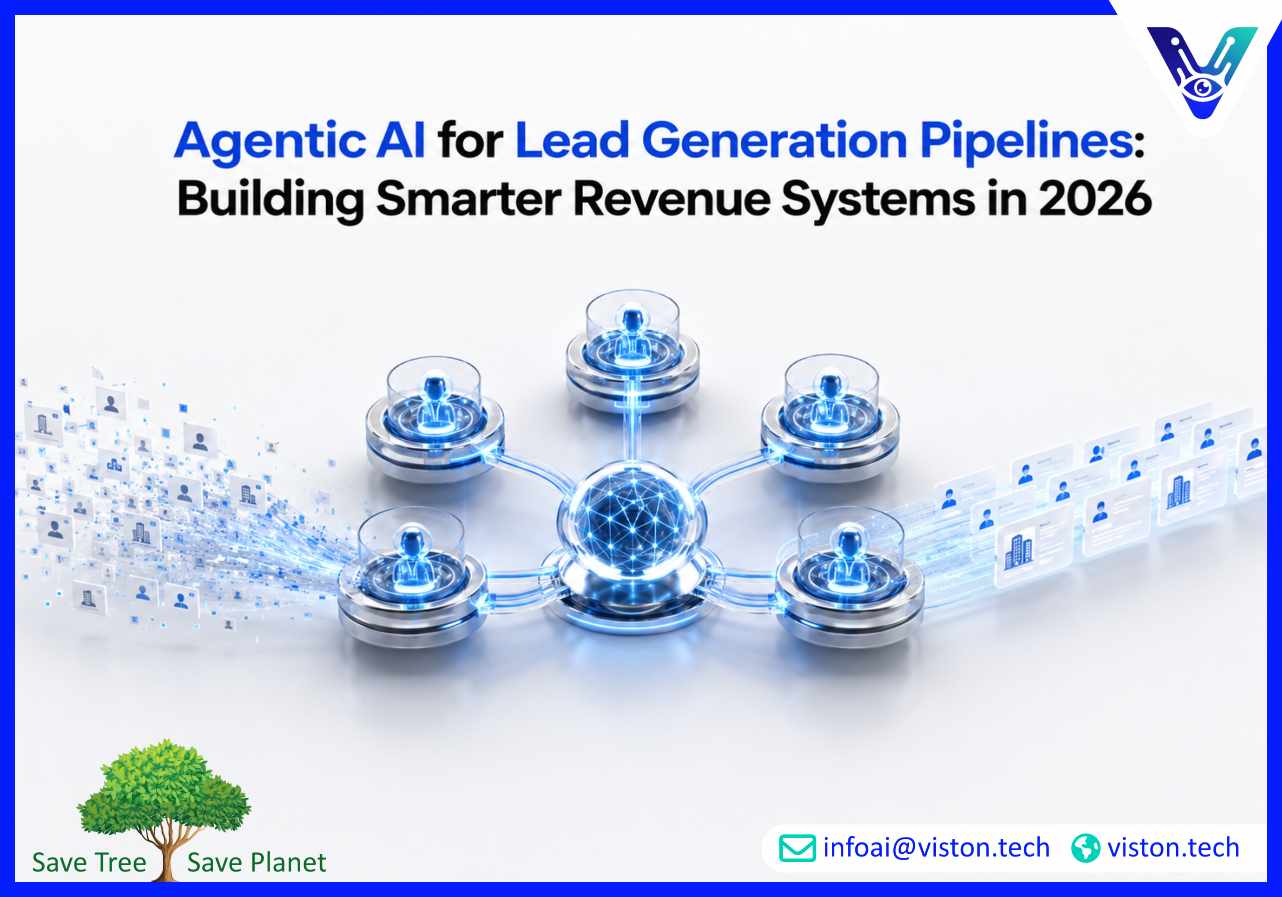
Lead generation has evolved far beyond static forms, manual prospecting, and disconnected sales tools. In 2026, businesses are increasingly adopting agentic AI for lead generation pipelines to automate prospect discovery, qualification, engagement, enrichment, and handoffs while maintaining greater accuracy and scalability. Organizations that implement AI-powered lead workflows effectively can accelerate pipeline growth while reducing operational overhead.
Agentic AI refers to AI systems capable of planning, executing, evaluating, and coordinating tasks with a degree of autonomy. Unlike traditional automation that follows fixed rules, agentic AI can adapt to changing conditions, gather information from multiple sources, make decisions within defined parameters, and collaborate across workflows
Within lead generation pipelines, AI agents can manage various stages of the buyer acquisition process. Instead of relying on separate manual activities for prospect research, lead qualification, data enrichment, outreach preparation, and CRM updates, specialized agents can work together as part of a coordinated pipeline.
This approach allows businesses to create more responsive and efficient revenue operations while maintaining oversight and governance.
Modern buyers generate vast amounts of digital signals across websites, social platforms, business databases, events, content interactions, and online communities. Sales and marketing teams often struggle to process this information quickly enough to identify high-intent opportunities.
Agentic AI helps solve this challenge by continuously monitoring, analyzing, and acting on lead-related data.
Businesses that rely solely on manual prospecting often face delays, inconsistent lead quality, incomplete data, and missed opportunities. Agentic AI enables organizations to build pipelines that operate continuously and intelligently.
Successful implementation requires more than adding an AI tool to an existing workflow. High-performing lead generation pipelines typically combine multiple AI agents with structured orchestration and business controls.
These agents identify potential leads from approved sources such as company databases, industry directories, websites, business platforms, events, and public data repositories. They continuously search for organizations and decision-makers that match predefined ideal customer profiles.
Once prospects are identified, enrichment agents gather additional information such as company size, industry classification, technology stack, geographic presence, funding status, growth indicators, and relevant contact information.
Enhanced lead profiles help sales teams prioritize opportunities more effectively.
Qualification agents assess whether a prospect meets specific business criteria. They can evaluate fit based on factors such as:
This reduces time spent pursuing low-quality opportunities.
These agents assist with personalization by analyzing prospect information and preparing context-aware messaging suggestions for sales teams. They can identify relevant pain points, market trends, and business triggers that support more meaningful engagement.
Operational agents update CRM systems, assign leads, schedule follow-ups, track status changes, and ensure pipeline data remains current. This reduces administrative workload while improving reporting accuracy.
Advanced implementations include monitoring agents that evaluate conversion rates, engagement metrics, qualification accuracy, and pipeline performance to identify opportunities for continuous improvement.
While agentic AI offers significant advantages, success depends on proper implementation and governance.
AI agents perform best when qualification rules are well-defined. Organizations should establish clear definitions for ideal customers, buying signals, lead scoring factors, and sales-readiness indicators.
The quality of lead generation depends heavily on data quality. Businesses should prioritize trusted sources and establish validation mechanisms to minimize inaccuracies.
Lead generation involves strategic decisions that often require human judgment. AI should support teams rather than operate entirely without supervision. Human review remains important for high-value opportunities and complex sales cycles.
Agentic AI delivers maximum value when integrated into broader revenue operations. Connections with CRM platforms, marketing automation systems, communication tools, analytics environments, and customer data platforms help create seamless workflows.
Businesses must ensure lead generation activities comply with applicable privacy regulations, data protection requirements, and internal governance policies. AI workflows should include controls that support responsible data usage.
Organizations should evaluate AI-driven lead generation using metrics such as:
These measurements help determine whether AI investments are producing meaningful business results.
Agentic AI lead generation pipelines are being adopted across a wide range of industries where identifying, qualifying, and engaging prospects efficiently is critical.
Technology providers use AI agents to identify target accounts, monitor buying signals, enrich prospect records, and support account-based marketing initiatives.
Consulting, legal, financial, and advisory firms leverage agentic workflows to discover potential clients, track market opportunities, and prioritize outreach efforts.
Manufacturers use AI-powered lead generation to identify distributors, suppliers, channel partners, and enterprise buyers across global markets.
Software companies benefit from continuous prospect monitoring, automated qualification, and sales workflow automation that improves pipeline efficiency.
Regardless of industry, the common objective is creating a more intelligent and scalable process for generating qualified business opportunities.
As businesses explore agentic AI for lead generation pipelines, successful implementation often requires expertise in AI Agent Development & Deployment. Viston AI helps organizations design, build, integrate, and deploy AI agents that support practical business workflows rather than isolated automation projects.
For lead generation initiatives, this can include developing specialized agents for prospect discovery, lead qualification, enrichment, workflow orchestration, CRM integration, and pipeline optimization. The focus is not simply on automating tasks but on creating coordinated AI systems that improve sales efficiency, operational consistency, and decision-making.
Organizations adopting agentic AI frequently require integration across multiple business systems, governance controls, workflow monitoring, and scalability planning. Viston AI’s expertise in AI Agent Development & Deployment helps businesses build agentic solutions aligned with revenue operations, customer acquisition strategies, and long-term growth objectives.
By combining agent design, orchestration, integrations, and business-focused implementation practices, organizations can develop lead generation pipelines that are more responsive, data-driven, and capable of supporting evolving sales requirements.
Agentic AI uses autonomous or semi-autonomous AI agents that can identify prospects, qualify leads, enrich data, support outreach activities, and coordinate workflows within a lead generation pipeline.
Traditional automation typically follows predefined rules. Agentic AI can evaluate context, make workflow decisions, retrieve information, adapt to changing conditions, and collaborate across multiple tasks.
Yes. AI agents can enrich prospect information, apply qualification criteria consistently, identify intent signals, and prioritize opportunities that align more closely with business objectives.
Absolutely. Agentic AI is designed to support sales and marketing teams by reducing repetitive work and improving efficiency. Human expertise remains essential for relationship building, negotiations, and strategic decision-making.
AI agents commonly integrate with CRM platforms, marketing automation tools, communication systems, customer data platforms, analytics environments, databases, and business applications.
Yes. Viston AI provides AI Agent Development & Deployment services that support the design, integration, deployment, and optimization of agentic AI workflows for lead generation and related business operations.
Agentic AI for lead generation pipelines is transforming how businesses identify, qualify, and engage potential customers in 2026. By combining specialized AI agents, workflow orchestration, data enrichment, and intelligent automation, organizations can create more efficient and scalable revenue operations. Success depends on clear qualification strategies, reliable data, effective integrations, governance controls, and continuous optimization. For businesses exploring AI Agent Development & Deployment, Viston AI provides expertise that helps translate agentic AI capabilities into practical lead generation systems that support measurable business growth.
