
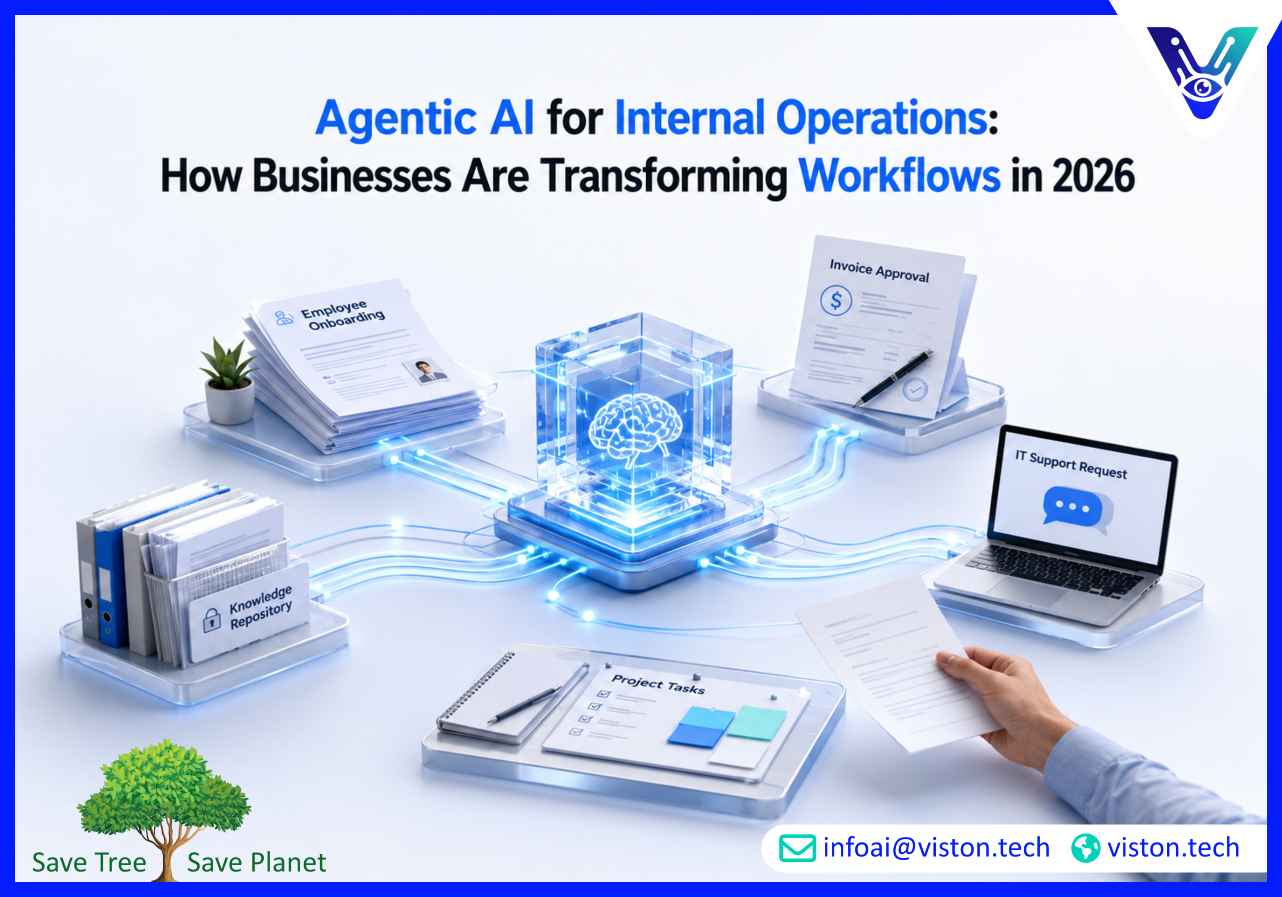
Organizations are increasingly looking beyond basic automation to improve efficiency, reduce operational bottlenecks, and support scalable growth. Agentic AI for internal operations has emerged as a practical solution for businesses that want intelligent systems capable of coordinating tasks, making workflow decisions, and supporting employees across departments.
Agentic AI refers to AI systems that can independently perform tasks, coordinate actions, access business tools, retrieve information, and work toward defined objectives with varying levels of autonomy. Unlike traditional automation, which follows predefined rules, agentic AI workflows can adapt to changing conditions, process context, and execute multi-step processes.
Within internal operations, agentic AI acts as a digital workforce that supports teams by automating repetitive activities, managing information flows, and improving operational consistency.
Examples of internal operational use cases include:
Rather than functioning as a standalone chatbot, agentic AI becomes part of the organization’s operational infrastructure.
Modern businesses face increasing pressure to do more with existing resources. Teams often spend significant time searching for information, manually transferring data between systems, managing approvals, and coordinating routine processes.
These inefficiencies create delays, increase operational costs, and limit organizational scalability.
Agentic AI workflows address these challenges by creating intelligent operational systems that can:
As businesses expand their technology ecosystems, agentic AI becomes increasingly valuable because it can connect multiple systems, coordinate activities, and automate complex workflows that traditionally required significant human involvement.
HR teams manage numerous repetitive and document-heavy processes. Agentic AI can streamline employee onboarding, answer policy-related questions, manage document collection, coordinate training workflows, and support employee requests.
This allows HR professionals to focus on strategic workforce initiatives rather than administrative tasks.
Finance departments often deal with approvals, reconciliations, reporting, and compliance-related activities. Agentic AI workflows can automate invoice processing, assist with expense management, coordinate approval chains, identify anomalies, and generate operational reports.
The result is faster processing and improved operational consistency.
Many employee support requests follow predictable patterns. Agentic AI can classify tickets, retrieve solutions from knowledge bases, guide users through troubleshooting steps, escalate complex issues, and track resolution status.
This improves employee experience while reducing support workloads.
Organizations generate large volumes of internal documentation, policies, procedures, and operational knowledge.
Agentic AI can help employees quickly locate accurate information, summarize documents, answer operational questions, and surface relevant knowledge when needed.
This reduces time spent searching for information and improves productivity.
Internal operations frequently require coordination across departments.
Agentic AI workflows can monitor project status, collect updates, identify delays, coordinate task assignments, and provide stakeholders with operational visibility.
This improves execution without increasing management overhead.
Successful implementation requires more than deploying AI models. Businesses must design workflows that align with operational objectives, governance requirements, and employee needs.
The best starting point is selecting workflows that are repetitive, time-consuming, and operationally important.
Examples include employee onboarding, internal support requests, document approvals, reporting workflows, and data processing tasks.
Each AI agent should have a clearly defined role.
Organizations commonly deploy:
Specialized roles improve reliability and simplify governance.
Internal operations rely on multiple platforms, including HR systems, CRM platforms, ERP software, project management tools, communication platforms, and document repositories.
Agentic AI workflows become significantly more valuable when connected to these systems through secure integrations.
Internal operational workflows often involve sensitive information.
Organizations should establish:
These controls help maintain operational trust while supporting responsible AI adoption.
Success should be evaluated through operational metrics such as:
Tracking outcomes ensures agentic AI initiatives remain aligned with business goals.
While agentic AI offers substantial operational benefits, businesses should approach implementation strategically.
Automating poorly designed workflows often magnifies existing inefficiencies.
Best practice is to optimize workflows before introducing AI agents.
AI systems depend on accurate and accessible information.
Organizations should improve data quality and governance before large-scale deployment.
Not every process should be fully autonomous.
Businesses should maintain human oversight for high-risk decisions, compliance activities, and sensitive operational actions.
Disconnected platforms limit workflow effectiveness.
Successful agentic AI implementations prioritize integration and orchestration across existing business systems.
Organizations that balance automation with governance typically achieve the strongest operational outcomes.
As organizations explore agentic AI for internal operations, implementation success often depends on workflow design, system integration, governance planning, and operational alignment. Viston AI specializes in Agentic AI Workflows that help businesses move beyond isolated automation toward coordinated, business-focused AI systems.
Its approach focuses on identifying operational bottlenecks, designing intelligent workflow architectures, integrating AI agents with existing business platforms, and creating scalable automation frameworks that support long-term growth.
For internal operations, this can include workflow orchestration across HR, finance, support, operations, knowledge management, and administrative processes. By combining AI agents, automation logic, integrations, and governance controls, businesses can build operational systems that improve efficiency while maintaining visibility and oversight.
Rather than replacing employees, agentic AI workflows help teams focus on higher-value activities by reducing manual coordination and routine operational workloads.
Agentic AI for internal operations involves using AI agents to automate, coordinate, and optimize internal business processes such as HR workflows, IT support, reporting, document management, and operational task execution.
Traditional automation follows predefined rules. Agentic AI workflows can understand context, make workflow decisions, coordinate multiple tasks, access information, and adapt to changing operational requirements.
Human resources, finance, IT support, operations, compliance, project management, and knowledge management teams often see significant benefits from agentic AI implementations.
Yes. Human-in-the-loop controls remain important for approvals, compliance-related decisions, financial activities, and situations requiring judgment or accountability.
Yes. Modern agentic AI workflows can integrate with CRM systems, ERP platforms, helpdesk software, communication tools, databases, and document management systems.
Viston AI helps businesses design, develop, integrate, and optimize Agentic AI Workflows that support internal operations, workflow automation, system orchestration, and scalable AI-driven process improvement.
Agentic AI for internal operations is becoming a critical capability for organizations seeking greater efficiency, scalability, and operational agility in 2026. By combining intelligent agents, workflow orchestration, system integrations, and governance controls, businesses can automate complex internal processes while maintaining visibility and accountability. Organizations that strategically implement Agentic AI Workflows can reduce manual effort, improve productivity, and create more responsive operational environments. For businesses evaluating this transformation, Viston AI provides specialized expertise in building practical, scalable agentic workflows aligned with real business objectives.
