
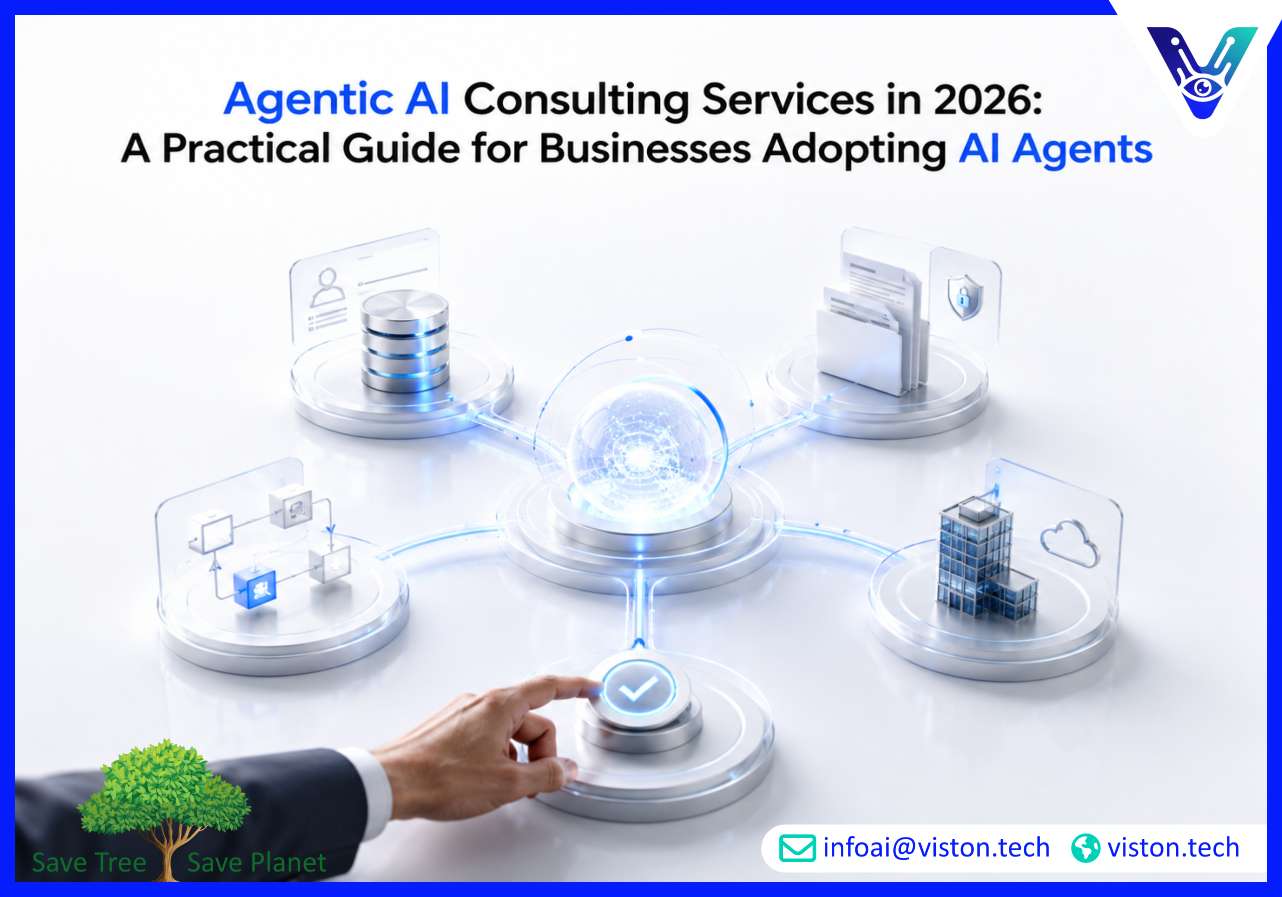
As businesses move beyond chatbots and basic automation, agentic AI is emerging as a strategic technology capable of executing tasks, making decisions, coordinating workflows, and interacting with business systems. Agentic AI consulting services help organizations plan, design, deploy, and govern AI agents that deliver measurable operational value while maintaining security, scalability, and business control.
Agentic AI consulting services help organizations identify, implement, and optimize AI agents that can perform business tasks with varying levels of autonomy. Unlike traditional AI applications that generate outputs based on prompts, agentic systems can plan actions, use tools, access data, interact with software platforms, and complete multi-step workflows.
Consulting services focus on aligning these capabilities with business objectives. This involves understanding existing processes, identifying automation opportunities, defining governance requirements, selecting appropriate technologies, and creating deployment strategies that fit operational needs.
In 2026, organizations are increasingly using agentic AI to support:
Because these systems often interact with critical business functions, consulting plays an important role in reducing implementation risks and ensuring long-term success.
The business value of agentic AI comes from its ability to move beyond task automation and support outcome-driven workflows. Organizations are increasingly looking for solutions that not only generate information but also take action within defined business parameters.
Modern AI agents can connect with CRMs, ERPs, helpdesk platforms, databases, knowledge repositories, communication tools, and custom applications. This allows them to perform work that previously required significant human coordination.
Businesses that approach agentic AI strategically are often better positioned to improve productivity while maintaining governance and oversight.
Successful AI agent initiatives require more than selecting a model or deploying a tool. Effective consulting services address the full lifecycle of AI agent adoption.
The first step is identifying where agentic AI can create meaningful value. Not every process is suitable for autonomous execution. Consultants evaluate workflow complexity, business impact, data availability, integration requirements, and operational risks before recommending implementation strategies.
Agent design involves defining responsibilities, decision boundaries, escalation rules, memory requirements, tool access, and communication patterns. Well-designed architectures improve reliability and make systems easier to monitor and maintain.
Many business processes require multiple agents working together. Workflow orchestration determines how agents coordinate activities, exchange information, trigger actions, and handle exceptions throughout the process.
AI agents often need access to business systems to complete work effectively. Integration planning focuses on connecting agents with:
Agentic systems must operate within clearly defined controls. Consulting services help organizations establish approval workflows, monitoring mechanisms, security policies, audit trails, compliance frameworks, and human oversight requirements.
Organizations that achieve sustainable results with AI agents typically follow a structured implementation approach rather than deploying autonomous systems across the business all at once.
The most effective projects focus on processes that are repetitive, measurable, and operationally important. Examples include customer onboarding, lead qualification, support ticket routing, document analysis, reporting workflows, and internal knowledge retrieval.
Not every decision should be automated. Businesses should determine when agents can act independently and when human approval is required. This balance helps improve trust and operational reliability.
Agentic AI performs best when connected to accurate and accessible business data. Organizations should evaluate data quality, system compatibility, API availability, and infrastructure readiness before deployment.
Successful implementations measure outcomes such as workflow completion rates, response times, cost reductions, operational efficiency improvements, customer satisfaction, and reduction in manual workload.
AI agents should not be treated as static systems. Performance monitoring, workflow refinement, model updates, governance reviews, and feedback loops help maintain effectiveness as business requirements evolve.
Agentic AI consulting services are increasingly supporting organizations across a variety of operational areas.
These use cases demonstrate how AI agents can support both front-office and back-office operations when properly designed and governed.
For organizations exploring agentic AI consulting services, implementation success often depends on combining strategic planning with practical deployment expertise. Viston AI specializes in AI Agent Development & Deployment, helping businesses design and implement agent-based systems that align with operational objectives and workflow requirements.
Its capabilities are particularly relevant for organizations seeking to move beyond experimental AI projects and build production-ready agentic solutions. This includes supporting agent architecture design, workflow orchestration, business system integration, governance planning, deployment strategies, and ongoing optimization.
Building effective AI agents requires careful consideration of process design, data access, security controls, scalability requirements, and business outcomes. Through its focus on AI Agent Development & Deployment, Viston AI helps organizations create structured implementations that support measurable business value rather than isolated automation initiatives.
As agentic AI adoption accelerates in 2026, businesses increasingly require implementation partners that understand both the technical and operational aspects of deploying AI agents within real-world business environments. Viston AI’s service focus aligns directly with these requirements, helping organizations create scalable agentic systems that support long-term growth and operational efficiency.
Agentic AI consulting services help businesses plan, design, implement, govern, and optimize AI agents that can perform tasks, interact with systems, and support business workflows with varying levels of autonomy.
Traditional automation typically follows predefined rules. Agentic AI can reason, plan actions, access tools, retrieve information, and adapt to changing situations within defined operational boundaries.
Organizations with complex workflows, high volumes of repetitive tasks, multiple business systems, and growing automation requirements often benefit most from agentic AI initiatives.
Yes. Most production environments use human-in-the-loop controls for approvals, exceptions, compliance-sensitive activities, and high-impact decisions to maintain governance and accountability.
Implementation timelines vary based on workflow complexity, integration requirements, governance needs, and deployment scope. Pilot projects may take weeks, while enterprise-scale initiatives often require several months.
Yes. Viston AI’s AI Agent Development & Deployment services support organizations in designing, integrating, deploying, and optimizing agentic AI systems aligned with business objectives.
Agentic AI consulting services have become increasingly important as businesses seek to transform AI from a standalone tool into an operational capability. Successful implementations require careful planning, strong governance, effective integrations, and a clear understanding of how AI agents support business outcomes. Organizations that adopt a structured approach can improve efficiency, streamline workflows, and create scalable automation strategies that deliver long-term value. For businesses exploring AI Agent Development & Deployment, Viston AI offers expertise that helps bridge the gap between agentic AI potential and practical business implementation.
