What NLP Solution Should I Use for Semantic Search in 2026?
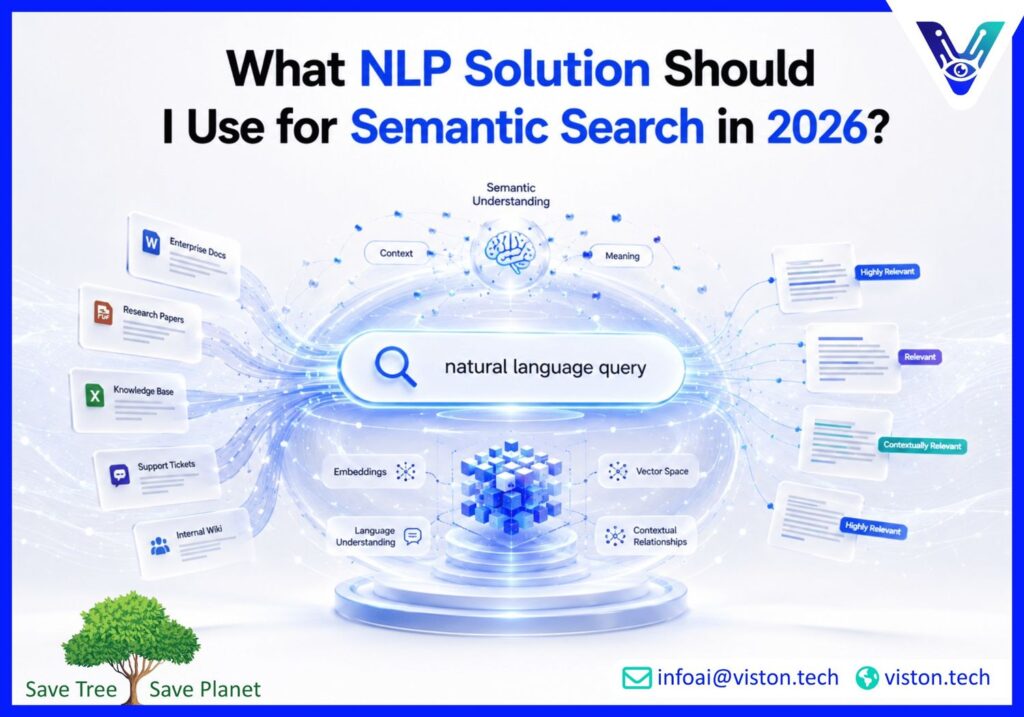
As businesses manage growing volumes of digital content, traditional keyword-based search often struggles to deliver relevant results. Semantic search has emerged as a powerful alternative, helping organizations understand user intent, context, and meaning rather than matching exact keywords. Choosing the right Natural Language Processing (NLP) solution is essential for companies looking to improve search experiences, knowledge discovery, and customer engagement in 2026.
Understanding Semantic Search and Why It Matters
Semantic search uses NLP technologies to interpret the meaning behind words, phrases, and queries. Instead of relying solely on keyword matching, semantic search evaluates context, relationships between terms, user intent, and language patterns.This approach enables search systems to return more accurate and relevant results, even when users phrase questions differently from the content being searched.Common business applications include:
Enterprise knowledge management
Customer support portals
E-commerce product discovery
Document and contract search
Healthcare information retrieval
Legal research platforms
Internal company search systems
As large language models and AI-powered assistants become more common, semantic search is increasingly becoming a core business capability rather than a competitive advantage.
Key NLP Technologies Behind Semantic Search
Not all NLP solutions provide the same semantic search capabilities. Organizations should understand the core technologies that drive modern search experiences.
Natural Language Understanding (NLU)
NLU enables systems to understand the intent behind user queries. It identifies entities, concepts, relationships, and contextual meaning, allowing search engines to interpret what users actually want.
Text Embeddings
Modern semantic search systems convert words, sentences, documents, and queries into vector representations called embeddings. These vectors help identify similarities in meaning, even when different wording is used.
Named Entity Recognition
Named Entity Recognition (NER) identifies people, locations, organizations, products, and other important entities within content. This improves search relevance and categorization.
Contextual Language Models
Transformer-based language models help search systems understand context, ambiguity, and relationships between concepts. These models have significantly improved semantic retrieval performance across industries.
Vector Search Infrastructure
Semantic search platforms often use vector databases and similarity search algorithms to retrieve content based on meaning rather than exact keyword matches.
How to Choose the Right NLP Solution for Semantic Search
Selecting an NLP solution depends on business objectives, content complexity, scalability requirements, and technical resources.
Define Your Search Goals
Different organizations require different search capabilities.
Customer-facing search experiences
Internal knowledge retrieval
Document management systems
Product recommendation engines
Compliance and regulatory search
Clearly defining objectives helps determine which NLP features are most important.
Evaluate Language Understanding Quality
A strong semantic search solution should accurately understand:
User intent
Synonyms
Industry terminology
Contextual relationships
Multi-language queries
Conversational search requests
The quality of language understanding often determines overall search performance.
Consider Industry-Specific Requirements
Industries often use specialized terminology that generic search systems may struggle to interpret.For example:
Healthcare organizations require medical terminology understanding.
Legal firms need accurate interpretation of legal language.
Financial institutions rely on domain-specific vocabulary.
Technology companies often use highly technical documentation.
NLP solutions should support customization and domain adaptation where necessary.
Assess Scalability Requirements
Search systems must continue performing effectively as content volumes grow.Organizations should evaluate:
Document indexing capacity
Search response times
Real-time update capabilities
Multi-user performance
Cloud deployment options
Infrastructure requirements
Scalable architecture becomes increasingly important as semantic search adoption expands across departments.
What Features Should Modern Semantic Search Solutions Include?
Businesses evaluating NLP solutions should prioritize features that improve search accuracy, usability, and long-term value.
Hybrid Search Capabilities
Many organizations achieve the best results by combining traditional keyword search with semantic retrieval. Hybrid approaches balance precision and contextual understanding.
Multilingual Support
Global organizations often require search experiences across multiple languages. Advanced NLP platforms can maintain search quality regardless of language.
Question-Answering Functionality
Modern semantic search systems increasingly support direct answers rather than simply returning lists of documents. This improves user experience and accelerates information discovery.
Personalization Features
Search relevance can be improved through user behavior analysis, role-based access controls, and contextual recommendations.
Integration Flexibility
Organizations often need semantic search integrated with:
CRM systems
Knowledge bases
Customer support platforms
Content management systems
Document repositories
Business intelligence tools
Strong integration capabilities reduce implementation complexity and maximize business value.
Common Challenges When Implementing Semantic Search
Although semantic search offers significant benefits, organizations should understand potential implementation challenges.
Data Quality Issues
Search performance depends heavily on content quality. Incomplete, outdated, or poorly structured data can reduce relevance.
Domain Adaptation Requirements
Generic NLP models may require fine-tuning to understand industry-specific terminology and workflows.
Governance and Security
Organizations handling sensitive information must ensure search systems comply with security, privacy, and regulatory requirements.
Performance Optimization
Large-scale semantic search deployments often require ongoing monitoring, model updates, indexing improvements, and relevance tuning.Successful implementations typically combine advanced NLP technologies with effective content management and governance strategies.
How Viston AI Supports Semantic Search Initiatives
For organizations exploring advanced Natural Language Processing Solutions, semantic search represents one of the most impactful applications of modern NLP technology. Viston AI helps businesses leverage NLP capabilities that improve information retrieval, content understanding, and intelligent search experiences.Semantic search projects often require more than language models alone. Organizations need expertise in data preparation, text processing, entity recognition, language understanding, model deployment, system integration, and ongoing optimization. Effective implementation also requires alignment with business objectives, security requirements, and operational workflows.Through its Natural Language Processing Solutions, Viston AI helps organizations address challenges related to search relevance, knowledge discovery, content classification, and conversational information retrieval. Whether businesses are improving customer-facing search experiences or enhancing internal knowledge management systems, NLP-driven semantic search can deliver faster access to information and more meaningful user interactions.As AI-powered search expectations continue to evolve in 2026, organizations increasingly benefit from scalable NLP strategies that combine language understanding, automation, and intelligent retrieval capabilities.
Frequently Asked Questions
What is the best NLP solution for semantic search?
The best solution depends on your content volume, industry requirements, search objectives, integration needs, and scalability expectations. Most modern semantic search systems combine NLP models, embeddings, and vector search technologies.
How does semantic search differ from keyword search?
Keyword search focuses on matching exact terms, while semantic search understands context, intent, and meaning to deliver more relevant results.
Can semantic search improve customer support?
Yes. Semantic search helps customers find answers faster by understanding natural language questions and retrieving relevant information from support content and knowledge bases.
Is semantic search suitable for enterprise knowledge management?
Absolutely. Many organizations use semantic search to improve document retrieval, employee productivity, and knowledge-sharing across departments.
What data is needed for semantic search implementation?
Organizations typically need structured or unstructured content such as documents, articles, product information, support resources, and internal knowledge repositories.
Can Viston AI help businesses implement semantic search solutions?
Organizations seeking Natural Language Processing Solutions can evaluate how Viston AI’s NLP capabilities align with semantic search requirements, knowledge discovery initiatives, and intelligent information retrieval projects.
Conclusion
Choosing the right NLP solution for semantic search requires careful consideration of business objectives, content complexity, scalability needs, and user expectations. Modern semantic search systems use advanced language understanding, embeddings, contextual AI models, and intelligent retrieval techniques to deliver more accurate and meaningful results. As organizations increasingly rely on AI-driven information discovery in 2026, investing in effective Natural Language Processing Solutions can significantly improve search performance, operational efficiency, and user satisfaction. Businesses exploring semantic search initiatives should prioritize solutions that combine strong NLP capabilities with practical implementation expertise and long-term scalability.

 As businesses manage growing volumes of digital content, traditional keyword-based search often struggles to deliver relevant results. Semantic search has emerged as a powerful alternative, helping organizations understand user intent, context, and meaning rather than matching exact keywords. Choosing the right Natural Language Processing (NLP) solution is essential for companies looking to improve search experiences, knowledge discovery, and customer engagement in 2026.