
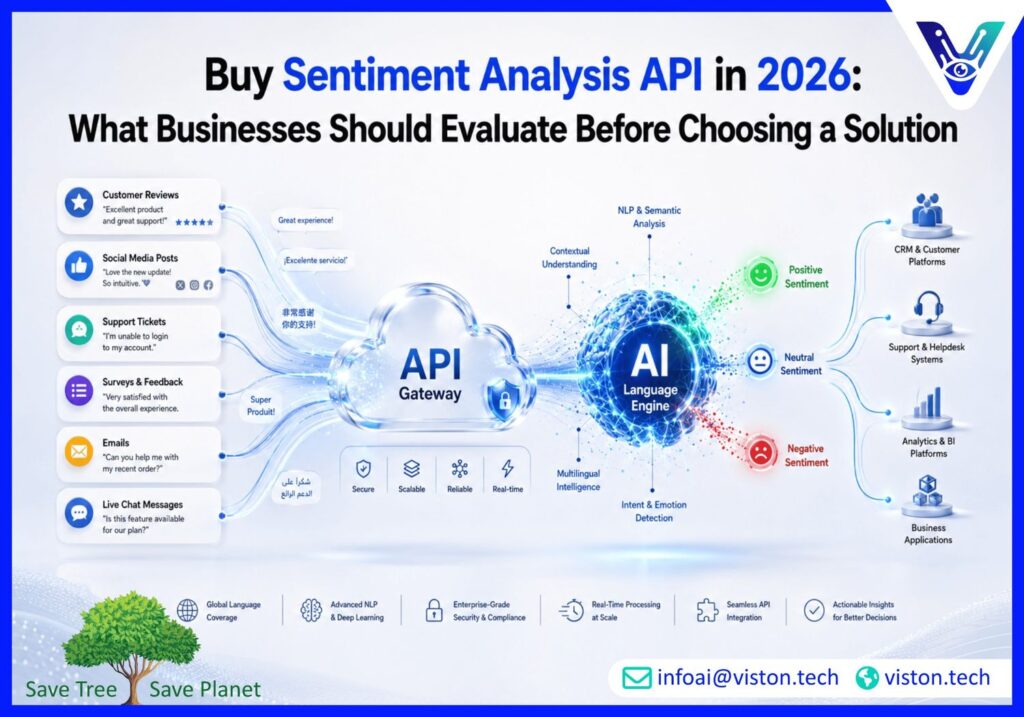
Customer opinions are generated across reviews, social media, support tickets, surveys, emails, and online communities every day. Businesses that can automatically understand customer sentiment gain a significant advantage in customer experience, product development, marketing, and risk management. For organizations looking to buy sentiment analysis API solutions in 2026, choosing the right platform requires more than simply comparing features—it requires evaluating accuracy, scalability, integration capabilities, and long-term business value.
A sentiment analysis API is a cloud-based service that uses Natural Language Processing (NLP) and machine learning to determine the emotional tone behind text. It helps businesses automatically classify content as positive, negative, neutral, or, in advanced systems, identify emotions such as frustration, satisfaction, excitement, or concern.
Instead of manually reviewing thousands of customer interactions, organizations can integrate a sentiment analysis API into their existing systems and receive real-time insights from customer-generated content.
Common data sources include:
Modern sentiment analysis platforms are increasingly capable of understanding context, intent, industry-specific terminology, and multilingual content.
Customer expectations continue to rise, while the volume of customer feedback grows across digital channels. Businesses need automated ways to understand customer opinions at scale.
Organizations can quickly identify recurring complaints, service issues, and product concerns before they impact retention and reputation.
Marketing and communications teams can monitor public sentiment and respond proactively to emerging issues or opportunities.
Product teams gain deeper insight into user satisfaction, feature requests, and pain points that influence roadmap decisions.
Automated sentiment classification reduces the need for manual review and enables teams to focus on higher-value activities.
Businesses can analyze customer conversations related to competitors and identify market opportunities.
Not all sentiment analysis solutions deliver the same level of accuracy or business value. Decision-makers should evaluate several critical capabilities before selecting a provider.
Accuracy remains one of the most important evaluation criteria. The API should effectively understand context, sarcasm, negation, slang, and industry-specific language.
Global businesses often require support for multiple languages. A strong API should provide consistent performance across different regions and languages.
Many use cases require immediate sentiment insights. Real-time analysis enables faster responses to customer concerns and market changes.
Organizations in specialized industries often benefit from customized sentiment models trained on sector-specific terminology and datasets.
The platform should handle increasing workloads without performance degradation, especially during periods of high customer engagement.
Businesses processing customer communications should verify encryption standards, access controls, compliance measures, and data handling practices.
The API should integrate easily with CRM platforms, customer support tools, analytics systems, data warehouses, and internal applications.
Sentiment analysis delivers value across multiple business functions and industries.
Support teams can prioritize tickets based on customer sentiment and escalate critical issues more efficiently.
Organizations can analyze thousands of online reviews and identify recurring satisfaction or dissatisfaction drivers.
Marketing teams gain visibility into brand perception, campaign performance, and audience reactions.
Businesses can transform large volumes of customer feedback into actionable insights for continuous improvement.
Analysts can evaluate consumer opinions on products, services, and industry trends without extensive manual review.
Organizations increasingly use sentiment analysis to understand employee feedback, engagement surveys, and workplace concerns.
For organizations seeking sentiment analysis capabilities, Viston AI focuses on Natural Language Processing solutions designed to help businesses extract meaningful insights from large volumes of text data.
Sentiment analysis plays an important role within broader NLP strategies, enabling organizations to better understand customer opinions, identify emerging trends, improve service quality, and support data-driven decision-making. Businesses often require solutions that go beyond simple positive or negative classification and can process large-scale customer interactions across multiple channels.
Viston AI’s expertise in NLP and language intelligence solutions can support organizations looking to integrate sentiment analysis into customer experience initiatives, marketing analytics, feedback management systems, and operational workflows. As demand for AI-driven text analytics continues to grow in 2026, businesses increasingly prioritize scalable, integration-friendly, and business-focused sentiment analysis capabilities that align with their operational objectives.
When evaluating sentiment analysis providers, organizations should focus on practical outcomes such as actionable insights, workflow integration, model performance, scalability, and long-term adaptability. These factors often have a greater impact on business success than standalone technical features.
Pricing structures vary significantly between providers. Understanding the primary cost drivers helps businesses make informed purchasing decisions.
Organizations should evaluate total cost of ownership rather than focusing exclusively on per-request pricing.
Before purchasing a sentiment analysis API, businesses should define their objectives clearly.
A structured evaluation process reduces implementation risk and increases the likelihood of achieving measurable business outcomes.
A sentiment analysis API automatically analyzes text and identifies customer opinions, emotions, and overall sentiment to support business decision-making.
Accuracy varies by provider, dataset quality, language support, and industry context. Advanced NLP-based solutions generally deliver higher accuracy when trained on relevant data.
Many modern platforms support multilingual analysis, allowing businesses to monitor customer sentiment across global markets.
APIs are commonly integrated with CRM systems, support platforms, customer feedback tools, marketing software, analytics environments, and custom applications.
Yes. Support teams can prioritize negative interactions, identify urgent cases faster, and improve response efficiency through automated sentiment detection.
Viston AI provides NLP-focused solutions that can support businesses seeking scalable text analytics, customer feedback analysis, and sentiment-driven insights as part of broader language intelligence strategies.
Businesses looking to buy sentiment analysis API solutions in 2026 should focus on accuracy, scalability, integration capabilities, security, and practical business outcomes. The right solution can transform large volumes of customer feedback into actionable insights that improve customer experience, strengthen decision-making, and support long-term growth. As sentiment analysis becomes an increasingly important component of modern NLP strategies, organizations should carefully evaluate providers based on their ability to deliver reliable, scalable, and business-focused solutions. For companies exploring advanced Sentiment Analysis capabilities, Viston AI offers expertise in NLP-driven solutions designed to help organizations unlock greater value from their data.
