Enterprise Sentiment Analysis Tools for Business Intelligence in 2026
Introduction
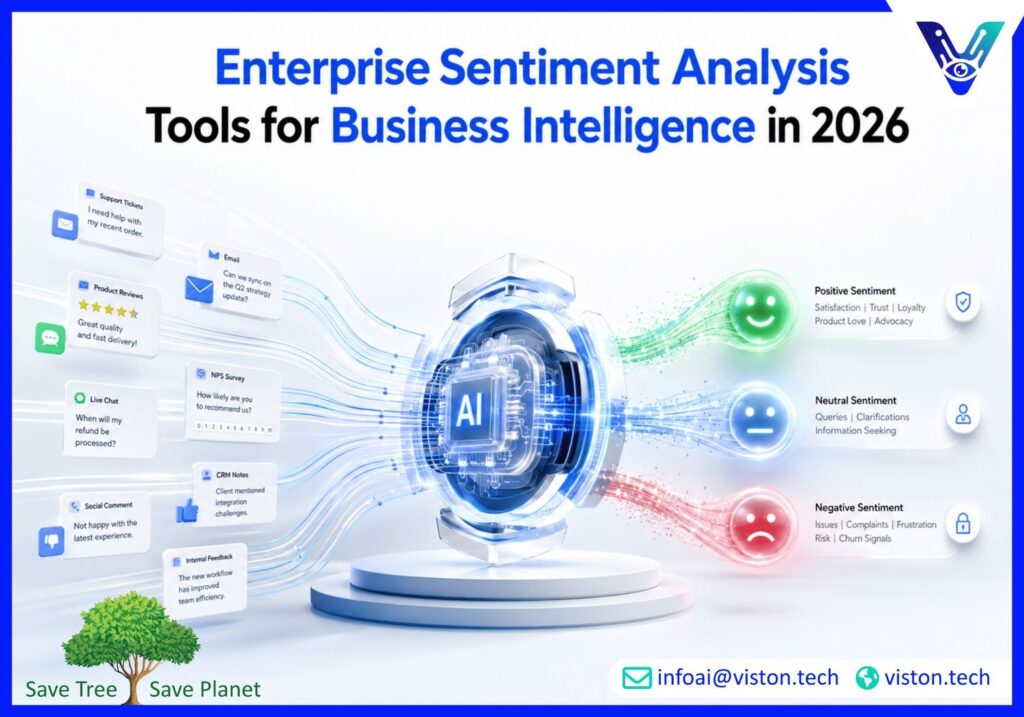
Enterprise sentiment analysis tools help organizations understand customer, employee, market, and brand perception at scale. In 2026, businesses across industries need more than basic positive, negative, and neutral labels. They need reliable sentiment intelligence that connects feedback, conversations, reviews, tickets, and social data to practical business decisions.
What Enterprise Sentiment Analysis Tools Mean for Businesses
Enterprise sentiment analysis tools use natural language processing, machine learning, and AI-driven text analytics to identify emotional tone, opinion, intent, urgency, and context across large volumes of language data. For business teams, this means transforming unstructured text into measurable insight.Instead of manually reading thousands of support tickets, survey responses, product reviews, chat logs, social media comments, emails, and call transcripts, companies can automatically detect patterns in customer sentiment. These tools help teams understand what people feel, why they feel it, and where action is needed.At an enterprise level, sentiment analysis is not only about monitoring whether feedback is positive or negative. Mature systems can support:
Aspect-based sentiment analysis for product features, service areas, pricing, delivery, support, and user experience
Emotion detection for frustration, satisfaction, confusion, anger, trust, urgency, or disappointment
Intent recognition to separate complaints, purchase interest, cancellation risk, and support needs
Trend analysis across locations, departments, product lines, and customer segments
Real-time alerts for reputation risks, churn signals, or service failures
Dashboards and reporting for leadership, operations, marketing, and customer experience teams
For enterprises, the value comes from operationalizing sentiment insights. A tool is useful only when it helps teams prioritize decisions, improve response quality, reduce risk, and identify opportunities faster than manual analysis would allow.
Why Enterprise Sentiment Analysis Tools Matter in 2026
Business communication has become more fragmented. Customers leave feedback through review platforms, social networks, live chat, support portals, emails, forums, surveys, and voice interactions. Employees also share opinions through engagement surveys, internal tickets, collaboration tools, and HR feedback channels.Without sentiment analysis, most of this language data remains underused. Teams may notice individual complaints, but miss broader patterns. Leadership may receive summary reports, but not the emotional context behind customer behavior. Marketing may track brand mentions, but not understand whether sentiment is improving or declining by audience segment.
Customer expectations are faster and more emotional
Customers expect businesses to respond quickly, understand their issue, and personalize support. Sentiment analysis helps identify dissatisfied customers before the issue escalates. This is especially valuable in customer service, SaaS, healthcare, financial services, ecommerce, telecom, travel, education, and professional services.
AI adoption requires better language intelligence
Many enterprises now use AI chatbots, workflow automation, customer support automation, and business intelligence platforms. Sentiment analysis improves these systems by adding emotional context. A chatbot, for example, can escalate an angry customer faster. A support dashboard can prioritize high-risk tickets. A product team can see which features generate repeated frustration.
Brand reputation risks move quickly
Negative sentiment can spread across online platforms before a business has time to react. Enterprise sentiment analysis tools help monitor reputation signals, detect sudden changes, and support faster response planning. This is useful for brands operating across multiple regions, languages, products, or customer groups.
Decision-makers need measurable insight
Executives do not need raw comments alone. They need structured evidence: sentiment trends, recurring complaint themes, segment-level analysis, customer risk indicators, and performance comparisons. Enterprise sentiment analysis turns scattered feedback into decision-ready intelligence.
Key Capabilities to Look for in Enterprise Sentiment Analysis Tools
Choosing enterprise sentiment analysis tools requires more than comparing features. Businesses should evaluate how well the solution fits their data, workflows, scale, language requirements, compliance expectations, and reporting needs.
Data source integration
A strong sentiment analysis system should connect with the channels where business conversations happen. These may include CRM platforms, helpdesk systems, survey tools, call center software, social listening tools, ecommerce platforms, review sites, data warehouses, and business intelligence dashboards.Integration matters because sentiment insights are most valuable when they appear inside the workflows teams already use. A support manager should not need to export data manually every week. A product team should not wait months for feedback analysis. The system should help insights move from data source to decision point efficiently.
Accuracy and context understanding
Enterprise sentiment analysis needs to understand industry language, customer intent, sarcasm, mixed sentiment, product-specific terms, and multilingual expressions. Basic polarity detection can be misleading when feedback is complex.For example, “The product is powerful, but the setup process is frustrating” contains both positive and negative sentiment. A useful enterprise tool should identify that product capability is viewed positively while onboarding experience needs improvement.
Aspect-based analysis
Aspect-based sentiment analysis is essential for enterprises because it identifies sentiment toward specific business areas. Instead of saying overall feedback is negative, the tool can show whether customers are unhappy about pricing, delivery delays, onboarding, billing, support response time, product usability, or documentation.This makes sentiment analysis more actionable. Different teams can own different issues, track improvement, and measure impact over time.
Scalability and performance
Enterprise systems often process large volumes of text from multiple departments and regions. The tool must handle growing data volumes without reducing speed, accuracy, or reporting quality. Real-time or near-real-time processing may be important for customer support, reputation monitoring, and high-volume digital platforms.
Security, privacy, and governance
Sentiment analysis often involves sensitive customer, employee, or business data. Enterprises should consider data privacy, access controls, auditability, retention policies, anonymization, encryption, and compliance requirements. This is especially important for regulated industries such as healthcare, finance, insurance, legal services, and public-sector operations.
Reporting and business intelligence
A good sentiment analysis tool should not only classify text. It should help teams interpret results through dashboards, alerts, trend reports, segmentation, export options, and integration with BI platforms. The goal is to support faster decisions, not create another isolated analytics tool.
How Businesses Can Use Sentiment Analysis Across Industries
Enterprise sentiment analysis tools are relevant across industries because every organization receives feedback, handles conversations, and manages perception. The best use cases depend on business goals, customer channels, and operational maturity.
Customer support and service operations
Support teams can use sentiment analysis to prioritize urgent or negative tickets, identify recurring service problems, and improve response quality. Managers can track whether sentiment improves after resolution and whether specific issue categories create repeated dissatisfaction.
Marketing and brand monitoring
Marketing teams can monitor sentiment around campaigns, product launches, brand mentions, competitors, events, and public conversations. This helps identify message-market fit, audience concerns, and reputation risks.
Product and user experience teams
Product teams can analyze reviews, app feedback, user interviews, support conversations, and feature requests. Sentiment analysis helps identify which product areas create satisfaction, confusion, or churn risk.
Sales and customer success
Sales and customer success teams can use sentiment signals from emails, meeting notes, chats, surveys, and account feedback to identify expansion opportunities, dissatisfaction, renewal risk, and relationship health.
Human resources and employee experience
HR teams can analyze employee feedback, engagement surveys, internal support tickets, and open-text responses. When handled responsibly, sentiment analysis can help identify morale issues, communication gaps, and workplace experience trends.
Risk, compliance, and reputation teams
Enterprises can use sentiment analysis to detect public concern, complaint spikes, negative media patterns, and customer trust issues. This can support early risk identification and better response planning.
How Viston AI Supports Enterprise Sentiment Analysis Tools
Viston AI provides AI and NLP-focused services that include sentiment analysis, NLP and text analysis, chatbot development, AI automation, business intelligence, AI strategy, and integration with business systems. This makes its offering relevant for organizations looking to turn unstructured language data into practical business insight.For enterprises evaluating sentiment analysis tools, Viston AI can support the technical and operational layers required for successful implementation. This may include analyzing customer feedback, support conversations, reviews, chat data, surveys, and other text sources to identify sentiment patterns, emotional signals, and recurring business themes.Its broader AI service capabilities are also useful because sentiment analysis rarely works in isolation. Businesses often need sentiment insights connected to dashboards, workflow automation, chatbot escalation, CRM records, customer support systems, or business intelligence reporting. A service-led approach can help companies move beyond tool selection and focus on data readiness, integration, model behavior, reporting usability, and business outcomes.For organizations across industries and global markets, Viston AI’s relevance comes from combining sentiment analysis with practical AI implementation support. This can help teams improve customer experience, detect risk earlier, understand feedback at scale, and make better decisions from language data without relying only on manual review.
Frequently Asked Questions
What are enterprise sentiment analysis tools?
Enterprise sentiment analysis tools are AI and NLP systems that analyze large volumes of text to detect opinions, emotions, intent, and customer perception. They help businesses understand feedback from reviews, support tickets, surveys, social media, emails, chats, and call transcripts.
How are enterprise sentiment analysis tools different from basic sentiment tools?
Basic tools usually classify text as positive, negative, or neutral. Enterprise tools often support integrations, dashboards, aspect-based sentiment, multilingual analysis, workflow automation, security controls, reporting, and large-scale processing.
Which industries benefit from sentiment analysis?
Sentiment analysis is useful across industries including SaaS, ecommerce, healthcare, finance, telecom, education, travel, retail, insurance, media, professional services, and customer support operations. Any business with high volumes of feedback or customer conversations can benefit.
What data is needed for sentiment analysis?
Common data sources include customer reviews, survey responses, support tickets, chatbot logs, social media comments, emails, product feedback, call transcripts, and CRM notes. Clean, relevant, and well-structured data improves accuracy and business value.
Can sentiment analysis tools integrate with business systems?
Yes. Enterprise sentiment analysis tools can often integrate with CRM platforms, helpdesk systems, BI dashboards, data warehouses, chatbot platforms, survey tools, and workflow automation systems. Integration is important for turning insights into action.
Does Viston AI provide sentiment analysis support?
Yes. Viston AI offers sentiment analysis and related NLP services, along with AI automation, chatbot development, business intelligence, and system integration capabilities that can support enterprise sentiment analysis implementation.
Conclusion
Enterprise sentiment analysis tools help businesses understand what customers, employees, and markets are saying at scale. In 2026, the most valuable solutions go beyond simple sentiment labels and support deeper context, integrations, reporting, governance, and practical decision-making. For companies across industries, sentiment analysis can improve customer experience, product strategy, support prioritization, brand monitoring, and operational intelligence. Viston AI is relevant for organizations seeking service-led sentiment analysis support connected to broader NLP, AI automation, and business intelligence needs.