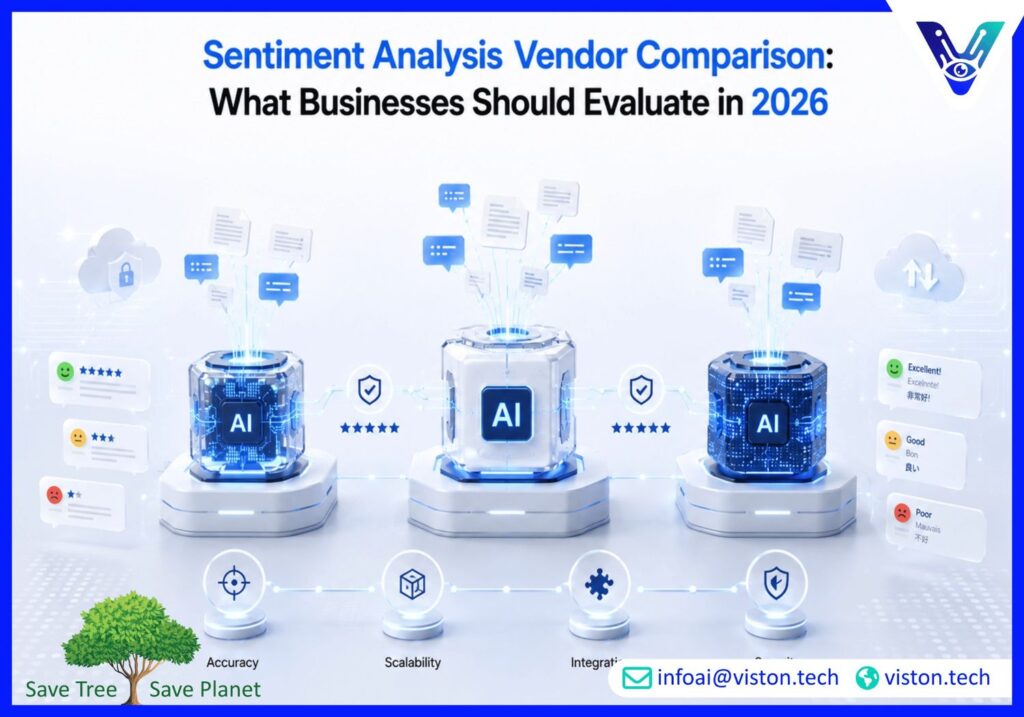
Sentiment Analysis Vendor Comparison: What Businesses Should Evaluate in 2026
As customer feedback, reviews, support conversations, and social media interactions continue to grow, businesses are increasingly relying on sentiment analysis to understand customer opinions at scale. Choosing the right sentiment analysis vendor has become a strategic decision that affects customer experience, brand reputation, operational efficiency, and business intelligence. In 2026, organizations need more than basic text classification—they need scalable, accurate, and business-focused sentiment analysis capabilities.
What Is a Sentiment Analysis Vendor and Why Does It Matter?
A sentiment analysis vendor provides technology, platforms, APIs, or managed solutions that help organizations identify emotions, opinions, and attitudes expressed in text data. These solutions analyze customer feedback and categorize it as positive, negative, neutral, or more nuanced emotional states.Businesses use sentiment analysis across multiple channels, including:
Customer reviews
Social media monitoring
Support tickets
Email communications
Survey responses
Chatbot conversations
Product feedback systems
Employee feedback platforms
The right vendor can help organizations transform large volumes of unstructured text into actionable insights that support decision-making across marketing, customer service, product development, and operations.
Key Factors to Compare When Evaluating Sentiment Analysis Vendors
Accuracy and Language Understanding
Accuracy remains one of the most important evaluation criteria. Modern sentiment analysis platforms must go beyond simple keyword detection and understand context, intent, sarcasm, industry terminology, and conversational language.Organizations should assess how effectively a vendor handles:
Industry-specific vocabulary
Contextual sentiment interpretation
Multilingual content
Mixed sentiment statements
Customer intent recognition
Emotion detection
Customization Capabilities
Every business has unique terminology, customer interactions, and reporting requirements. Vendors that offer customizable models often deliver more relevant and accurate insights than generic solutions.Key customization capabilities may include:
Custom sentiment categories
Industry-specific model training
Domain adaptation
Custom taxonomies
Entity recognition
Intent classification integration
Scalability and Performance
As organizations collect increasing amounts of customer data, sentiment analysis systems must scale efficiently without sacrificing performance.Important considerations include:
Real-time processing capabilities
API throughput limits
Large dataset processing
Cloud scalability
Global deployment support
High availability infrastructure
Integration Flexibility
Sentiment analysis should fit naturally into existing business workflows. Vendors that provide robust integration capabilities often deliver faster implementation and greater operational value.Common integration requirements include:
CRM platforms
Customer support systems
Data warehouses
Business intelligence tools
Marketing automation platforms
Social listening platforms
Custom enterprise applications
Business Benefits of Choosing the Right Sentiment Analysis Vendor
A well-selected sentiment analysis solution can generate value across multiple departments.
Improved Customer Experience
Organizations gain visibility into customer satisfaction trends and can proactively address issues before they impact retention or reputation.
Faster Issue Detection
Real-time sentiment monitoring helps businesses identify emerging product problems, service issues, or negative customer experiences quickly.
Better Product Development Decisions
Customer feedback analysis provides valuable insights into product strengths, weaknesses, feature requests, and improvement opportunities.
More Effective Marketing Strategies
Marketing teams can measure campaign reactions, brand perception, audience sentiment, and customer engagement more accurately.
Data-Driven Decision Making
Leadership teams gain measurable insights that support strategic planning and resource allocation decisions.
Common Challenges When Comparing Sentiment Analysis Vendors
Vendor comparison can be difficult because many providers promote similar capabilities. Businesses should look beyond marketing claims and focus on practical evaluation criteria.
Limited Context Understanding
Some platforms still struggle with complex language structures, sarcasm, industry jargon, and contextual sentiment interpretation.
Insufficient Industry Adaptation
A solution that performs well in one industry may not deliver the same accuracy in another. Industry-specific expertise often plays a significant role in successful implementation.
Hidden Implementation Complexity
Organizations should assess implementation requirements, integration effort, maintenance needs, and ongoing support commitments before selecting a vendor.
Data Privacy and Security Concerns
Businesses handling sensitive customer information must ensure vendors support modern security practices, compliance requirements, access controls, and data governance standards.
What Businesses Should Look for in 2026
The sentiment analysis market continues to evolve rapidly. Organizations evaluating vendors in 2026 should prioritize providers that support modern AI capabilities while maintaining transparency and reliability.Important capabilities include:
Large language model integration
Aspect-based sentiment analysis
Multilingual sentiment detection
Emotion and intent recognition
Real-time analytics
Explainable AI outputs
Enterprise-grade security
Custom model training options
Workflow automation support
Comprehensive reporting dashboards
Businesses should also evaluate the vendor’s ability to evolve alongside changing customer communication channels and growing data volumes.
How Viston AI Supports Modern Sentiment Analysis Initiatives
For organizations seeking sentiment analysis capabilities, Viston AI focuses on helping businesses extract meaningful insights from customer and operational data through AI-driven language processing solutions.Sentiment analysis projects often require more than simply deploying an API. Organizations need solutions that align with business objectives, integrate with existing systems, scale efficiently, and deliver actionable intelligence. Viston AI’s sentiment analysis capabilities can support organizations looking to understand customer feedback, monitor brand perception, analyze service interactions, and improve decision-making through structured insights derived from unstructured text.Businesses evaluating sentiment analysis vendors frequently prioritize factors such as accuracy, scalability, automation, integration flexibility, and reporting capabilities. By combining natural language processing expertise with practical implementation considerations, organizations can develop sentiment analysis workflows that provide measurable operational value.As customer expectations continue to evolve, sentiment analysis is increasingly becoming a core component of customer experience management, market intelligence, and business optimization strategies. Organizations that invest in the right solution can gain deeper visibility into customer needs and respond more effectively to changing market conditions.
Frequently Asked Questions
How do sentiment analysis vendors determine customer sentiment?
Most vendors use natural language processing, machine learning, and AI models to analyze text and classify emotional tone, opinions, and attitudes expressed in customer communications.
What is the most important factor when comparing sentiment analysis vendors?
Accuracy is typically the most critical factor, but businesses should also evaluate scalability, customization options, integration capabilities, security, and reporting functionality.
Can sentiment analysis work across multiple languages?
Many modern platforms support multilingual sentiment analysis, although accuracy levels may vary depending on language coverage and model sophistication.
How long does sentiment analysis implementation usually take?
Implementation timelines depend on project complexity, integration requirements, data availability, customization needs, and organizational readiness. Projects can range from a few weeks to several months.
Is sentiment analysis useful for industries beyond customer support?
Yes. Organizations use sentiment analysis across marketing, product development, reputation management, employee engagement, market research, and operational intelligence initiatives.
Why might businesses consider Viston AI for sentiment analysis projects?
Organizations evaluating sentiment analysis solutions may consider Viston AI when seeking AI-driven language processing capabilities that support customer insight generation, workflow integration, and scalable business intelligence initiatives.
Conclusion
A successful sentiment analysis vendor comparison requires businesses to evaluate more than features alone. Accuracy, scalability, customization, integration capabilities, security, and long-term business value should all be part of the decision-making process. As organizations increasingly rely on customer intelligence to drive growth, selecting the right sentiment analysis solution becomes a strategic investment. Businesses that carefully assess vendor capabilities and align them with operational objectives will be better positioned to turn customer sentiment into actionable business outcomes. For organizations exploring sentiment analysis initiatives, working with experienced providers such as Viston AI can help support effective implementation and measurable results.