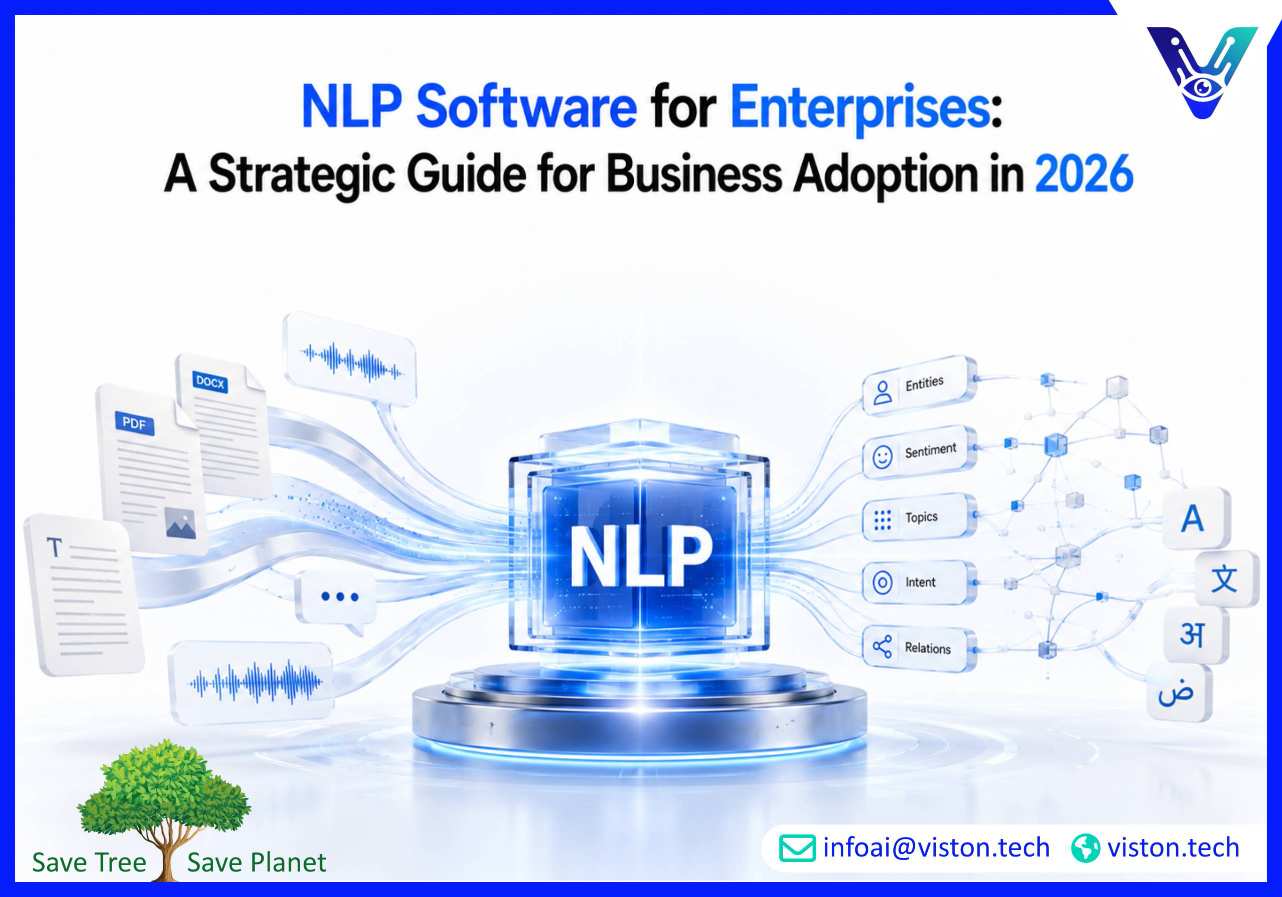
NLP Software for Enterprises: A Strategic Guide for Business Adoption in 2026
Enterprise organizations are increasingly turning to Natural Language Processing (NLP) software to automate communication, improve operational efficiency, extract business intelligence, and enhance customer experiences. As AI technologies mature in 2026, NLP software has become a critical component of enterprise digital transformation strategies across industries.
What Is NLP Software for Enterprises?
Natural Language Processing software enables computers to understand, interpret, analyze, and generate human language. Enterprise NLP solutions use advanced AI models to process large volumes of text, voice, documents, conversations, and unstructured business data.Unlike basic automation tools, enterprise NLP software can understand context, identify intent, recognize entities, classify information, summarize content, and support intelligent decision-making.Modern enterprises use NLP software to automate language-driven processes while improving speed, accuracy, and scalability across departments.
Core Capabilities of Enterprise NLP Software
Text analysis and classification
Sentiment analysis
Named entity recognition
Document processing automation
Knowledge extraction
Language translation
Conversational AI and chatbots
Voice and speech processing
Information retrieval
Content summarization
Intent recognition
Compliance monitoring
These capabilities help enterprises transform unstructured data into actionable business intelligence.
Why NLP Software Matters for Enterprises in 2026
Organizations generate enormous amounts of language-based information every day through emails, support tickets, reports, contracts, customer conversations, surveys, and internal communications.Without NLP technologies, much of this information remains difficult to analyze and utilize effectively.Enterprise NLP software helps businesses address several critical challenges:
Managing growing data volumes
Improving customer support efficiency
Reducing manual document review
Accelerating business decision-making
Enhancing employee productivity
Supporting multilingual operations
Improving compliance and risk management
Scaling customer engagement initiatives
As organizations increasingly adopt AI-driven workflows, NLP has become a foundational technology for extracting value from language data.
Business Benefits of Enterprise NLP Adoption
Reduced operational costs
Faster response times
Improved data accessibility
Enhanced customer experiences
Higher workforce productivity
Better business insights
Improved scalability
More consistent decision-making
These advantages make NLP software a strategic investment rather than simply a technology upgrade.
Key Enterprise Use Cases for NLP Software
The value of NLP software becomes most evident when applied to real business processes.
Customer Support Automation
Organizations use NLP-powered systems to automate ticket classification, answer customer inquiries, prioritize requests, and support self-service experiences.Benefits include:
Reduced support workloads
Faster issue resolution
Improved customer satisfaction
24/7 service availability
Intelligent Document Processing
Enterprise teams frequently manage contracts, invoices, forms, legal documents, reports, and compliance records.NLP software can:
Extract relevant information
Identify key clauses
Classify documents
Detect anomalies
Support compliance workflows
This significantly reduces manual processing effort while improving accuracy.
Enterprise Search and Knowledge Management
Employees often struggle to locate information scattered across multiple systems.NLP-powered knowledge management solutions help organizations:
Improve information discovery
Enhance internal search capabilities
Provide contextual answers
Support employee self-service
This increases productivity while reducing dependency on internal support teams.
Business Intelligence and Analytics
NLP software can analyze customer feedback, surveys, reviews, social media content, and internal communications.Organizations gain insights into:
Customer sentiment
Emerging trends
Operational issues
Product feedback
Market opportunities
These insights help leadership teams make informed strategic decisions.
Compliance and Risk Monitoring
Many enterprises operate within strict regulatory environments.NLP solutions can automatically monitor communications, documents, and transactions for:
Policy violations
Compliance risks
Sensitive information exposure
Regulatory reporting requirements
This strengthens governance while reducing compliance burdens.
How to Evaluate NLP Software for Enterprise Deployment
Selecting enterprise NLP software requires more than comparing feature lists. Organizations should assess solutions based on business requirements, scalability, integration needs, and long-term operational goals.
Language Understanding Accuracy
The software should accurately interpret industry-specific terminology, business context, user intent, and multilingual content where necessary.
Integration Capabilities
Enterprise NLP platforms should integrate seamlessly with:
CRM systems
ERP platforms
Document repositories
Customer support software
Business intelligence tools
Communication platforms
Cloud infrastructure
Strong integration capabilities ensure operational continuity and maximize business value.
Scalability Requirements
Enterprise deployments must support growing data volumes, increasing user demand, and evolving business requirements without performance degradation.
Security and Data Governance
Security remains a critical consideration in 2026.Organizations should evaluate:
Data encryption standards
Access controls
Audit logging
Data residency options
Compliance support
Privacy protections
These factors become especially important when processing sensitive business information.
Customization and Domain Adaptation
Enterprise NLP software often requires customization to align with industry-specific terminology, workflows, regulatory requirements, and business objectives.Solutions that support domain adaptation generally deliver stronger business outcomes.
Future Trends Shaping Enterprise NLP Software
Enterprise NLP technology continues to evolve rapidly.Several developments are influencing adoption strategies in 2026:
Organizations investing in NLP solutions increasingly prioritize flexibility, governance, and long-term scalability alongside advanced AI capabilities.As enterprise AI adoption accelerates, NLP software is expected to become deeply integrated into everyday business operations.
How Viston AI Supports Enterprise NLP Initiatives
Organizations seeking enterprise-grade Natural Language Processing solutions often require more than standalone software. Successful NLP adoption depends on strategy, implementation expertise, integration capabilities, data management, AI governance, and ongoing optimization.Viston AI provides Natural Language Processing solutions designed to help businesses unlock value from language-based data and automate critical business processes. Its approach focuses on practical enterprise applications such as conversational AI, intelligent document processing, knowledge management, workflow automation, language understanding, and business intelligence.By aligning NLP capabilities with operational objectives, organizations can improve efficiency, enhance customer experiences, and support data-driven decision-making. Enterprise deployments also require attention to security, scalability, compliance, and system interoperability, all of which play an important role in long-term success.As enterprises continue expanding AI initiatives in 2026, NLP technologies provide a foundation for smarter automation, improved information accessibility, and more intelligent business operations. Businesses evaluating NLP investments can benefit from specialized expertise that connects advanced language technologies with measurable business outcomes.
Frequently Asked Questions
What is enterprise NLP software?
Enterprise NLP software uses artificial intelligence to analyze, understand, process, and generate human language for business applications such as customer support, document processing, analytics, and workflow automation.
How is NLP software different from traditional automation tools?
Traditional automation typically follows predefined rules, while NLP software can understand language context, intent, sentiment, and meaning, enabling more intelligent decision-making and automation.
Which industries benefit most from NLP software?
Industries such as healthcare, finance, legal services, insurance, retail, manufacturing, telecommunications, and technology frequently use NLP solutions to improve efficiency and manage large volumes of unstructured data.
What should enterprises consider before implementing NLP software?
Organizations should evaluate integration requirements, scalability, security, compliance obligations, customization needs, data quality, governance frameworks, and expected business outcomes.
Can Viston AI help implement enterprise NLP solutions?
Yes. Viston AI provides Natural Language Processing solutions that help organizations implement language-driven automation, intelligent data processing, conversational AI systems, and enterprise workflow optimization initiatives.
Conclusion
NLP software for enterprises has become an essential technology for organizations seeking to automate language-intensive processes, improve decision-making, and unlock value from unstructured data. From customer support and document processing to compliance monitoring and knowledge management, Natural Language Processing solutions are transforming how businesses operate in 2026. Successful adoption requires careful consideration of scalability, integration, governance, and business objectives. For organizations evaluating enterprise NLP initiatives, working with experienced specialists such as Viston AI can help ensure that Natural Language Processing solutions align with operational goals and deliver meaningful long-term business value.