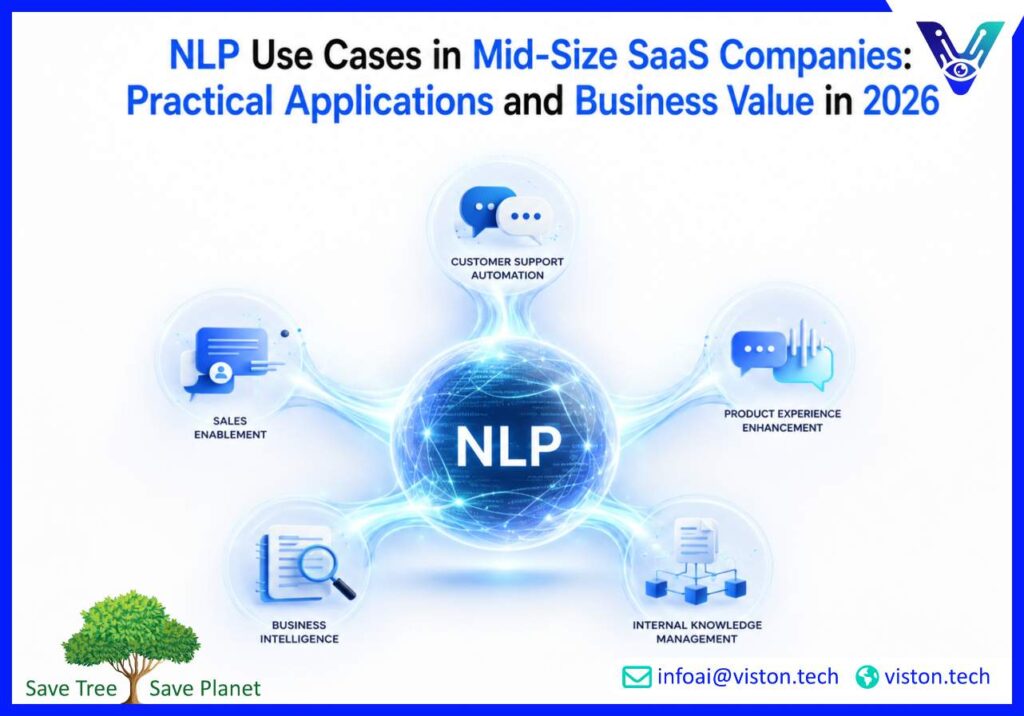
NLP Use Cases in Mid-Size SaaS Companies: Practical Applications and Business Value in 2026
As Software-as-a-Service (SaaS) companies continue to scale customer acquisition, support operations, and product delivery, Natural Language Processing (NLP) has become a key technology for improving efficiency and enhancing user experiences. For mid-size SaaS companies, NLP offers practical opportunities to automate communication, extract insights from data, and streamline workflows without increasing operational complexity.
Why NLP Matters for Mid-Size SaaS Companies in 2026
Mid-size SaaS businesses often operate in a challenging growth phase. They must serve larger customer bases, support expanding product portfolios, and compete with larger enterprises while maintaining lean teams and controlled budgets.Natural Language Processing solutions help address these challenges by enabling software systems to understand, analyze, and generate human language. Modern NLP technologies support automation, personalization, analytics, and customer engagement across multiple business functions.In 2026, SaaS organizations are increasingly adopting NLP to:
Reduce support workloads
Improve customer experience
Accelerate sales processes
Enhance product usability
Extract business intelligence from unstructured data
Improve operational efficiency
Scale customer interactions without proportional staffing increases
The value of NLP lies not only in automation but also in helping businesses make better decisions using information that was previously difficult to analyze at scale.
Customer Support Automation and Intelligent Self-Service
One of the most widely adopted NLP use cases in mid-size SaaS companies is customer support automation.Support teams often manage thousands of tickets, chat conversations, emails, and knowledge base requests each month. NLP-powered systems can understand customer intent and provide accurate responses without requiring human intervention for routine inquiries.
Common Support Applications
AI-powered chatbots
Automated ticket categorization
Knowledge base search assistants
Email response suggestions
Customer issue routing
Sentiment detection for escalations
By automating repetitive support interactions, SaaS companies can reduce response times while allowing support teams to focus on complex customer issues that require human expertise.
Business Benefits
Lower support costs
Faster resolution times
Improved customer satisfaction
24/7 customer assistance
Consistent support experiences
Sales Enablement and Lead Qualification
Sales teams in growing SaaS companies often spend significant time qualifying leads, responding to inquiries, and managing repetitive communication.NLP solutions help automate early-stage sales interactions while providing sales representatives with better context and insights.
Key NLP Sales Use Cases
Lead qualification chatbots
Automated meeting scheduling conversations
Intent analysis from prospect communications
Email summarization
Conversation intelligence tools
Sales call transcription and analysis
NLP systems can identify buying signals, analyze prospect intent, and prioritize leads based on conversation patterns and engagement behaviors.This allows sales teams to focus on high-value opportunities while improving overall pipeline efficiency.
Product Experience Enhancement Through Conversational Interfaces
Many SaaS products contain extensive functionality that users may struggle to navigate effectively. NLP-powered interfaces can simplify product interactions and reduce learning curves.
Popular Product-Level NLP Implementations
Natural language search
AI-powered product assistants
Contextual help systems
Voice-enabled features
Guided onboarding assistants
Feature recommendation engines
Instead of requiring users to navigate complex menus, NLP enables customers to interact with software using natural language queries.For example, users can ask questions such as:
“Show me customer churn reports from last quarter.”
“Generate a sales performance dashboard.”
“How do I connect my CRM integration?”
This improves usability while increasing product adoption and customer retention.
Data Analysis and Business Intelligence from Unstructured Data
Mid-size SaaS companies generate large volumes of unstructured information across customer conversations, feedback forms, support tickets, reviews, surveys, and internal communications.Traditional analytics tools often struggle to extract value from this data.
NLP-Driven Analytics Applications
Customer sentiment analysis
Voice of customer programs
Product feedback categorization
Trend detection
Competitive intelligence monitoring
Customer satisfaction analysis
NLP technologies can automatically identify patterns, recurring complaints, feature requests, and emerging market trends.This enables leadership teams to make more informed decisions based on customer-driven insights rather than relying solely on quantitative metrics.
Strategic Advantages
Faster decision-making
Improved product planning
Enhanced customer understanding
Better prioritization of development resources
Reduced manual analysis efforts
Operational Efficiency and Internal Knowledge Management
As SaaS companies grow, internal knowledge often becomes fragmented across documents, emails, communication platforms, and support resources.NLP-powered knowledge management solutions help employees find information quickly while reducing time spent searching across multiple systems.
Internal NLP Applications
Enterprise search assistants
Knowledge base automation
Document summarization
Meeting transcription and analysis
Policy and procedure retrieval
Internal helpdesk automation
These capabilities become increasingly valuable as organizations scale and operational complexity increases.Employees gain faster access to information, reducing delays and improving productivity across departments.
How Natural Language Processing Solutions Support SaaS Growth
Implementing NLP successfully requires more than deploying AI models. Businesses need solutions that align with operational goals, customer expectations, existing technology ecosystems, and scalability requirements.Effective Natural Language Processing Solutions typically include:
Custom NLP model development
AI chatbot implementation
Intent recognition systems
Text analytics platforms
CRM and SaaS platform integrations
Knowledge management automation
Workflow automation capabilities
Continuous model optimization
For mid-size SaaS companies, the most successful NLP initiatives are often those that solve specific business challenges while integrating seamlessly with existing workflows.
How Viston AI Helps SaaS Companies Leverage NLP Effectively
As businesses increasingly adopt AI-driven automation, Viston AI provides Natural Language Processing Solutions designed to help organizations transform customer interactions, operational processes, and business intelligence workflows.For mid-size SaaS companies, NLP implementation often requires balancing scalability, performance, integration requirements, and user experience considerations. Viston AI supports organizations through tailored NLP development, conversational AI deployment, workflow automation, text analytics, and intelligent system integration strategies.By focusing on practical business outcomes rather than standalone AI features, Viston AI helps SaaS businesses implement NLP capabilities that align with customer support goals, product innovation initiatives, sales efficiency programs, and operational growth objectives.As SaaS markets become increasingly competitive in 2026, organizations that successfully leverage NLP technologies are often better positioned to improve customer experiences, streamline operations, and scale efficiently.
Frequently Asked Questions
What are the most common NLP use cases in mid-size SaaS companies?
Common use cases include customer support automation, AI chatbots, sentiment analysis, lead qualification, knowledge management, conversational search, and business intelligence from unstructured data.
How does NLP improve customer support for SaaS businesses?
NLP enables chatbots, automated ticket routing, knowledge base search, and sentiment analysis, helping support teams respond faster while reducing manual workloads.
Can NLP help SaaS companies improve product adoption?
Yes. NLP-powered product assistants, conversational interfaces, and intelligent onboarding experiences help users navigate software more efficiently and discover relevant features.
Is NLP suitable for mid-size companies with limited resources?
Modern NLP platforms and cloud-based AI services make NLP accessible for mid-size organizations. Many companies begin with targeted use cases before expanding adoption across departments.
How can Viston AI support NLP implementation for SaaS businesses?
Viston AI provides Natural Language Processing Solutions that help SaaS companies implement conversational AI, automation workflows, text analytics, system integrations, and intelligent customer engagement capabilities aligned with business goals.
Conclusion
NLP use cases in mid-size SaaS companies continue to expand as businesses seek smarter ways to automate operations, improve customer experiences, and generate actionable insights from growing volumes of data. From support automation and sales enablement to product enhancement and business intelligence, Natural Language Processing Solutions provide practical opportunities for sustainable growth. Organizations that strategically implement NLP technologies can improve efficiency, strengthen customer relationships, and scale operations more effectively. For companies looking to accelerate NLP adoption, Viston AI offers specialized expertise in designing and implementing solutions that align technology investments with measurable business outcomes.