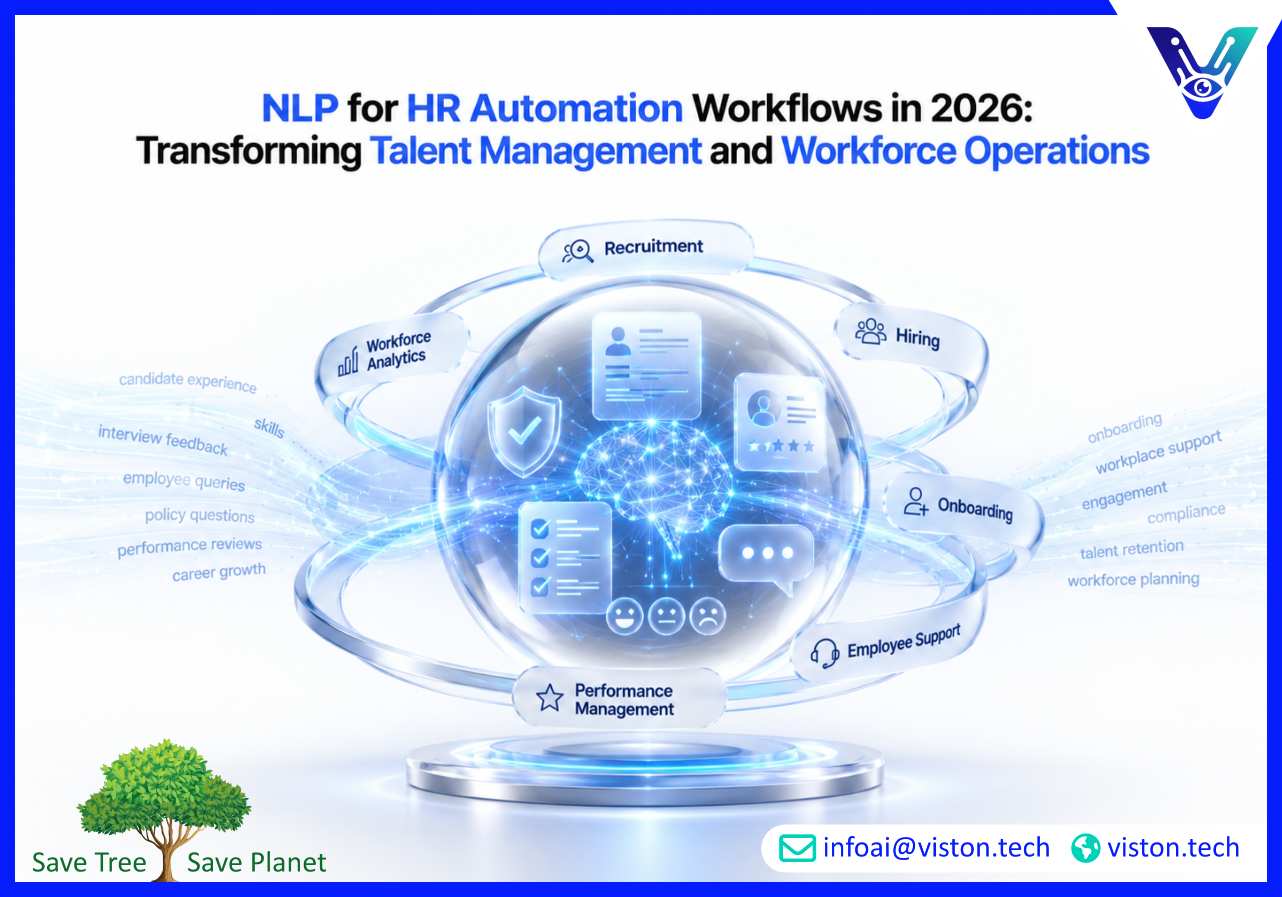
NLP for HR Automation Workflows in 2026: Transforming Talent Management and Workforce Operations
Human resources teams are under increasing pressure to manage growing workforces, improve employee experiences, accelerate hiring, and maintain compliance while controlling operational costs. NLP for HR automation workflows has emerged as a practical solution that helps organizations automate repetitive tasks, extract insights from workforce data, and streamline HR processes without sacrificing accuracy or employee engagement.
What Is NLP for HR Automation Workflows?
Natural Language Processing (NLP) is a branch of artificial intelligence that enables systems to understand, analyze, interpret, and generate human language. In HR automation workflows, NLP helps organizations process large volumes of employee, candidate, and organizational data that would otherwise require significant manual effort.Unlike traditional automation systems that rely on predefined rules, NLP-powered solutions can understand context, identify intent, extract relevant information, and respond intelligently to human interactions.Common HR workflows supported by NLP include:
Resume screening and candidate evaluation
Employee onboarding assistance
HR helpdesk automation
Performance review analysis
Employee sentiment monitoring
Policy and compliance management
Internal knowledge management
Workforce analytics and reporting
As organizations continue to digitize HR operations in 2026, NLP has become a valuable technology for improving efficiency while enabling HR teams to focus on strategic workforce initiatives.
Why NLP Matters for Modern HR Operations
HR departments manage vast amounts of unstructured data every day. Job applications, employee feedback, survey responses, performance reviews, support requests, and policy documents often contain valuable insights hidden within natural language.Manual processing of this information can be time-consuming, inconsistent, and difficult to scale.NLP addresses these challenges by transforming unstructured text into actionable business intelligence.
Faster Recruitment Processes
Recruiters frequently spend significant time reviewing resumes and matching candidates to open positions. NLP-powered systems can automatically identify relevant skills, qualifications, certifications, and experience levels, helping recruiters prioritize suitable candidates more efficiently.This reduces screening time while improving candidate selection consistency.
Improved Employee Support
Employees often have recurring questions regarding benefits, leave policies, payroll, compliance requirements, and workplace procedures.NLP-enabled virtual assistants can provide instant responses, reducing the workload on HR support teams and improving employee satisfaction.
Enhanced Workforce Insights
Organizations increasingly rely on employee feedback to understand workforce engagement and retention risks. NLP can analyze surveys, exit interviews, and feedback channels to identify trends, concerns, and sentiment patterns across departments and locations.These insights help HR leaders make informed workforce decisions.
Scalable HR Operations
As businesses grow, manual HR processes often become operational bottlenecks. NLP-driven automation enables HR functions to scale efficiently without requiring proportional increases in administrative resources.
Key HR Automation Workflows Powered by NLP
NLP technologies support multiple HR functions throughout the employee lifecycle.
Candidate Screening and Talent Acquisition
Recruitment remains one of the most common NLP use cases in HR.NLP solutions can:
Parse resumes automatically
Identify candidate skills and qualifications
Match applicants to job descriptions
Rank candidates based on predefined criteria
Reduce recruiter workload
Improve hiring consistency
This allows hiring teams to focus on interviewing and relationship-building rather than manual document review.
Employee Onboarding Automation
Onboarding often involves multiple documents, policies, training materials, and support requests.NLP-powered assistants can guide new hires through onboarding workflows by answering questions, retrieving relevant documents, and providing personalized information based on role requirements.This creates a more efficient onboarding experience while reducing administrative burdens.
HR Service Desk Automation
Many HR departments handle thousands of employee inquiries annually.NLP chatbots and virtual assistants can automate responses to common requests involving:
Leave balances
Benefits information
Payroll questions
Policy clarification
Training programs
Internal procedures
Automated support improves response times while enabling HR specialists to focus on more complex employee matters.
Performance Management Analysis
Performance reviews contain valuable information that often remains underutilized.NLP systems can analyze review comments, manager feedback, and employee self-assessments to identify:
Skill gaps
Development opportunities
Leadership potential
Recurring performance concerns
Organizational capability trends
This helps organizations make more data-driven talent development decisions.
Employee Sentiment Monitoring
Employee engagement directly affects productivity, retention, and organizational culture.NLP can continuously analyze feedback from surveys, internal communications, and employee support channels to identify sentiment changes and emerging workplace issues before they become larger organizational challenges.
Implementation Considerations for NLP in HR Workflows
While NLP offers significant advantages, successful implementation requires careful planning and governance.
Data Privacy and Security
HR systems process highly sensitive employee information. Organizations must ensure that NLP solutions align with privacy regulations, internal security policies, and data governance requirements.Access controls, encryption, audit trails, and secure integrations are essential components of responsible HR automation.
Integration with Existing HR Systems
Most organizations already use HRIS, payroll, applicant tracking systems, and workforce management platforms.NLP solutions should integrate seamlessly with existing systems to ensure smooth data flow and operational efficiency.
Bias Detection and Fairness
Responsible HR automation requires ongoing monitoring to minimize bias in recruitment, employee evaluation, and decision-support processes.Organizations should regularly assess NLP models to ensure fairness, transparency, and compliance with employment regulations.
Human Oversight
NLP should enhance HR decision-making rather than replace human judgment.Critical workforce decisions involving hiring, promotions, disciplinary actions, and workforce planning should continue to involve experienced HR professionals.
Continuous Optimization
Language patterns, workforce needs, and organizational policies evolve over time.NLP systems require ongoing training, monitoring, and optimization to maintain accuracy and business relevance.
The Business Benefits of NLP-Driven HR Automation in 2026
Organizations adopting NLP-powered HR workflows often pursue broader operational and strategic objectives beyond simple task automation.Key business benefits include:
Reduced administrative workload
Faster recruitment cycles
Improved employee experience
Enhanced workforce analytics
Better knowledge accessibility
Consistent HR service delivery
Greater operational scalability
Improved compliance support
More efficient workforce planning
Data-driven talent management
As HR functions become increasingly digital, organizations are seeking solutions that combine automation, intelligence, and scalability. NLP technologies help bridge this gap by turning language-based interactions into actionable business processes.
How Viston AI Supports NLP-Powered HR Automation Workflows
As organizations look to modernize workforce operations, implementing effective Natural Language Processing solutions requires more than deploying AI models. Success depends on building workflows that align with business objectives, employee experiences, operational requirements, and existing technology ecosystems.Viston AI specializes in Natural Language Processing Solutions designed to help organizations automate language-driven business processes while maintaining accuracy, scalability, and operational control.For HR environments, NLP capabilities can support recruitment automation, employee support systems, document processing, workforce analytics, knowledge management, and sentiment analysis initiatives. By transforming unstructured workforce data into actionable insights, businesses can improve efficiency while enabling HR teams to focus on strategic priorities.Modern HR automation projects often require integration across multiple systems, including applicant tracking platforms, HR information systems, internal communication tools, and reporting environments. Effective NLP implementation also requires attention to governance, security, compliance, workflow design, and continuous optimization.Organizations evaluating NLP-powered HR initiatives benefit from working with specialists who understand both language technologies and real-world business processes. A structured implementation approach helps ensure that automation delivers measurable operational value while supporting long-term workforce management objectives.
Frequently Asked Questions
What is NLP in HR automation?
NLP in HR automation refers to the use of Natural Language Processing technology to understand, analyze, and automate language-based HR tasks such as recruitment, employee support, onboarding, and workforce analytics.
How does NLP improve recruitment workflows?
NLP can automatically screen resumes, identify candidate qualifications, match applicants to job requirements, and prioritize candidates for review, helping recruiters reduce manual effort and accelerate hiring decisions.
Can NLP help improve employee engagement?
Yes. NLP can analyze employee feedback, surveys, support requests, and communication channels to identify sentiment trends, workplace concerns, and engagement opportunities.
Is NLP suitable for enterprise HR environments?
Yes. Modern NLP platforms are designed to support large-scale HR operations through automation, analytics, integration capabilities, security controls, and scalable deployment models.
What are the biggest challenges when implementing NLP for HR?
Common challenges include data privacy requirements, integration complexity, model accuracy, bias management, governance, and ensuring appropriate human oversight of automated processes.
How can Viston AI support NLP-based HR automation projects?
Viston AI provides Natural Language Processing Solutions that can help organizations automate language-driven workflows, improve workforce insights, enhance employee experiences, and support scalable HR transformation initiatives.
Conclusion
NLP for HR automation workflows is becoming a critical component of modern workforce management strategies in 2026. By automating repetitive processes, improving employee support, accelerating recruitment, and unlocking insights from unstructured data, NLP enables HR teams to operate more efficiently and strategically. Organizations evaluating Natural Language Processing Solutions should focus on scalability, integration, security, governance, and measurable business outcomes. With the right implementation approach, businesses can transform HR operations while creating better experiences for employees and decision-makers alike. Viston AI supports organizations seeking practical, business-focused NLP capabilities that align with evolving workforce needs.