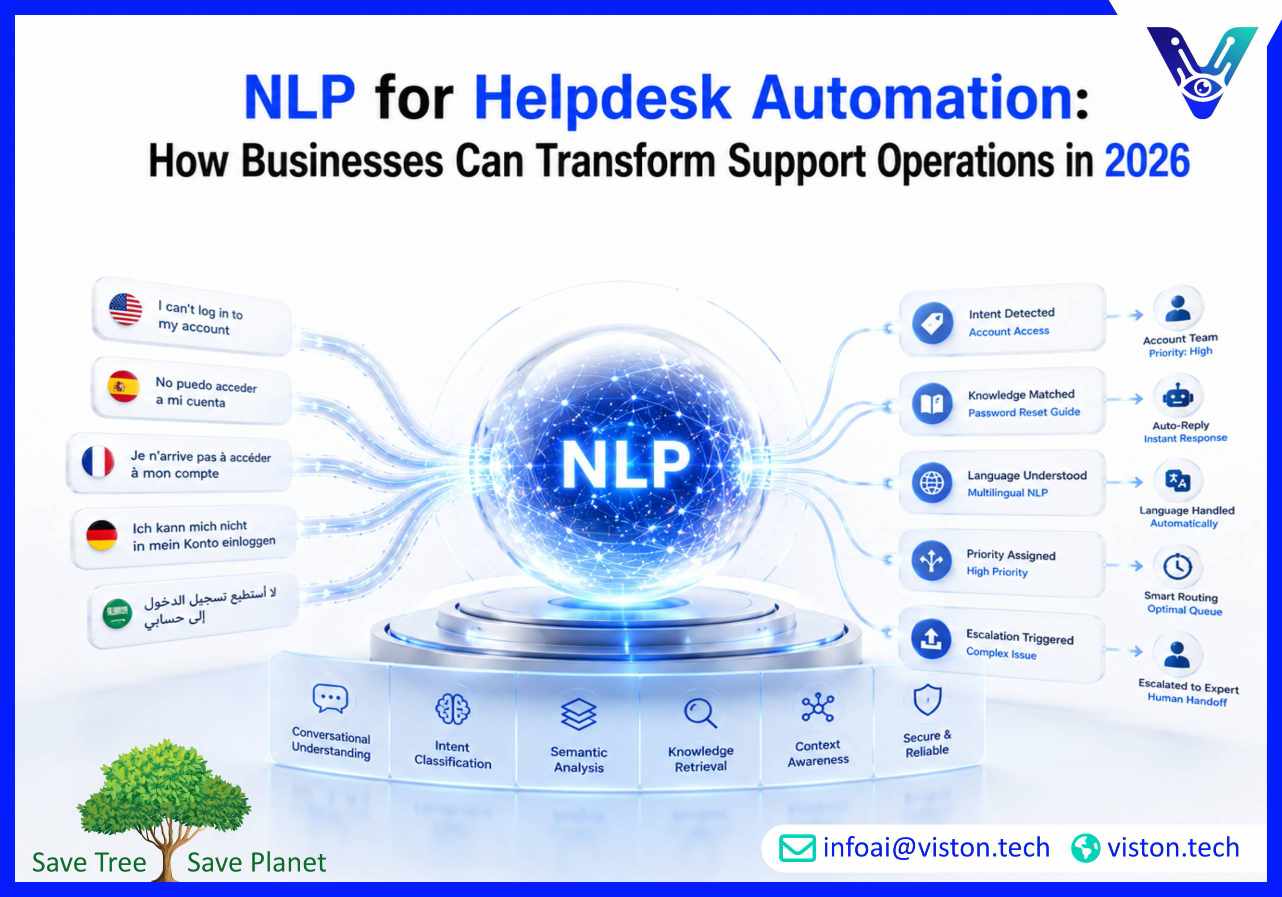
NLP for Helpdesk Automation: How Businesses Can Transform Support Operations in 2026
Customer support teams are under constant pressure to respond faster, resolve issues efficiently, and maintain high service quality across growing volumes of customer inquiries. NLP for helpdesk automation has emerged as a practical solution for organizations seeking to improve support operations while reducing manual workloads. In 2026, businesses are increasingly using Natural Language Processing to automate ticket handling, streamline workflows, and deliver more responsive customer experiences.
What NLP for Helpdesk Automation Means for Modern Businesses
Natural Language Processing (NLP) is a branch of artificial intelligence that enables systems to understand, interpret, and process human language. Within helpdesk environments, NLP helps support platforms analyze customer requests, identify intent, classify tickets, extract relevant information, and provide intelligent responses.Rather than relying solely on manual ticket triage and agent intervention, NLP-powered helpdesk systems can automate many repetitive support processes while improving accuracy and consistency.Common NLP-driven helpdesk capabilities include:
Automatic ticket categorization
Priority detection and routing
Sentiment analysis
Knowledge base search
Automated responses
Conversation summarization
Multilingual support
Self-service assistance
Intelligent escalation workflows
As support teams handle increasing volumes of customer interactions across multiple channels, NLP has become a valuable component of modern service operations.
Why NLP-Powered Helpdesk Automation Matters in 2026
Customer expectations continue to evolve. Businesses are expected to provide quick, accurate, and personalized support regardless of communication channel or time zone.Traditional helpdesk processes often struggle with:
High ticket volumes
Long response times
Inconsistent ticket routing
Agent overload
Knowledge management challenges
Rising operational costs
Support scalability limitations
NLP addresses these challenges by enabling systems to understand customer intent and automate routine support activities.
Faster Ticket Resolution
NLP can instantly analyze incoming requests, identify issue types, and route tickets to the appropriate department or support specialist. This reduces delays caused by manual triage and improves first-response times.
Improved Customer Experience
Customers receive faster answers and more relevant support interactions. NLP-powered systems can understand conversational language, making interactions feel more natural and efficient.
Reduced Support Costs
Automating repetitive support tasks allows organizations to allocate human agents to higher-value issues while reducing operational overhead.
Better Scalability
As businesses grow, NLP-enabled helpdesk systems can manage increasing support demand without requiring proportional increases in staffing levels.
Key NLP Applications in Helpdesk Automation
Organizations implement NLP in various ways depending on their support objectives, workflows, and customer service requirements.
Intelligent Ticket Classification
One of the most common NLP use cases involves automatically categorizing support requests.Instead of manually reviewing tickets, NLP models can identify:
Technical issues
Billing inquiries
Product questions
Account management requests
Feature requests
Complaint categories
This ensures tickets are directed to the correct team immediately.
Automated Ticket Prioritization
Not every support request carries the same urgency.NLP systems can evaluate language patterns, sentiment, keywords, and contextual information to determine ticket priority levels.Critical issues can be escalated automatically while lower-priority requests follow standard workflows.
AI-Powered Virtual Support Assistants
NLP-driven chatbots and virtual assistants can handle common support requests without agent involvement.Typical tasks include:
Password reset assistance
Order status inquiries
Account updates
FAQ responses
Troubleshooting guidance
Knowledge base recommendations
This improves service availability while reducing agent workload.
Knowledge Base Search and Retrieval
Traditional keyword-based searches often fail when users phrase questions differently from documented content.NLP-powered semantic search enables support systems to understand intent rather than exact keywords, helping customers and agents locate relevant information more effectively.
Sentiment Analysis and Customer Insights
NLP can analyze customer language to identify frustration, urgency, satisfaction, or escalation risk.Support managers can use these insights to:
Improve service quality
Identify recurring issues
Monitor customer satisfaction
Optimize support workflows
Reduce churn risks
Implementation Considerations for NLP Helpdesk Automation
Successful NLP implementation requires more than deploying AI tools. Organizations should consider operational, technical, and governance factors to ensure long-term success.
Integration with Existing Support Systems
NLP solutions should integrate seamlessly with existing platforms such as:
Helpdesk software
CRM systems
Customer portals
Knowledge management platforms
Communication channels
Workflow automation tools
Strong integration ensures consistent data access and smoother support operations.
Data Quality and Training
NLP performance depends heavily on data quality. Historical support tickets, customer conversations, and knowledge base content help train systems to understand business-specific terminology and workflows.
Security and Compliance
Support environments often contain sensitive customer information.Organizations should ensure NLP solutions support:
Data encryption
Access controls
Audit logging
Privacy requirements
Responsible AI governance
Regulatory compliance standards
Human Escalation Workflows
While NLP can automate many support processes, complex cases still require human expertise. Effective helpdesk automation includes clear escalation pathways for situations where AI confidence is low or customer needs require specialized assistance.
Best Practices for Maximizing NLP Helpdesk Performance
Organizations that achieve the strongest results from NLP automation typically follow several proven practices.
Start with high-volume repetitive support tasks
Define measurable automation objectives
Continuously train and optimize NLP models
Monitor customer satisfaction metrics
Maintain accurate knowledge base content
Use analytics to identify automation opportunities
Balance automation with human support availability
Regularly review ticket classification accuracy
NLP implementations perform best when treated as an evolving business capability rather than a one-time technology deployment.
How Viston AI Supports NLP for Helpdesk Automation
As organizations increasingly adopt AI-driven support technologies, Viston AI provides Natural Language Processing Solutions designed to help businesses automate and optimize helpdesk operations. The focus extends beyond simple automation by connecting NLP capabilities with real support workflows, customer service objectives, and operational requirements.Its Natural Language Processing Solutions support capabilities such as intelligent ticket classification, conversational AI, semantic knowledge search, workflow automation, multilingual support, and customer interaction analysis. By integrating NLP technologies with existing business systems, organizations can improve service efficiency while maintaining high-quality customer experiences.For businesses seeking helpdesk automation initiatives, successful implementation requires a combination of language intelligence, integration expertise, scalability planning, governance controls, and continuous optimization. Viston AI helps organizations develop practical NLP strategies that align with support operations, customer expectations, and long-term business goals.As support environments continue evolving in 2026, businesses increasingly benefit from NLP solutions that improve responsiveness, reduce manual effort, and create more intelligent customer service experiences.
Frequently Asked Questions
What is NLP in helpdesk automation?
NLP in helpdesk automation refers to the use of Natural Language Processing technologies to understand customer requests, automate ticket handling, improve routing accuracy, and support customer service workflows.
How does NLP improve support ticket management?
NLP can automatically classify, prioritize, route, and analyze support tickets, helping organizations reduce response times and improve operational efficiency.
Can NLP-powered helpdesks support multiple languages?
Yes. Modern NLP solutions can support multilingual customer interactions, making them valuable for organizations serving diverse customer bases across multiple regions.
Is NLP helpdesk automation suitable for small and mid-sized businesses?
Yes. Businesses of all sizes can benefit from NLP-powered automation, particularly for managing repetitive inquiries, improving response consistency, and scaling support operations.
Can Viston AI help implement NLP for helpdesk automation?
Yes. Viston AI provides Natural Language Processing Solutions that support intelligent ticket management, conversational AI, workflow automation, semantic search, and customer support optimization initiatives.
Conclusion
NLP for helpdesk automation is becoming an essential capability for organizations seeking to improve customer support efficiency, scalability, and service quality in 2026. By automating ticket classification, routing, knowledge retrieval, and customer interactions, Natural Language Processing helps businesses reduce operational burdens while delivering faster and more consistent support experiences. Successful implementation requires careful attention to integration, governance, optimization, and user experience. Organizations looking to modernize support operations can benefit from working with specialists such as Viston AI to develop and implement Natural Language Processing Solutions that align with business objectives and evolving customer expectations.