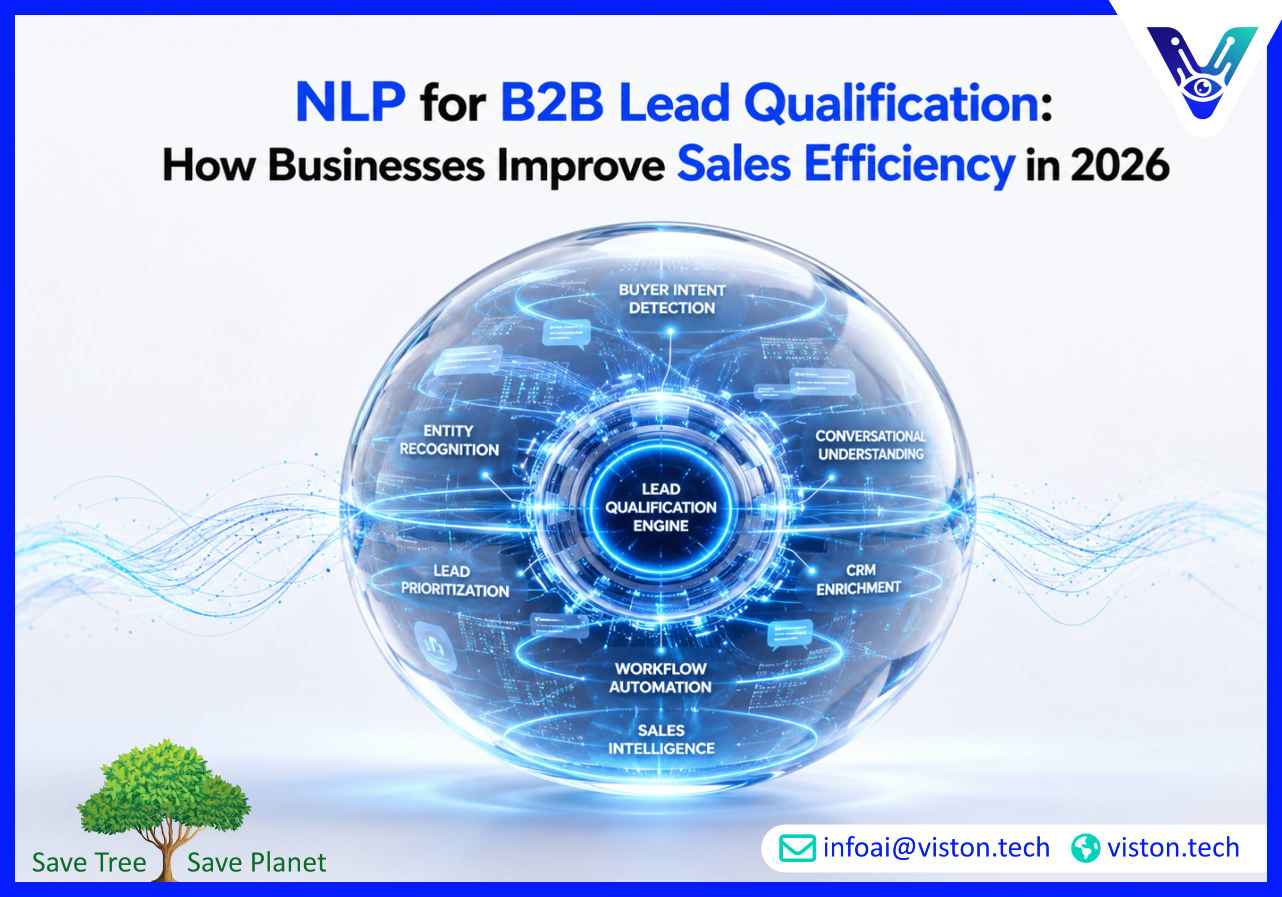
NLP for B2B Lead Qualification: How Businesses Improve Sales Efficiency in 2026
As B2B sales cycles become increasingly complex, businesses are looking for smarter ways to identify, prioritize, and engage high-quality prospects. NLP for B2B lead qualification has emerged as a powerful approach for analyzing conversations, inquiries, forms, emails, and customer interactions at scale. By leveraging Natural Language Processing solutions, organizations can improve lead quality, accelerate sales workflows, and help revenue teams focus on opportunities with the highest potential.
What NLP for B2B Lead Qualification Means for Modern Businesses
B2B lead qualification is the process of determining whether a prospect is likely to become a customer based on factors such as business needs, budget, intent, authority, and engagement level. Traditionally, this process required significant manual effort from sales and marketing teams.Natural Language Processing (NLP) allows businesses to automate and enhance lead qualification by analyzing human language across multiple channels, including:
Website inquiries
Contact forms
Email communications
Sales conversations
Chatbot interactions
Customer support requests
Social engagement
Meeting transcripts
Rather than relying solely on static lead scoring rules, NLP systems can understand context, intent, sentiment, urgency, and buying signals hidden within conversations and text-based interactions.For B2B organizations handling large volumes of leads, this creates opportunities to improve qualification accuracy while reducing the burden on sales teams.
Why NLP-Based Lead Qualification Matters in 2026
Modern buyers conduct extensive research before engaging with vendors. By the time a prospect reaches out, valuable qualification insights are often embedded within their language and communication patterns.NLP technology helps businesses uncover these insights automatically.
Faster Lead Assessment
Sales teams no longer need to manually review every inquiry. NLP engines can evaluate messages in real time and identify indicators such as purchase intent, project urgency, business challenges, and solution requirements.
Improved Sales Productivity
By prioritizing qualified opportunities, sales representatives can spend more time engaging serious buyers and less time filtering unqualified leads.
More Accurate Lead Scoring
Traditional lead scoring often depends on demographic and behavioral data. NLP adds contextual intelligence by evaluating what prospects actually say and ask.
Better Customer Experiences
Prospects receive faster responses, more relevant follow-up communication, and a smoother buying journey when qualification processes become more intelligent.
Scalable Growth
As lead volumes increase, NLP-powered systems help maintain qualification consistency without requiring proportional increases in staffing.
How Natural Language Processing Supports B2B Lead Qualification
NLP technologies can be applied throughout the lead qualification lifecycle to improve decision-making and sales effectiveness.
Intent Detection
One of the most valuable NLP capabilities is identifying buyer intent.For example, inquiries containing phrases such as:
“Need implementation support”
“Looking for a solution provider”
“Request a demo”
“Interested in pricing”
“Evaluating vendors”
often indicate stronger purchasing intent than general information requests.NLP systems can automatically classify and prioritize leads based on these signals.
Entity Recognition
Entity extraction helps identify important business information from conversations, including:
Company names
Industry sectors
Geographic locations
Project timelines
Budget references
Technology platforms
Business requirements
This information can enrich CRM records and support more accurate qualification processes.
Sentiment Analysis
Understanding sentiment helps organizations determine whether prospects are expressing urgency, frustration with existing solutions, enthusiasm, or hesitation.These insights can help sales teams tailor outreach strategies more effectively.
Conversation Summarization
NLP-powered summarization can automatically generate concise lead profiles from lengthy interactions, helping sales representatives prepare for conversations more efficiently.
Automated Routing
Qualified leads can be automatically assigned to appropriate sales teams, regions, industries, or product specialists based on extracted language insights.
Key Implementation Considerations for NLP Lead Qualification Projects
While NLP offers significant opportunities, successful implementation requires careful planning and alignment with business objectives.
Define Qualification Criteria Clearly
Organizations should establish clear definitions of what constitutes a qualified lead. NLP systems perform best when supported by well-defined qualification frameworks and business rules.
Integrate with Existing Sales Systems
Lead qualification workflows should connect seamlessly with:
CRM platforms
Marketing automation tools
Customer support systems
Chatbot platforms
Sales engagement software
Analytics environments
Integration ensures that qualification insights become actionable across the revenue ecosystem.
Maintain Data Quality
High-quality data remains essential for NLP performance. Businesses should continuously review lead records, interaction histories, and qualification outcomes to improve model effectiveness.
Monitor Accuracy and Outcomes
Organizations should track metrics such as:
Lead-to-opportunity conversion rates
Sales acceptance rates
Qualification accuracy
Pipeline velocity
Response times
Revenue attribution
Continuous optimization helps maximize long-term value from NLP investments.
Common B2B Use Cases for NLP-Based Lead Qualification
NLP solutions are increasingly being adopted across multiple B2B environments.
SaaS Companies
Software providers use NLP to evaluate inbound demo requests, product inquiries, trial sign-ups, and support interactions to identify high-potential prospects.
Professional Services Firms
Consulting and service organizations use NLP to analyze project inquiries and determine alignment with expertise, budget expectations, and business requirements.
Technology Vendors
Technology providers often leverage NLP to prioritize enterprise opportunities, identify buying committees, and route inquiries to specialized sales teams.
Manufacturing and Industrial Businesses
Manufacturers use NLP to process RFQs, distributor inquiries, and procurement requests more efficiently.Across industries, the objective remains the same: improving lead quality while reducing manual effort.
How Viston AI Supports NLP-Driven Lead Qualification Strategies
As businesses increasingly seek smarter sales automation and customer engagement capabilities, Viston AI provides Natural Language Processing Solutions designed to help organizations transform language-based interactions into actionable business intelligence.NLP-driven lead qualification requires more than simple keyword matching. Effective implementations often combine intent detection, entity extraction, conversational AI, workflow automation, semantic analysis, CRM integration, and reporting capabilities. Viston AI focuses on helping businesses connect these technologies with practical sales and marketing processes.Organizations evaluating NLP for B2B lead qualification often need solutions that can integrate with existing customer acquisition workflows while supporting scalability, accuracy, automation, and operational efficiency. By aligning NLP technologies with real business objectives, companies can improve lead prioritization, reduce qualification bottlenecks, and support more effective revenue generation strategies.As AI adoption continues to mature in 2026, businesses increasingly benefit from NLP solutions that transform customer conversations and unstructured data into meaningful qualification insights that support faster and more informed sales decisions.
Frequently Asked Questions
What is NLP for B2B lead qualification?
NLP for B2B lead qualification uses Natural Language Processing technologies to analyze customer interactions, identify buying intent, extract relevant business information, and help sales teams prioritize qualified prospects.
How does NLP improve lead scoring?
NLP adds contextual understanding by evaluating the language prospects use in emails, forms, chats, and conversations, helping organizations identify stronger buying signals than traditional scoring models alone.
Can NLP integrate with CRM platforms?
Yes. Modern NLP solutions can integrate with CRM systems, marketing automation tools, customer support platforms, and sales workflows to enrich lead data and automate qualification processes.
Which industries benefit most from NLP-based lead qualification?
SaaS, technology, professional services, manufacturing, healthcare, financial services, and many other B2B industries can benefit from NLP-driven lead qualification capabilities.
Can Viston AI help businesses implement NLP lead qualification solutions?
Yes. Viston AI provides Natural Language Processing Solutions that support conversational analysis, workflow automation, lead qualification, customer engagement, and business process optimization initiatives.
Conclusion
NLP for B2B lead qualification is becoming an essential capability for organizations seeking to improve sales efficiency, qualification accuracy, and customer engagement in 2026. By analyzing language, intent, sentiment, and contextual business information, Natural Language Processing solutions help businesses identify high-value opportunities more effectively and streamline revenue operations. Organizations that invest in well-designed NLP-driven qualification processes can reduce manual effort, accelerate pipeline development, and improve sales outcomes. For businesses exploring advanced Natural Language Processing Solutions, Viston AI offers capabilities that help transform customer interactions into actionable qualification intelligence and measurable business value.