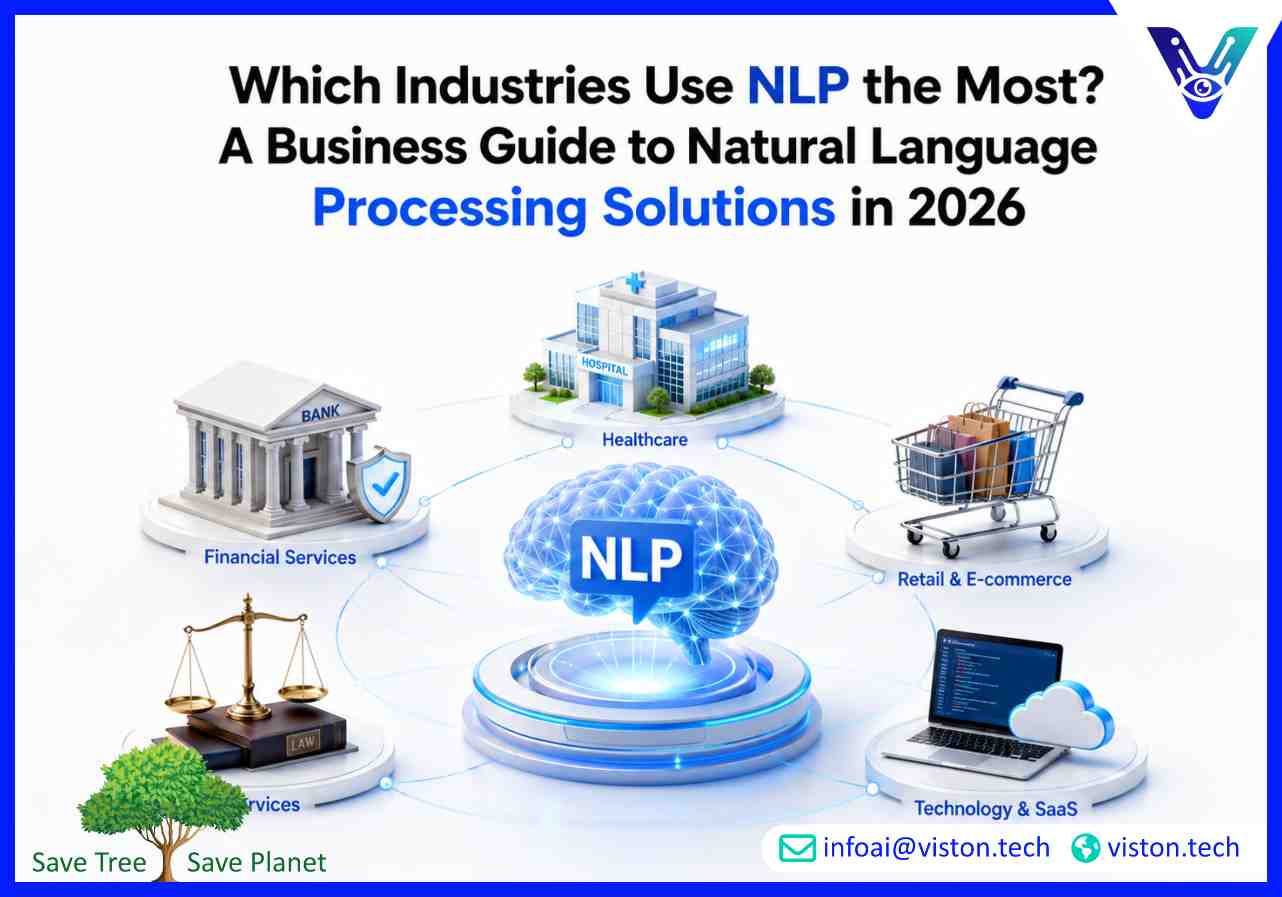
Which Industries Use NLP the Most? A Business Guide to Natural Language Processing Solutions in 2026
Natural Language Processing (NLP) has become one of the most widely adopted branches of artificial intelligence, helping businesses automate communication, extract insights from text, and improve operational efficiency. As organizations generate and manage increasing volumes of unstructured data, NLP solutions are becoming essential across multiple industries. Understanding where NLP delivers the most value can help business leaders identify opportunities for automation, customer engagement, and data-driven decision-making.
Why NLP Adoption Is Growing Across Industries
Natural Language Processing enables computers to understand, interpret, analyze, and generate human language. Businesses use NLP technologies to process emails, documents, customer conversations, support tickets, contracts, reviews, reports, and other text-based information that would otherwise require significant manual effort.In 2026, organizations are increasingly investing in NLP because it helps:
Automate repetitive communication tasks
Improve customer experiences
Analyze large volumes of text data
Enhance knowledge management
Support AI-powered search and chatbots
Reduce operational costs
Accelerate business decision-making
While NLP can benefit almost any sector, certain industries have adopted it more extensively due to the volume and complexity of language-based information they manage daily.
Healthcare: Transforming Clinical and Administrative Processes
Healthcare is one of the largest adopters of NLP technology because of the enormous amount of unstructured medical data generated through patient records, physician notes, diagnostic reports, and research documents.
Common NLP Applications in Healthcare
Medical record analysis
Clinical documentation automation
Patient support chatbots
Healthcare knowledge management
Medical research analysis
Appointment scheduling automation
NLP helps healthcare providers improve efficiency while reducing administrative burdens on medical professionals. It also supports faster access to critical patient information and enhances care delivery.
Financial Services: Improving Compliance and Customer Service
Banks, insurance companies, and financial institutions process vast amounts of documentation and customer communications. NLP solutions help automate these workflows while supporting regulatory compliance requirements.
Common NLP Applications in Finance
Fraud detection support
Customer service automation
Document classification
Risk assessment analysis
Regulatory compliance monitoring
Financial sentiment analysis
Financial organizations use NLP to improve customer experiences while managing operational complexity and regulatory obligations more effectively.
Retail and E-commerce: Enhancing Customer Experiences
Retailers increasingly rely on NLP to deliver personalized shopping experiences and improve customer engagement across digital channels.
Common NLP Applications in Retail
AI-powered customer support
Product recommendation systems
Review and feedback analysis
Voice commerce solutions
Multilingual customer support
Intelligent product search
NLP enables retailers to understand customer preferences, improve conversion rates, and provide faster support without significantly increasing staffing costs.
Legal Services: Managing Complex Documentation
The legal industry depends heavily on document-intensive processes, making it a strong candidate for NLP adoption.
Common NLP Applications in Legal Organizations
Contract review automation
Legal document classification
Case research support
Compliance monitoring
Information extraction
Knowledge management systems
NLP solutions help legal teams reduce manual review workloads while improving accuracy and efficiency in document-heavy environments.
Technology and SaaS Companies: Driving Automation and Support
Technology companies frequently deploy NLP solutions to improve customer support, product experiences, and internal operations.
Common NLP Applications in SaaS Businesses
AI chatbots and virtual assistants
Helpdesk automation
Knowledge base search
Customer feedback analysis
Product usage insights
Automated ticket routing
For SaaS companies, NLP supports scalability by helping teams manage growing customer bases without proportional increases in operational overhead.
How Natural Language Processing Solutions Support Modern Businesses
Although industry-specific applications vary, the core benefits of NLP remain remarkably consistent.
Operational Efficiency
NLP automates repetitive tasks such as document processing, email classification, customer support, and information extraction.
Improved Customer Experiences
Organizations can provide faster, more personalized interactions through chatbots, virtual assistants, and intelligent support systems.
Better Data Utilization
NLP helps businesses unlock valuable insights hidden within customer communications, reports, contracts, reviews, and internal documentation.
Scalable Automation
Businesses can handle increasing volumes of interactions and information without significantly expanding operational resources.
How Viston AI Helps Businesses Implement Natural Language Processing Solutions
As organizations across industries continue to adopt AI-driven automation, Viston AI focuses on delivering Natural Language Processing Solutions that connect advanced language technologies with practical business objectives. NLP implementation requires more than deploying AI models; it demands integration with business workflows, data sources, customer engagement channels, and operational systems.Viston AI supports businesses looking to leverage conversational AI, intelligent document processing, semantic search, workflow automation, customer support automation, and knowledge management solutions. By aligning NLP capabilities with real business requirements, organizations can improve efficiency, enhance customer experiences, and gain greater value from their data.Whether businesses operate in healthcare, finance, retail, legal services, technology, or other sectors, successful NLP adoption depends on scalability, integration readiness, security, governance, and long-term optimization. Viston AI helps organizations build solutions that support sustainable business outcomes while adapting to evolving AI capabilities and market demands.
Frequently Asked Questions
Which industry uses NLP the most?
Healthcare, financial services, retail, technology, and legal services are among the industries with the highest levels of NLP adoption due to their reliance on large volumes of text-based information.
Why is NLP important for businesses?
NLP helps businesses automate communication, process unstructured data, improve customer experiences, and gain actionable insights from documents and conversations.
Can small businesses benefit from NLP solutions?
Yes. Modern NLP technologies are increasingly accessible and can help small businesses automate customer support, manage documents, analyze feedback, and improve operational efficiency.
What are the most common NLP use cases?
Popular use cases include chatbots, document processing, sentiment analysis, email classification, semantic search, customer support automation, and knowledge management.
Can Viston AI help organizations implement NLP solutions?
Yes. Viston AI provides Natural Language Processing Solutions that support automation, conversational AI, intelligent document processing, and language-driven business workflows across multiple industries.
Conclusion
Understanding which industries use NLP the most highlights the growing importance of language-based AI across modern business operations. From healthcare and finance to retail, legal services, and technology, organizations are leveraging Natural Language Processing Solutions to automate processes, improve customer experiences, and extract greater value from their data. As NLP capabilities continue to advance in 2026, businesses that strategically adopt these technologies will be better positioned to improve efficiency, enhance decision-making, and scale operations effectively. For organizations seeking practical NLP implementation strategies, Viston AI offers expertise in developing solutions that align AI innovation with measurable business outcomes.