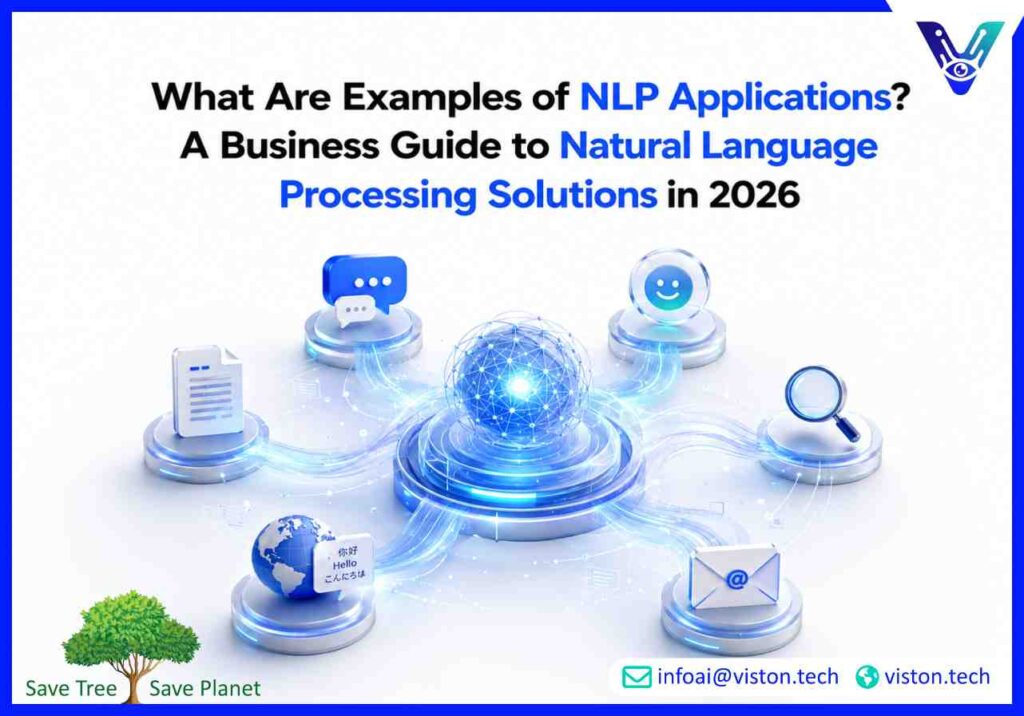
What Are Examples of NLP Applications? A Business Guide to Natural Language Processing Solutions in 2026
Natural Language Processing (NLP) has become one of the most widely adopted branches of artificial intelligence in modern business. From customer support automation to intelligent document processing, NLP applications help organizations understand, analyze, and respond to human language at scale. As businesses continue investing in digital transformation in 2026, understanding real-world NLP applications is essential for identifying opportunities to improve efficiency, customer experiences, and decision-making.
What Is Natural Language Processing and Why Does It Matter?
Natural Language Processing is a field of artificial intelligence that enables computers to interpret, process, generate, and analyze human language. NLP bridges the gap between how people communicate and how machines understand information.Businesses generate enormous volumes of unstructured language data every day through emails, support tickets, contracts, surveys, chat conversations, reports, and social media interactions. NLP solutions help transform this information into actionable insights and automated workflows.In 2026, NLP has become a foundational technology for organizations seeking to improve operational efficiency, automate repetitive tasks, and create more personalized customer experiences.
Core Capabilities of NLP Solutions
Text analysis and classification
Language understanding
Sentiment analysis
Entity extraction
Document processing
Speech recognition
Language generation
Semantic search
Machine translation
Conversational AI
Common Examples of NLP Applications in Business
NLP applications can be found across nearly every industry. While implementation approaches vary, the goal remains the same: enabling organizations to use language data more effectively.
AI Chatbots and Virtual Assistants
One of the most visible NLP applications is the use of AI-powered chatbots and virtual assistants. These systems understand customer questions, provide relevant answers, and automate routine interactions.Businesses use conversational AI for:
Customer support
Lead qualification
Appointment scheduling
Order tracking
Product recommendations
Internal employee support
Modern NLP-powered chatbots can understand intent, context, and natural language variations, creating more effective customer interactions.
Sentiment Analysis
Sentiment analysis enables businesses to evaluate customer opinions and emotions expressed in text.Organizations commonly analyze:
Customer reviews
Survey responses
Support conversations
Social media mentions
Feedback forms
This helps businesses identify satisfaction trends, detect potential issues early, and make informed decisions based on customer sentiment.
Document Processing Automation
Many organizations manage thousands of documents containing valuable business information. NLP can automate document classification, extraction, and analysis.Common document processing applications include:
Invoice processing
Contract analysis
Insurance claims review
Compliance documentation
Financial reporting
Medical records processing
Automating these tasks reduces manual effort while improving consistency and accuracy.
Email Classification and Routing
NLP systems can automatically categorize incoming emails and direct them to the appropriate department or workflow.Businesses use email classification for:
Customer support requests
Sales inquiries
Billing questions
Technical issues
Partner communications
This improves response times and helps teams prioritize work more effectively.
Industry-Specific NLP Applications
While many NLP use cases apply broadly, some industries benefit from highly specialized implementations.
Healthcare
Healthcare organizations use NLP to process large volumes of clinical and administrative data.Examples include:
Medical record analysis
Clinical documentation support
Patient communication automation
Healthcare chatbot systems
Research data extraction
Financial Services
Financial institutions leverage NLP for both customer-facing and operational processes.Applications include:
Fraud detection support
Compliance monitoring
Customer service automation
Risk assessment
Financial document review
Legal Services
Legal organizations use NLP to manage extensive document workloads and improve research efficiency.Common applications include:
Contract review
Legal research support
Document summarization
Compliance verification
Case file organization
Retail and Ecommerce
Retail businesses increasingly use NLP to improve customer experiences and operational performance.Examples include:
Product recommendation engines
Customer support automation
Review analysis
Search optimization
Personalized marketing communications
Advanced NLP Applications Emerging in 2026
As AI technologies continue to evolve, businesses are adopting increasingly sophisticated NLP capabilities.
Semantic Search Systems
Traditional keyword-based search is being replaced by semantic search systems that understand meaning and intent.These solutions help users find information faster by interpreting the context behind search queries rather than matching exact keywords.
Knowledge Management Platforms
NLP-powered knowledge management systems allow employees to access internal information using natural language questions.This improves productivity by reducing the time spent searching across documents, databases, and knowledge repositories.
Multilingual Communication Solutions
Global organizations increasingly use NLP technologies to support multilingual operations.Applications include:
Real-time translation
Multilingual customer support
Cross-border communication
International content management
Content Generation and Summarization
Modern NLP systems can generate summaries, reports, recommendations, and draft content from large datasets or lengthy documents.These capabilities help organizations process information more efficiently while supporting faster decision-making.
How Businesses Can Successfully Implement NLP Solutions
Successful NLP adoption requires more than selecting the latest AI technology. Organizations should focus on solving specific business problems and integrating NLP capabilities into existing workflows.
Identify High-Value Use Cases
Businesses should prioritize areas where language-driven tasks consume significant time or resources.
Evaluate Data Quality
NLP performance depends heavily on the quality and accessibility of organizational data.
Plan for Integration
NLP solutions often deliver the most value when connected with CRM platforms, ERP systems, support tools, databases, and business applications.
Consider Security and Governance
Organizations should ensure NLP implementations align with privacy requirements, data protection standards, and responsible AI practices.
How Viston AI Helps Businesses Leverage Natural Language Processing Solutions
As organizations explore practical applications of AI, Viston AI provides Natural Language Processing Solutions designed to address real business challenges. The company helps organizations implement NLP technologies that support conversational AI, intelligent document processing, semantic search, workflow automation, customer engagement, and language-driven business intelligence.Effective NLP implementation requires more than deploying AI models. Businesses need solutions that integrate with operational systems, support scalability, maintain security standards, and align with measurable business objectives. Viston AI focuses on helping organizations connect advanced language technologies with practical workflows that improve efficiency, enhance customer experiences, and support digital transformation initiatives.By combining NLP expertise with integration and automation capabilities, businesses can move beyond isolated AI experiments and create sustainable solutions that deliver long-term operational value.
Frequently Asked Questions
What is the most common NLP application?
AI chatbots and virtual assistants are among the most common NLP applications, helping businesses automate customer interactions, support services, and lead engagement.
Can NLP be used for document processing?
Yes. NLP is widely used for document classification, information extraction, summarization, compliance review, and workflow automation involving large volumes of text-based documents.
Which industries use NLP the most?
Healthcare, finance, legal services, retail, ecommerce, education, technology, and customer service industries are among the most active adopters of NLP solutions.
How does NLP improve customer experience?
NLP enables faster responses, personalized interactions, intelligent search, sentiment analysis, and automated support systems that help businesses serve customers more efficiently.
Can Viston AI help implement NLP applications for businesses?
Yes. Viston AI provides Natural Language Processing Solutions that help organizations implement conversational AI, document automation, semantic search, workflow optimization, and other language-driven business applications.
Conclusion
Understanding what are examples of NLP applications is increasingly important for organizations seeking practical ways to use artificial intelligence. From chatbots and sentiment analysis to document processing and semantic search, Natural Language Processing Solutions are helping businesses automate communication, unlock insights from data, and improve operational performance. As NLP technologies continue to mature in 2026, organizations that strategically implement language-driven automation will be better positioned to enhance customer experiences, improve efficiency, and support long-term growth. Businesses looking to adopt these capabilities can benefit from experienced partners such as Viston AI that specialize in transforming NLP technologies into measurable business outcomes.