Is NLP Part of AI or Machine Learning? Understanding the Relationship in 2026
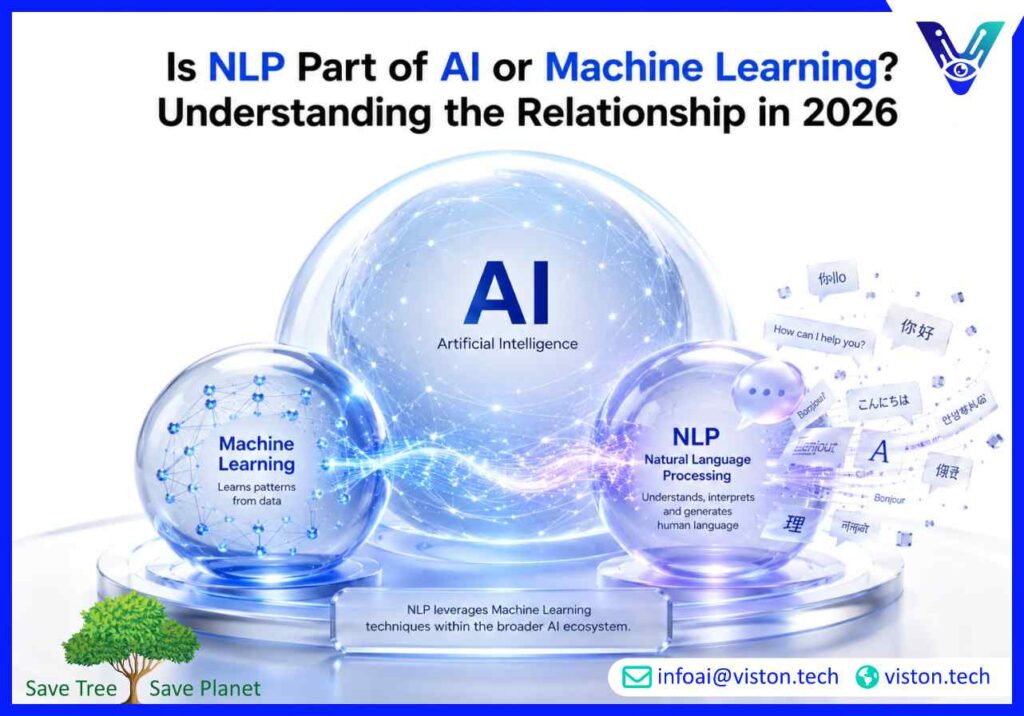
As businesses increasingly adopt artificial intelligence technologies, many decision-makers ask a common question: Is Natural Language Processing (NLP) part of Artificial Intelligence (AI) or Machine Learning (ML)? The answer is that NLP is a specialized field within Artificial Intelligence that often uses Machine Learning techniques to enable computers to understand, interpret, and generate human language. Understanding this relationship helps organizations make informed decisions when investing in Natural Language Processing Solutions.
What Is Artificial Intelligence?
Artificial Intelligence is the broader field of computer science focused on creating systems that can perform tasks that typically require human intelligence. These tasks include reasoning, learning, problem-solving, decision-making, perception, and language understanding.AI encompasses multiple technologies and disciplines, including:
Machine Learning
Natural Language Processing
Computer Vision
Expert Systems
Robotics
Speech Recognition
Generative AI
In simple terms, AI serves as the umbrella category under which many specialized technologies operate.
Where Does Machine Learning Fit In?
Machine Learning is a subset of Artificial Intelligence. It enables systems to learn patterns from data and improve performance without being explicitly programmed for every scenario.Instead of relying solely on predefined rules, machine learning models analyze data to make predictions, classifications, and recommendations.Common machine learning applications include:
Fraud detection
Recommendation engines
Predictive analytics
Customer segmentation
Image recognition
Language processing
Modern AI systems rely heavily on machine learning because it allows applications to adapt and improve as more data becomes available.
What Is Natural Language Processing (NLP)?
Natural Language Processing is a branch of Artificial Intelligence focused on enabling computers to understand, analyze, interpret, and generate human language.NLP bridges the gap between human communication and computer systems by allowing machines to process text and speech in meaningful ways.Typical NLP capabilities include:
Text classification
Sentiment analysis
Language translation
Named entity recognition
Document summarization
Semantic search
Chatbots and virtual assistants
Speech-to-text processing
Without NLP, computers would struggle to interact naturally with users through language.
Is NLP Part of AI or Machine Learning?
The most accurate answer is that NLP is a subfield of Artificial Intelligence that frequently uses Machine Learning to achieve its objectives.The relationship can be understood as follows:
Artificial Intelligence is the broadest category.
Machine Learning is a subset of AI.
Natural Language Processing is another specialized area within AI.
Modern NLP solutions often rely on Machine Learning and Deep Learning models to improve language understanding.
While traditional NLP systems relied on predefined linguistic rules, most advanced NLP applications in 2026 use machine learning techniques to achieve higher accuracy and scalability.
Traditional NLP vs Machine Learning-Based NLP
Early NLP systems used rule-based approaches where developers manually defined language patterns and grammatical structures.Today, machine learning-based NLP systems learn language patterns directly from large datasets, making them significantly more effective for real-world business applications.Examples include:
AI chatbots
Generative AI assistants
Customer support automation
Document intelligence platforms
Voice assistants
Enterprise search systems
This evolution has transformed NLP into one of the most commercially valuable areas of AI.
Why NLP Matters for Businesses in 2026
Organizations generate and receive vast amounts of unstructured language data every day through emails, support tickets, customer reviews, contracts, reports, chats, and documents.NLP technologies help businesses turn this information into actionable insights and automated workflows.
Customer Service Automation
NLP powers intelligent chatbots and virtual assistants that can understand customer requests and provide relevant responses.
Document Processing
Businesses use NLP to classify, extract, summarize, and analyze information from large document collections.
Sentiment Analysis
Companies can analyze customer feedback to identify trends, satisfaction levels, and improvement opportunities.
Knowledge Management
NLP enables employees to search internal information using natural language instead of complex keyword queries.
Business Intelligence
Language-based analytics provide deeper visibility into customer behavior, operational performance, and market trends.
How Natural Language Processing Solutions Support Modern Organizations
As AI adoption accelerates, businesses require more than access to language models. They need practical Natural Language Processing Solutions that integrate with existing systems, workflows, and business objectives.Viston AI helps organizations implement Natural Language Processing Solutions that transform language data into business value. These solutions can support conversational AI, intelligent document processing, semantic search, workflow automation, sentiment analysis, and knowledge management initiatives.By combining NLP technologies with machine learning capabilities and business system integrations, organizations can improve operational efficiency, enhance customer experiences, and automate language-intensive processes at scale.For companies evaluating AI investments in 2026, understanding the relationship between AI, Machine Learning, and NLP is essential for selecting the right technologies and implementation strategies.
Frequently Asked Questions
Is NLP a type of Artificial Intelligence?
Yes. Natural Language Processing is a specialized branch of Artificial Intelligence focused on understanding and generating human language.
Is NLP the same as Machine Learning?
No. NLP and Machine Learning are different fields within AI. However, modern NLP systems often use machine learning models to improve language understanding and accuracy.
Can NLP work without Machine Learning?
Yes. Traditional NLP systems used rule-based approaches without machine learning. However, most advanced NLP applications today rely on machine learning and deep learning techniques.
What industries use NLP the most?
Healthcare, finance, legal services, retail, education, technology, telecommunications, and customer service industries commonly use NLP for automation and data analysis.
How does Viston AI help businesses with NLP?
Viston AI provides Natural Language Processing Solutions that support conversational AI, intelligent document processing, workflow automation, semantic search, and language-driven business applications.
Conclusion
NLP is a branch of Artificial Intelligence that frequently relies on Machine Learning to process and understand human language. While AI represents the broader field and Machine Learning serves as one of its core technologies, NLP focuses specifically on language-related tasks. As businesses continue investing in automation and data-driven decision-making, Natural Language Processing Solutions play a critical role in transforming text and speech data into meaningful business outcomes. Organizations seeking to implement NLP effectively can benefit from specialized expertise and practical implementation support from providers such as Viston AI.