How Long Does It Take to Build NLP Solutions? A Business Guide for 2026
As organizations increasingly adopt AI-driven automation, many business leaders ask the same question: how long does it take to build NLP solutions? The answer depends on project complexity, data availability, integration requirements, and business objectives. While some Natural Language Processing solutions can be deployed within weeks, enterprise-grade implementations often require several months of planning, development, testing, and optimization.
Understanding the Timeline for NLP Solutions
Natural Language Processing (NLP) enables systems to understand, analyze, and generate human language. Businesses use NLP solutions for customer support automation, document processing, sentiment analysis, conversational AI, knowledge management, content classification, and workflow automation.The development timeline varies significantly because NLP projects are not one-size-fits-all. Factors such as customization, security requirements, integrations, and language complexity all influence delivery schedules.In 2026, organizations increasingly prioritize scalable, business-focused NLP implementations that deliver measurable outcomes while integrating seamlessly with existing systems.
Key Factors That Affect NLP Development Time
Project Scope and Complexity
A simple NLP application designed to classify customer inquiries requires far less development effort than an enterprise-wide conversational AI platform connected to multiple business systems.Typical complexity levels include:
Basic text classification and tagging
Sentiment analysis systems
Document extraction and processing
AI-powered chatbots
Knowledge management platforms
Multilingual NLP solutions
Custom large language model integrations
The broader the functionality, the longer the implementation timeline.
Data Availability and Quality
NLP systems depend heavily on quality data. Businesses with well-structured datasets often accelerate development significantly compared to organizations that need extensive data preparation.Data-related activities may include:
Data collection
Data cleaning
Annotation and labeling
Quality validation
Compliance review
Training dataset preparation
Data readiness frequently becomes one of the largest factors affecting project duration.
Integration Requirements
Modern NLP solutions rarely operate independently. Most businesses require integrations with:
CRM platforms
ERP systems
Helpdesk software
Knowledge bases
Communication platforms
Business intelligence tools
Document management systems
Complex integrations often add several weeks to implementation schedules but are essential for achieving meaningful business value.
Typical NLP Development Timelines
Basic NLP Solutions (2–6 Weeks)
Smaller projects with limited customization can often be delivered relatively quickly.Examples include:
Text categorization tools
Keyword extraction systems
Simple sentiment analysis applications
Content tagging automation
These projects generally rely on existing NLP frameworks and require minimal integration.
Mid-Level NLP Solutions (6–12 Weeks)
Projects involving moderate customization, workflow automation, and business system connectivity typically fall into this category.Examples include:
Customer feedback analysis platforms
Email classification systems
Internal knowledge search solutions
Document processing automation
Support ticket routing systems
These implementations often require custom model tuning and API integration work.
Enterprise NLP Solutions (3–9 Months)
Large-scale deployments require extensive planning, testing, governance, and optimization.Examples include:
Enterprise conversational AI platforms
Multilingual NLP environments
Advanced document intelligence systems
AI-powered customer service ecosystems
Cross-department automation platforms
Enterprise projects typically involve multiple stakeholders, security reviews, integration architecture, and phased deployment strategies.
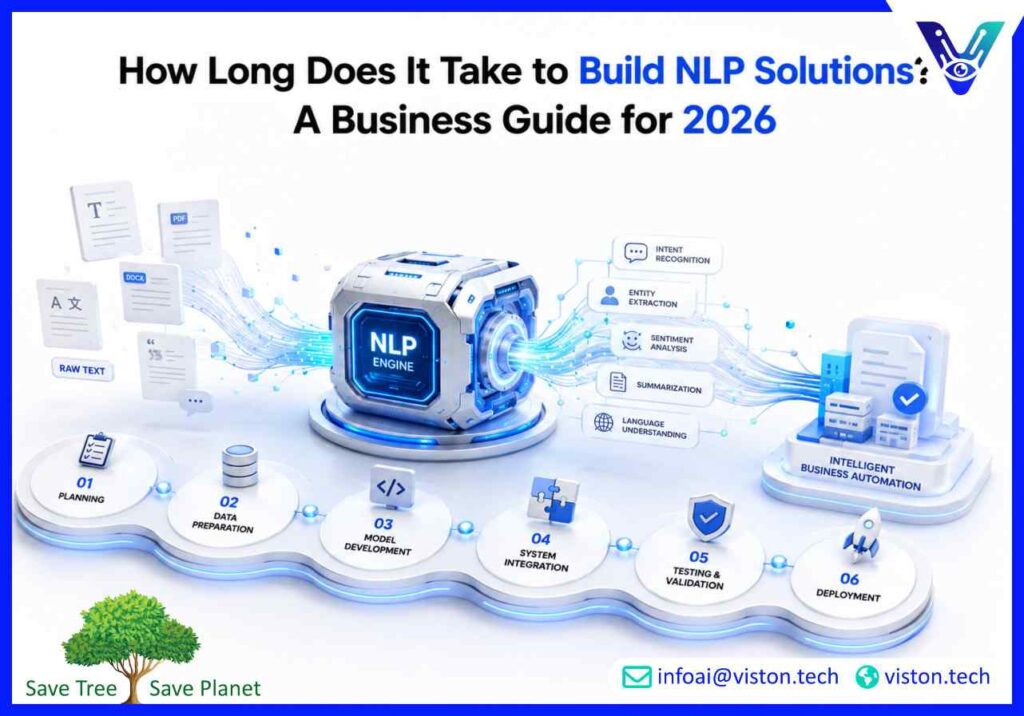
The Typical NLP Development Process
Discovery and Requirements Analysis
The first phase focuses on identifying business objectives, use cases, technical requirements, success metrics, and operational constraints.Organizations that invest sufficient time in discovery often avoid delays later in the project lifecycle.
Data Preparation and Assessment
Teams evaluate available data sources, identify gaps, prepare datasets, and establish governance requirements.This stage directly impacts model accuracy and long-term performance.
Model Development and Configuration
Developers select appropriate NLP technologies, train models, configure workflows, and build required business logic.Depending on complexity, this phase may involve:
Intent recognition
Named entity recognition
Semantic search
Language generation
Classification models
Information extraction systems
System Integration
Once core functionality is established, NLP solutions are connected to operational platforms and data sources.Reliable integration is critical for achieving automation, personalization, and workflow efficiency.
Testing and Optimization
Before deployment, organizations should conduct:
Functional testing
Performance testing
Security validation
User acceptance testing
Workflow verification
Testing helps ensure the solution performs consistently in real-world business environments.
Why Businesses Should Avoid Rushing NLP Projects
Many organizations underestimate the importance of planning, data preparation, and optimization. While rapid deployment is attractive, poorly implemented NLP systems can create long-term operational challenges.Common risks include:
Low accuracy rates
Poor customer experiences
Integration failures
Compliance concerns
Limited scalability
High maintenance costs
A structured implementation approach often delivers better business outcomes than prioritizing speed alone.
How Viston AI Helps Businesses Build NLP Solutions Efficiently
For organizations exploring Natural Language Processing Solutions, balancing implementation speed with quality is essential. Viston AI focuses on helping businesses develop NLP solutions that align with operational goals, automation strategies, and customer experience requirements.Its capabilities support a wide range of NLP applications, including conversational AI, intelligent document processing, semantic search, workflow automation, language analytics, and business intelligence solutions. By combining NLP expertise with integration capabilities, organizations can connect language-driven automation directly with existing business systems and processes.Successful NLP implementation requires more than model development. Businesses must also consider scalability, security, governance, reporting, user adoption, and ongoing optimization. Viston AI helps organizations address these factors while building practical solutions designed to deliver measurable business value in evolving AI environments.
Frequently Asked Questions
How long does it take to build an NLP solution?
Simple NLP solutions may take 2–6 weeks, while enterprise-grade implementations can require 3–9 months depending on complexity, integrations, and customization requirements.
What factors affect NLP development timelines?
Project scope, data quality, integration requirements, compliance considerations, customization needs, and testing requirements all influence development schedules.
Can NLP solutions be built using existing AI models?
Yes. Many projects leverage existing NLP frameworks and large language models, which can significantly reduce development time compared to building models from scratch.
Why do enterprise NLP projects take longer?
Enterprise implementations often involve multiple systems, larger datasets, security reviews, workflow automation, governance requirements, and extensive testing processes.
Can Viston AI help accelerate NLP implementation?
Yes. Viston AI provides Natural Language Processing Solutions that help businesses implement language-driven automation, conversational AI, and intelligent workflow solutions while maintaining scalability and operational reliability.
Conclusion
Understanding how long it takes to build NLP solutions requires evaluating business objectives, technical complexity, data readiness, and integration requirements. While smaller projects can often be delivered within weeks, enterprise-level Natural Language Processing Solutions typically require a more comprehensive implementation approach. Businesses that prioritize planning, quality, and scalability are better positioned to achieve sustainable outcomes from AI investments. For organizations seeking reliable NLP implementation support, Viston AI offers expertise that helps transform language technologies into practical business solutions that support growth, automation, and operational efficiency.